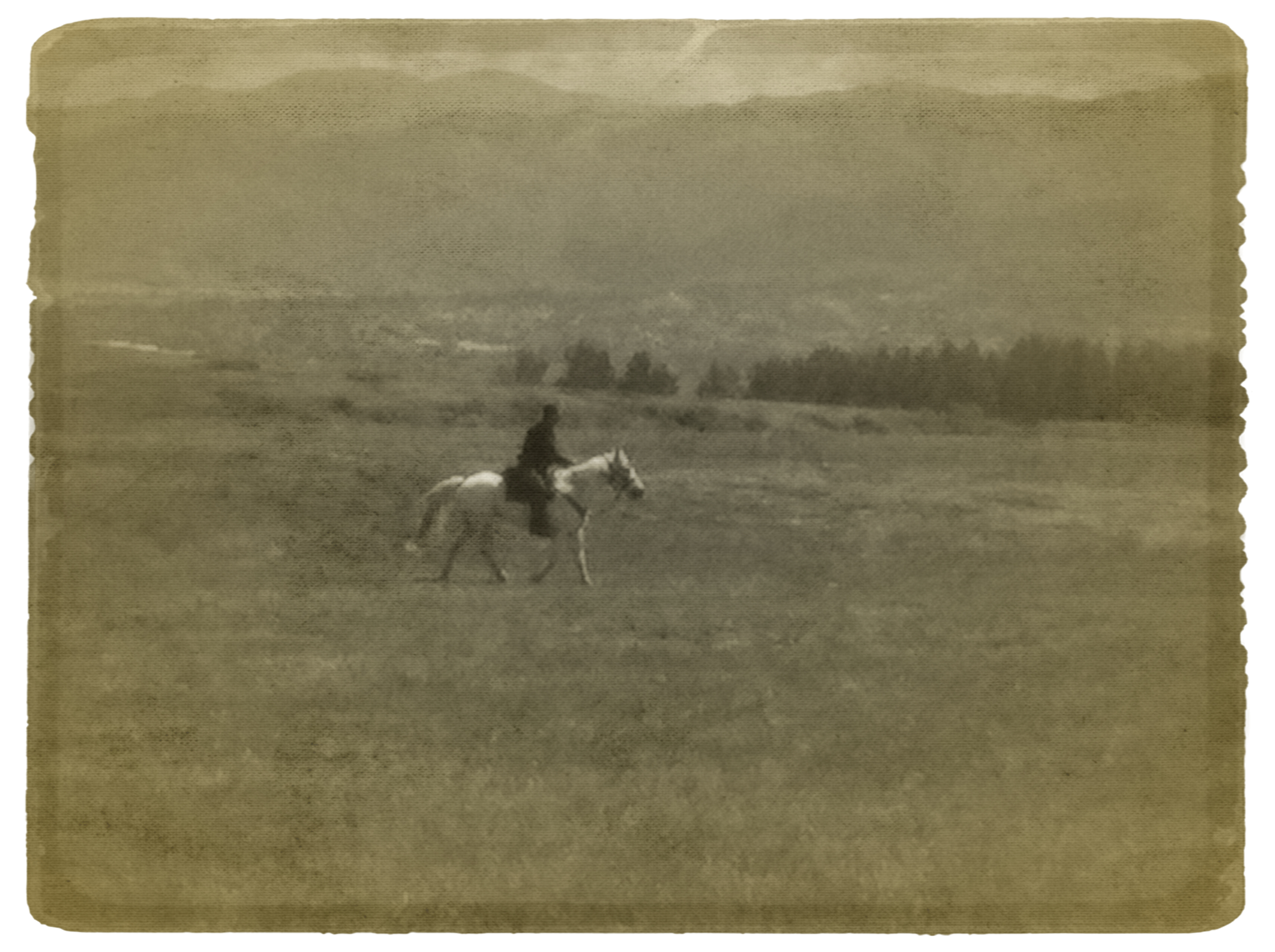
A horse and rider caught mid-trot. The photo is aged and worn but does not look like some of the earlier 19th century photos I have seen. Why could that be? Click for the answer. Continue reading
A horse and rider caught mid-trot. The photo is aged and worn but does not look like some of the earlier 19th century photos I have seen. Why could that be? Click for the answer. Continue reading

The CdV above shows a pretty young lady with quite a few flourishes to her ensemble. First, she has her hair styled in some type of chignon with a fancy comb or peineta visible that would have been lovely when seen from behind her. Then she also has a fabric bow on the very top of her head, plus little frise curls at her hairline. Her dress is modestly styled and she has added a lacy jabot with a high frilled lace collar and a delicate bar pin.
The chignon [she-nyon] style is generally a twisted arrangement for the hair. Today it is known as only one style, but in the 19th century, hair was elaborately twisted and arranged, using braids, curls, rats or puffs, false hair and even fine wire frames to achieve the desired look…and it was all called a chignon.
The peineta is most well known as an elaborately carved or styled comb that supports a lace mantilla. In the 1880s, they were very popular with middle class women and used as a decorative embellishment for the hair. Historically they were carved from tortoise shell, but today they are generally made of plastic.
Her frise curls were likely achieved with a tiny curling iron, similar to what women used today, but heated in the fire. Ow! They were most popular with young women, but older women trying to hold on to their youth also adopted the look.
The jabot was introduced for men in the 17th century, and by the 18th century had achieved prominence as the definitive style of neck cloth for men of fashion. They were popular from kings to pirates. By the 19th century men moved on to bow ties and neck ties, and in the 1880s women adopted the fashion. Originally a jabot was simply strips of lawn or cambric stitched into the center front closure of a man’s blouse. As they evolved, they became a separate item, such as a neck tie. The jabot could be made as part of the garment or detachable. Some very fine examples exist that show how prized they were, being made from the finest laces, embroidered silk, tatted and more. They were quite often fastened to the neck of the bodice and held in place with a pin such as in the photograph above. In typical French irony, the word jabot translates as “that bit of skin hanging down a turkey’s neck.” While the jibe worked perfectly when dressing men – and in particular men of the baroque period who tended to um, overdress – with women it could be derogatory, except that fashion has its way of ignoring the meaning of a word after a while, now doesn’t it.
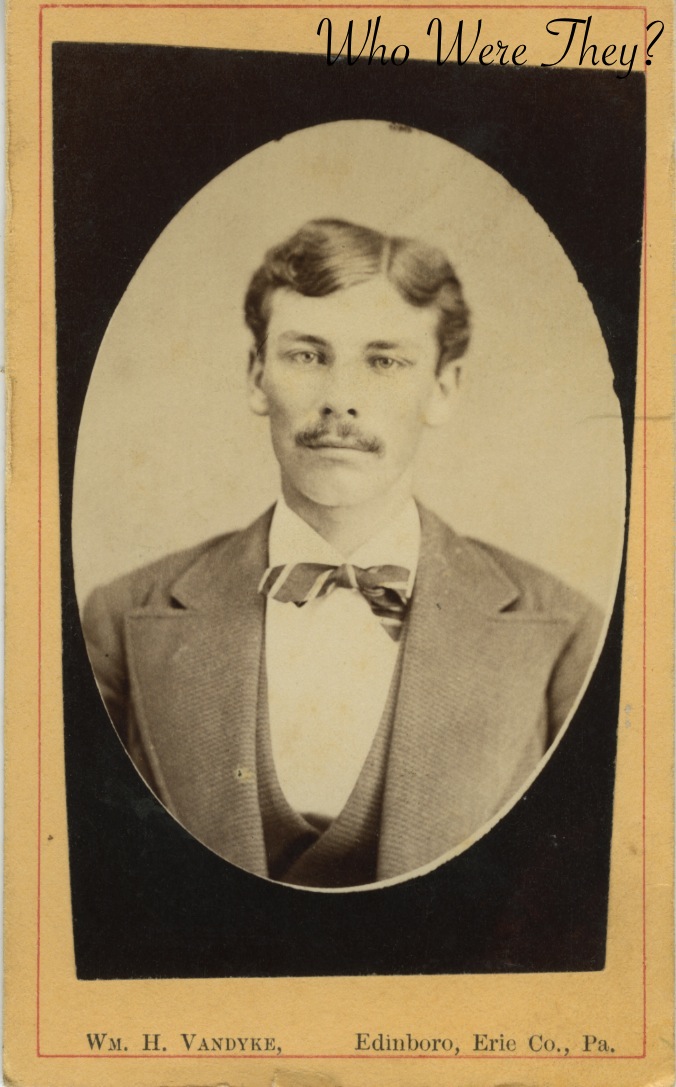
Here is a second VanDyke CdV from the Red Velvet Album. The pair were placed side by side in the album. Considering the identical treatment of the photographic mount, it is a safe guess this fellow and the serene beauty were married. His suit and necktie are nondescript but he has nice hair and a clean, trimmed mustache.
Recently a site reader suggested I take a look at an ebay auction for a cabinet card described as a wedding portrait. Of course I had to look, and you know me, I had to have it. Lucky me, I won the auction and for this week’s Sepia Saturday we’ll be looking at it.
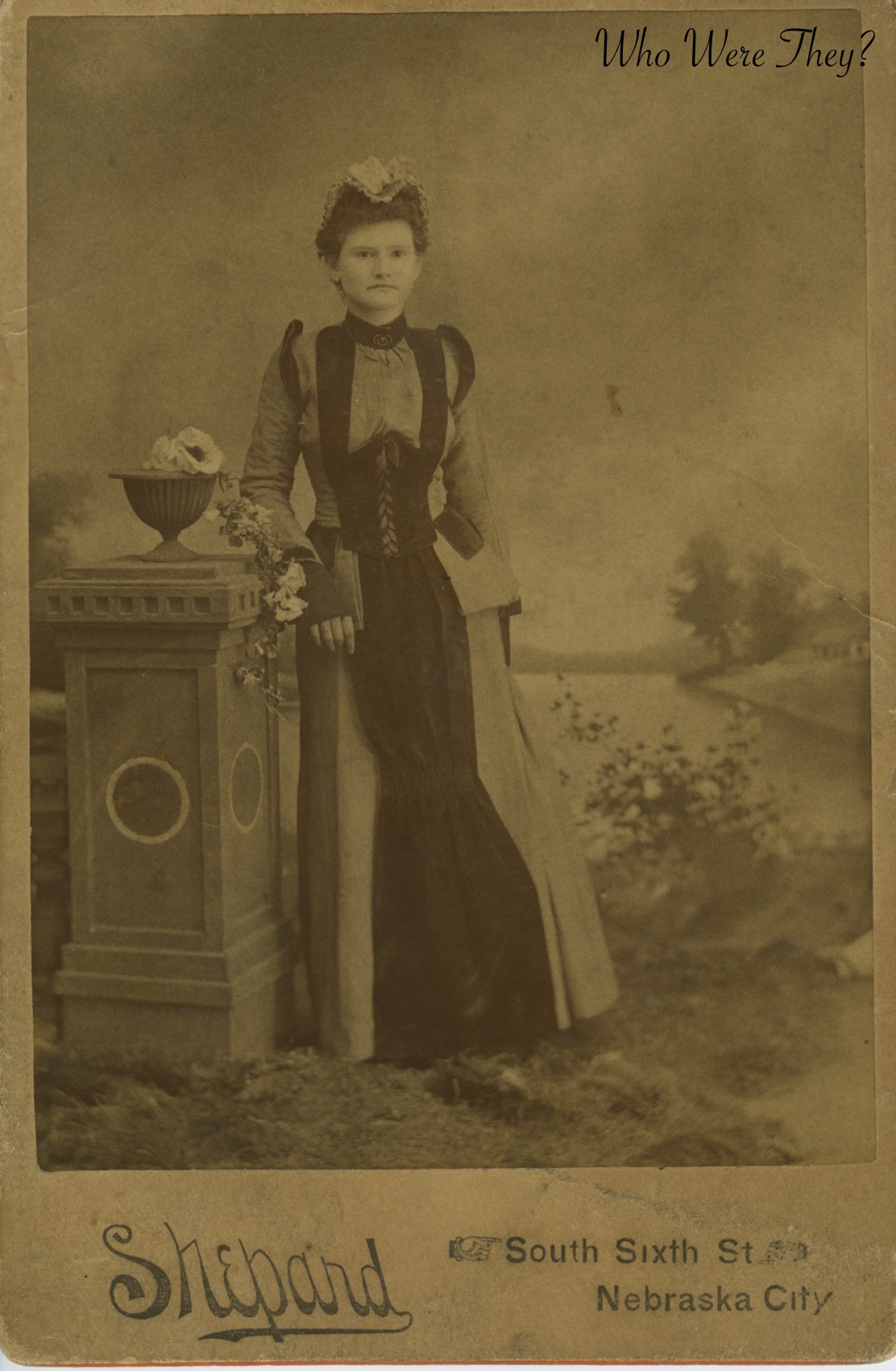
Aunt Minnie Mills
Someone wrote on the back, identifying this as Aunt Minnie Mills. The picture was taken in 1889 and she is wearing Jane Mills’ wedding dress. The dress is described as grey cashmere wool trimmed in orange velvet. Although I have asked some of my costume historian friends for input, no one really seems to know how this might have looked. Was it burnt orange or carrot orange? We can never know. Women did select a good dress for their wedding, but nothing like the single-use white dresses we see at modern weddings. Dresses were intended for later use, such as in this instance where another woman wore the dress. Coincidentally, my Dad has a photo of my great aunt wearing my grandmother’s wedding dress. Her’s was blue. Either way, my aunt borrowed the wedding dress because she was going out for a special engagement, and I suspect that is the reason Aunt Minnie was wearing Jane’s wedding dress as well.
The photographer was Shepard on South Sixth Street, Nebraska City.
For more photographs of people dressed to go out, click over to Sepia Saturday via the button below.
Clicking through in style
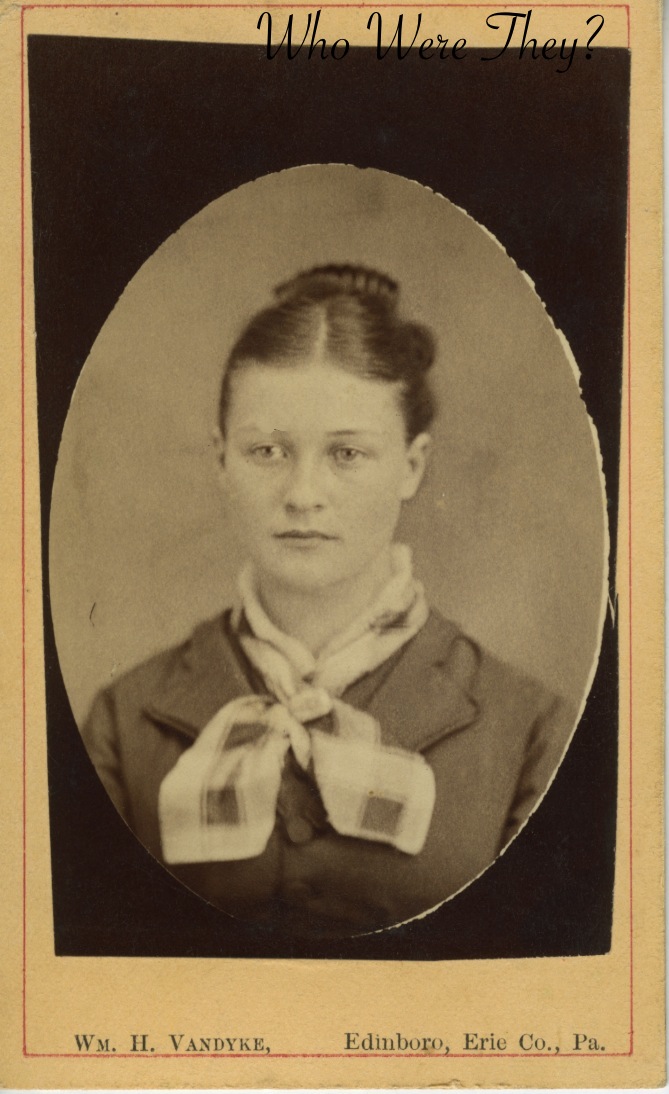
Here we have a CdV that I believe might be from the 1870s. It is not labeled. The woman is attractive with a pretty scarf around her neck.
The photographer was William Henry VanDyke, originally from Wyoming (b 4-27-27). His parents were from the East, and at some point it appears the family returned east and settled in and around Erie County, PA. In 1850, William was a farmer, but by 1870 he had relocated to Edinboro where he bought an established photography gallery. He was included in a biography of residents in 1884, at which time he was still thriving with his third wife and son in business with him. He sired a total of nine children, three of which died in infancy, from his three wives. Interestingly, the biography notes that his two previous wives were remarried, suggesting that each union was dissolved through divorce. We hear so much about divorce being taboo in the 19th century, yet here are two examples with the same groom!
I do wonder if VanDyke capitalized on his surname. There was a photographic process popular in the 19th century called a VanDyke print. It resulted in deep brown colors (see above!) similar to those used by the famous Flemish painter VanDyke. However, I haven’t been able to determine how well known it was. Photography buffs can click through here for an instructional page with a video on how to create the solution.


 Who Were They?