Who Were They?

Lost and forgotten photos from the past

Directly across from the photo I posted last is this one of a family. I don’t think it is the same family but the little boy seems similar. Maybe they were related in some way. This particular photo was made by Barry in Bismarck, Dakota Territory. Today, Bismarck is located in North Dakota. Dakota Territory was created in 1861 and included much more than the current two states named after the territory. Parts of Montana, Wyoming and Idaho were included in the original territory, but later were spun off into territories or states on their own. What remained was Dakota Territory until 1889 when it was divided into the states North and South Dakota.

This is helpful in dating the photo to prior to 1889. The photographer is quite famous! David F. Barry learned the photographic trade from an itinerant photographer named O. S. Goff from about 1870, but he did not become a business partner of Goff’s until 1878. At that time Goff & Barry were working in Bismarck, D. T. Barry then became a prolific and important itinerant photographer in American history. He spent the next five years traveling through the Territory photographing the local Indian population, including Sitting Bull and Red Cloud, as well as American Calvary officers, forts, soldiers, battlefields, working men and trappers. His documentation of the Indian Wars of the era are important evidence to understand the crucible that was the Dakota Territory. Some of his images of Indian Chiefs are the only known photographs of these amazing men. In 1883, Barry returned home and established his gallery in Bismarck, so this dates the photo from 1883-1889. In 1890, Barry left the Dakotas never to return; he died in Superior, WI in 1934. His papers and images are housed at the Denver Public Library and include his original glass plate negatives.

Coming up for your viewing pleasure, I will be featuring the photographs from another album, one that I call Red Velvet. No, I am not terribly clever with this, the album is covered in red velvet as you must have guessed. Once upon a time there was an emblem in fancy script across the front that said “Album” but it has long since parted ways with its host. The album is of a fairly standard size I am learning, approximately 9″ w by 10.5″ high and roughly 2″ thick. There is a fancy sliver clasp that still works so I assume the long lost emblem was also in silver. It must have been stunning when original! There are 13 pages with single openings for cabinet cards – so space for 26 cabinet cards – and then three pages with spaces for 4 CdVs each, so room for 24 CdVs.

Each page is faced in a different color paper, ranging from pink to lemon, blue to gray. Each picture opening is trimmed in a gilded scroll work, making each photo the centerpiece of the page in a magnificent fashion. While there is room for 50 photos total, there are far fewer. 12 cabinet cards and 17 CdVs remain. All are probably unidentified. As I take them out to scan I will carefully inspect them for any indication of names, but I am not hopeful. What I have seen in the past is that some family member goes through and takes the photos that are identified and/or that they can identify, and they leave the rest for the junk sale.

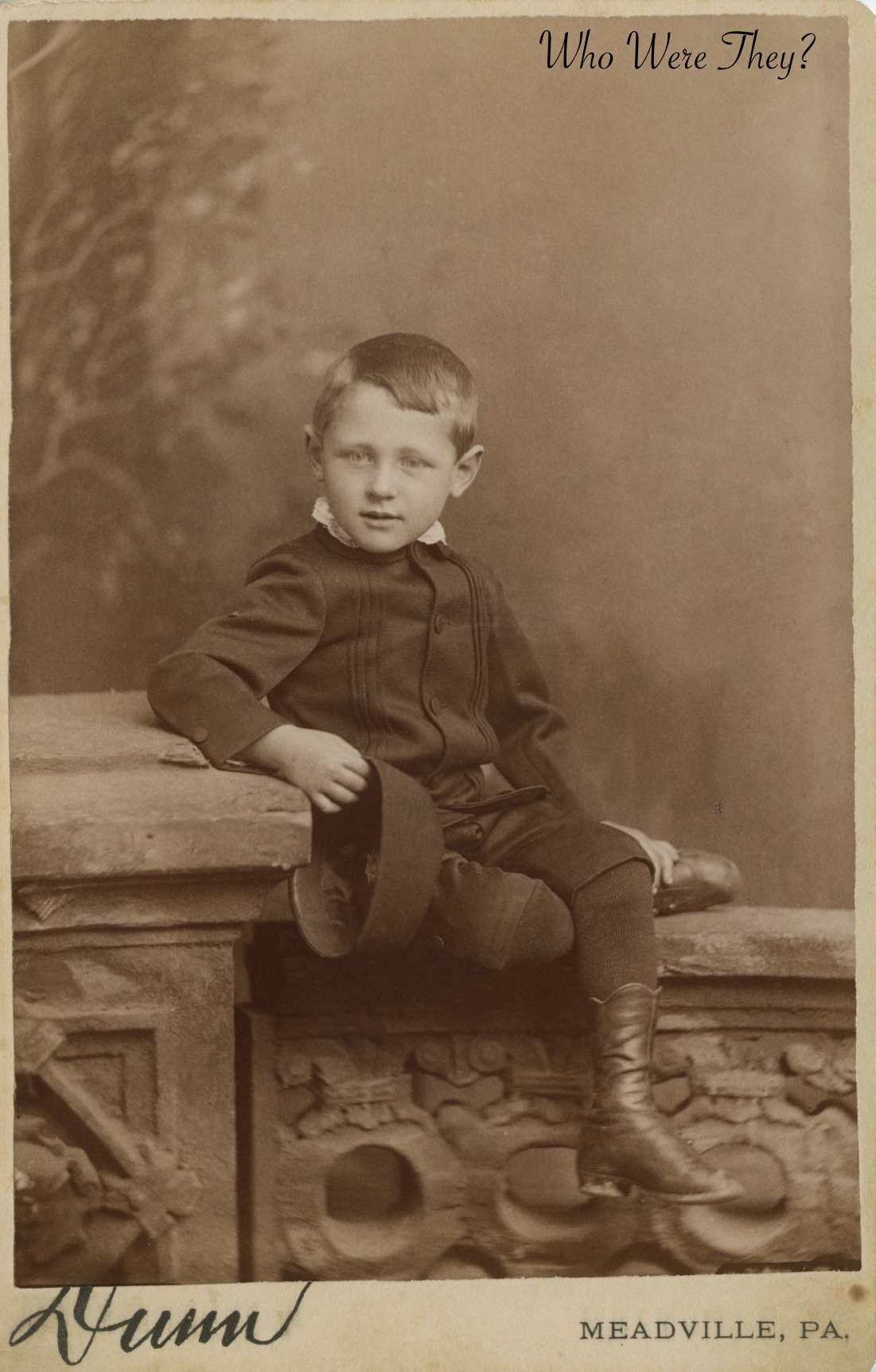
The first photo I found in the Red Velvet album was this one of a very handsome young boy, posed on a stone wall or monument, one leg folded under the other. He is wearing knee length short pants, black stockings and high boots, a fine black coat with a white collar, and he is holding a round cap in one hand. His attitude is engaged, as though he has just agreed to play a game of marbles once the shoot has finished.

The photographer was Dunn in Meadville, PA. I didn’t have much time to research this fellow, but what I did find was interesting. There was an early settler of Portland, NY named James Dunn who emigrated from Meadville, PA. This was in 1806, so it could not have been the photographer, but could certainly have been an ancestor of him. I shall try to work on this more later, but readers are welcome to play with it as well. I am tentatively dating this photo to the 1880s because that is when I believe the stone monument setting was popular in photography studios. Should I find I am wrong I will amend the date as needed.

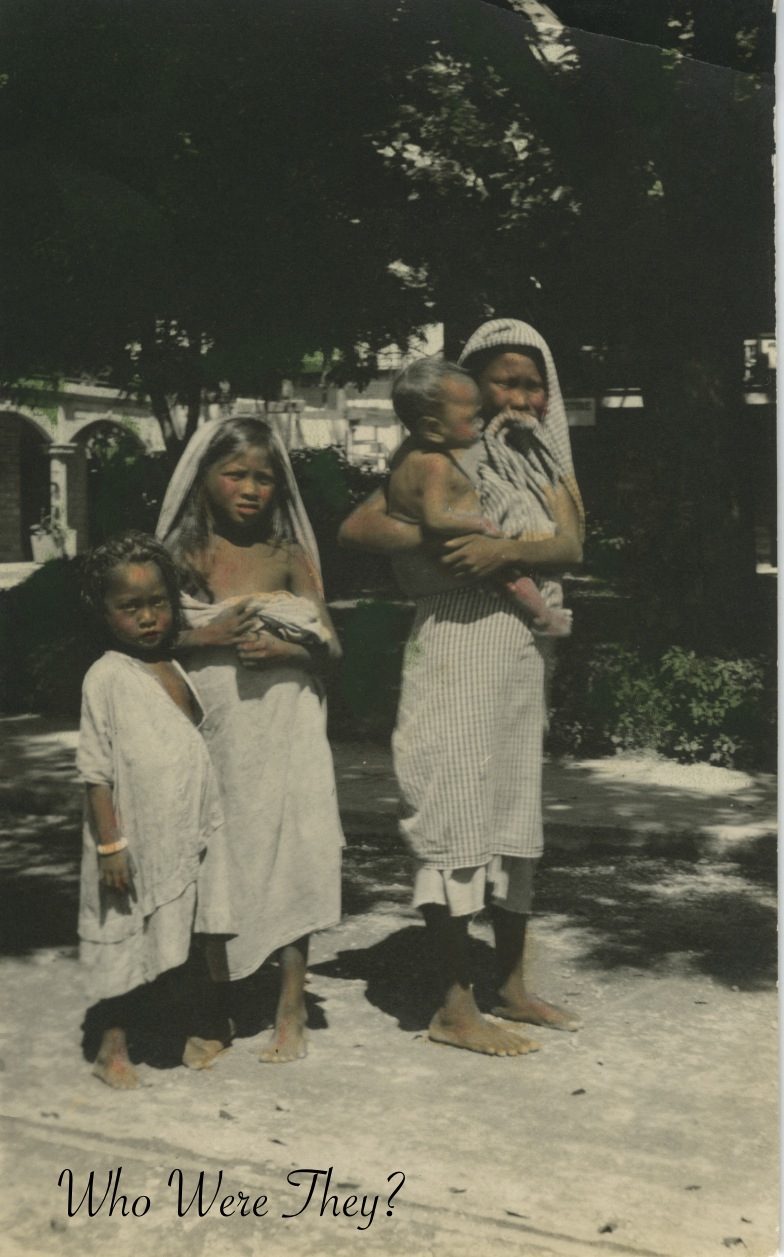
I have previously posted hand tinted photographs of an Asian family, possibly Japanese. The art of hand tinting was considered to be quite an art in Japan and was popular in the surrounding countries. Although the Sepia Saturday prompt was a photo of Korean girls playing a game of Go, I decided to feature the Asian photos rather than the game photos. Partly because I don’t have any game photos, but that’s beside the point now, isn’t it?

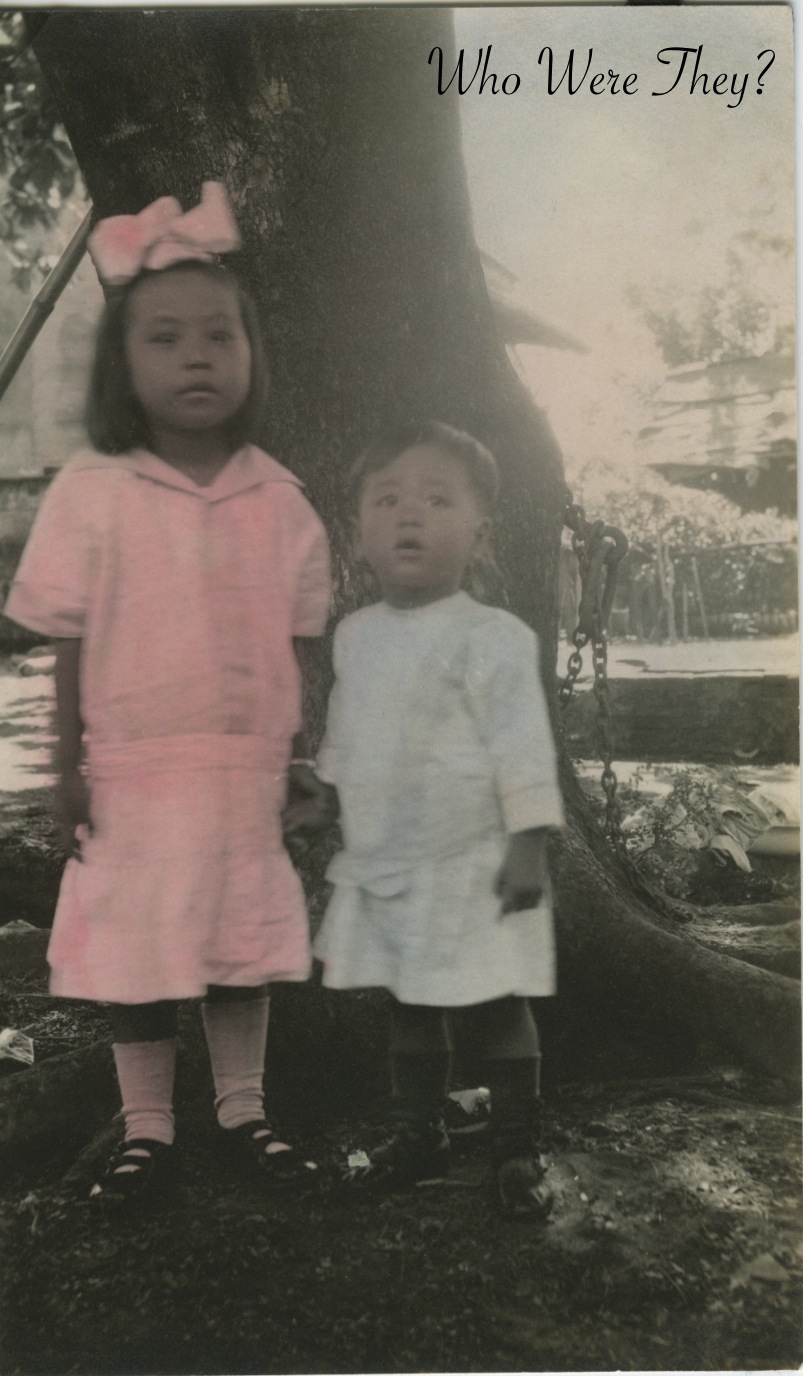
First up, two cute kids. At first blush you might think this is a color photo, but as you look closely, you will see that the skin tones are carefully mixed and applied, and while there is blue on the girl’s dress and a bit in the background, the majority of the image is black & white.

This is quite possibly the same pair of children and you can definitely tell this one is tinted. The consistency of color in the bow and dress our wee girl is wearing is just too close. The tinting does cause the children to “pop out” of the image while the rest fades away as an afterthought. It appears there are some kind of tools or hand equipment leaning against the wall in the background, making me think this is a backyard shot.

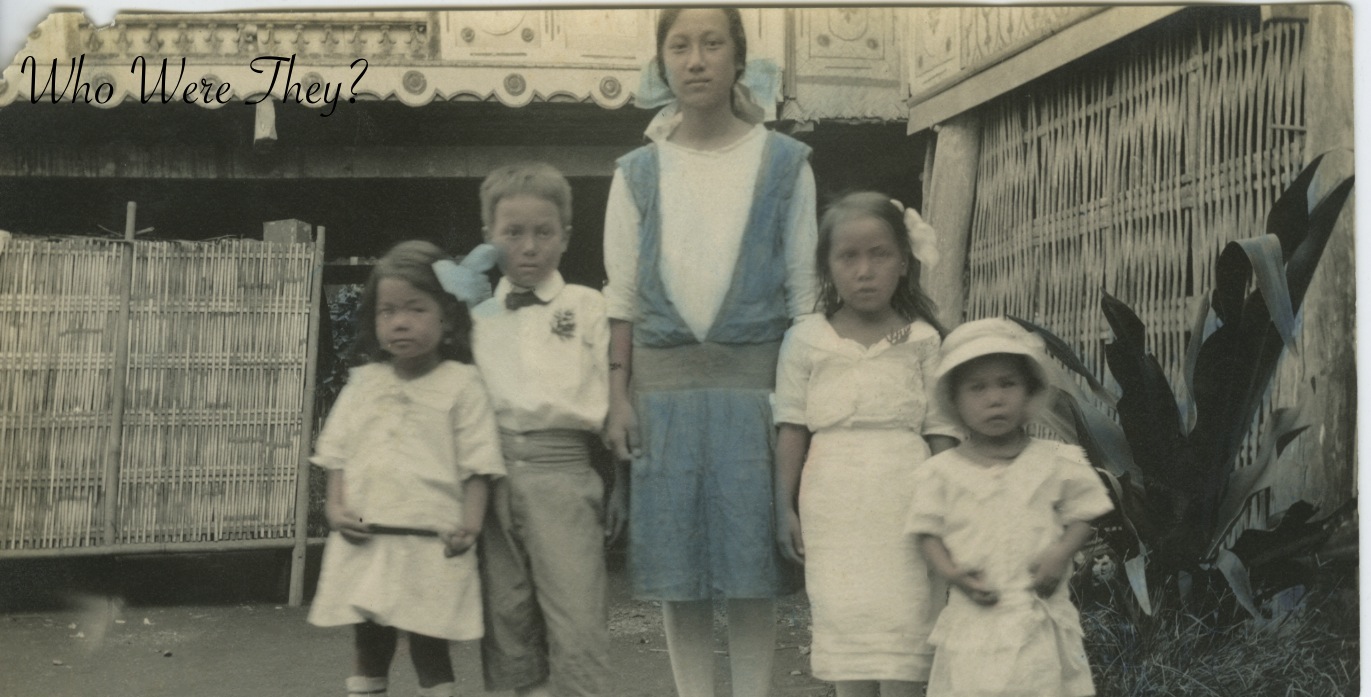
Maybe this is their parents? The photograph is meticulously tinted, again making it look like a color photo. The hint is in the color of the plants – they are all one color with no variation, but just look at the detail! The photo is about 2×4, so this took a lot of time and accuracy. And maybe a magnifying glass to hit all those flowers.

Could this be a group of friends caught in the middle of play?

This looks like a school photo or maybe a Sunday School photo. The children are all well dressed and posed in stair-steps. Again, the skin tones are carefully applied to their faces, giving them more depth than perhaps the standard black & white photo.

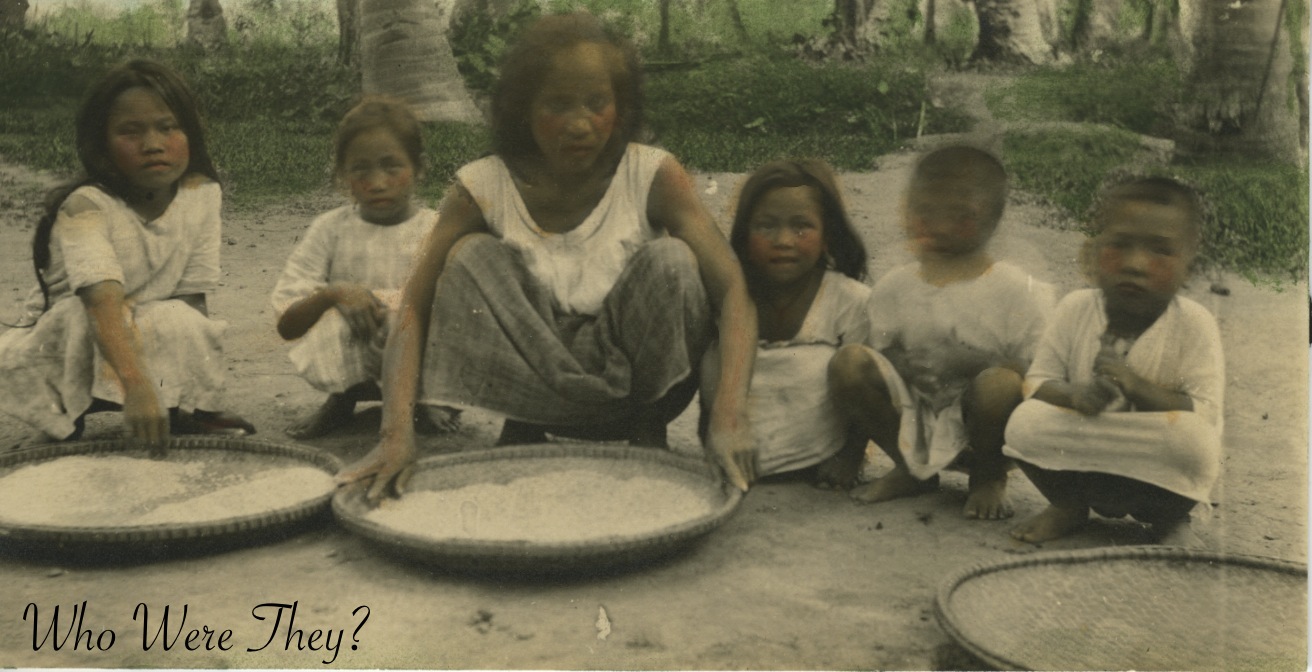
Here a group of children are sorting rice I think.  It is unfortunate that the little boys on the right moved their heads just at the moment the shutter clicked. From the palm trees in the background we can tell this is a tropical locale, so maybe Veitnam, the Phillipines?

The photos are all on the same flimsy paper and have no gloss or finish on them. I would liken their texture to standard letter paper that comes out of your local photocopier. This particular image shows the careful application of the skin tones to all the exposed skin of the children. Upon enlargement you can see that some got onto the little bracelet worn by the girl on the left. The artist even was careful to color their feet.

I hope you have enjoyed these images. They captivate me and cause me to wonder about the family, the location and the events surrounding the when and wheres. For more photos from around the world please click over to Sepia Saturday, where the theme this week is generally games.

Join in the fun!

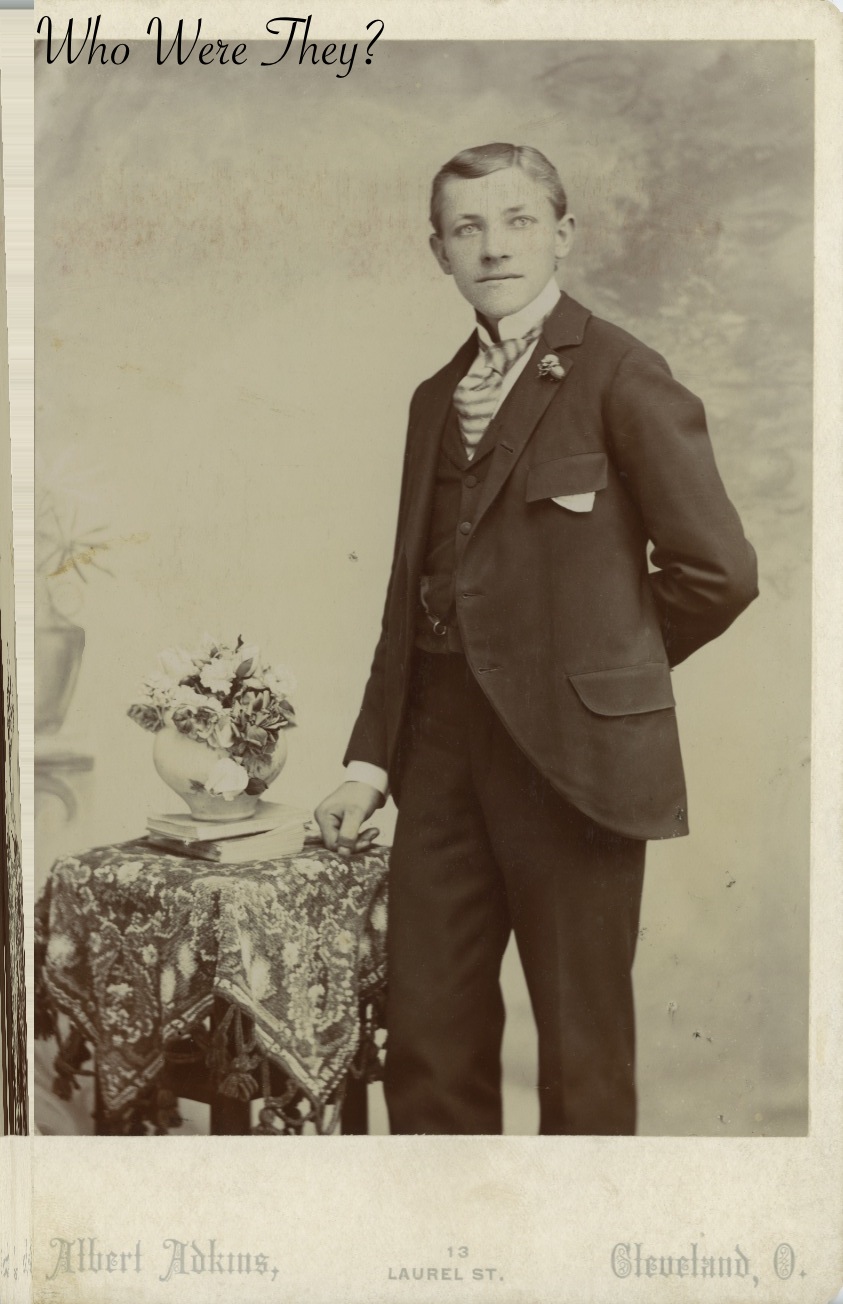
I think this photograph might be an older version of our Communion boy featured in my Button, Button Sepia Saturday post last weekend. Take a good look at the two and you decide. This young man is a fine looking example of youth on the verge of manhood in the late 19th century. Might this be a graduation photo? He is quite tall and slender, with light eyes and hair. I bet the young women in town all though he was quite a catch. This is the last photo from the Leaf Album. It has been a treat to look at these photos and speculate who they might portray, and also to discover more about the photographers in Ohio in the 1890s. I just wish there was some way to find names for these people; it makes me so sad to think of them this way, leaving us asking who they were?

The photographer Albert Adkins was born in England in 1865, emigrating to the US in 1871. He was in the photography business 1895-1900 at least. He died in Cuyahoga in 1932.

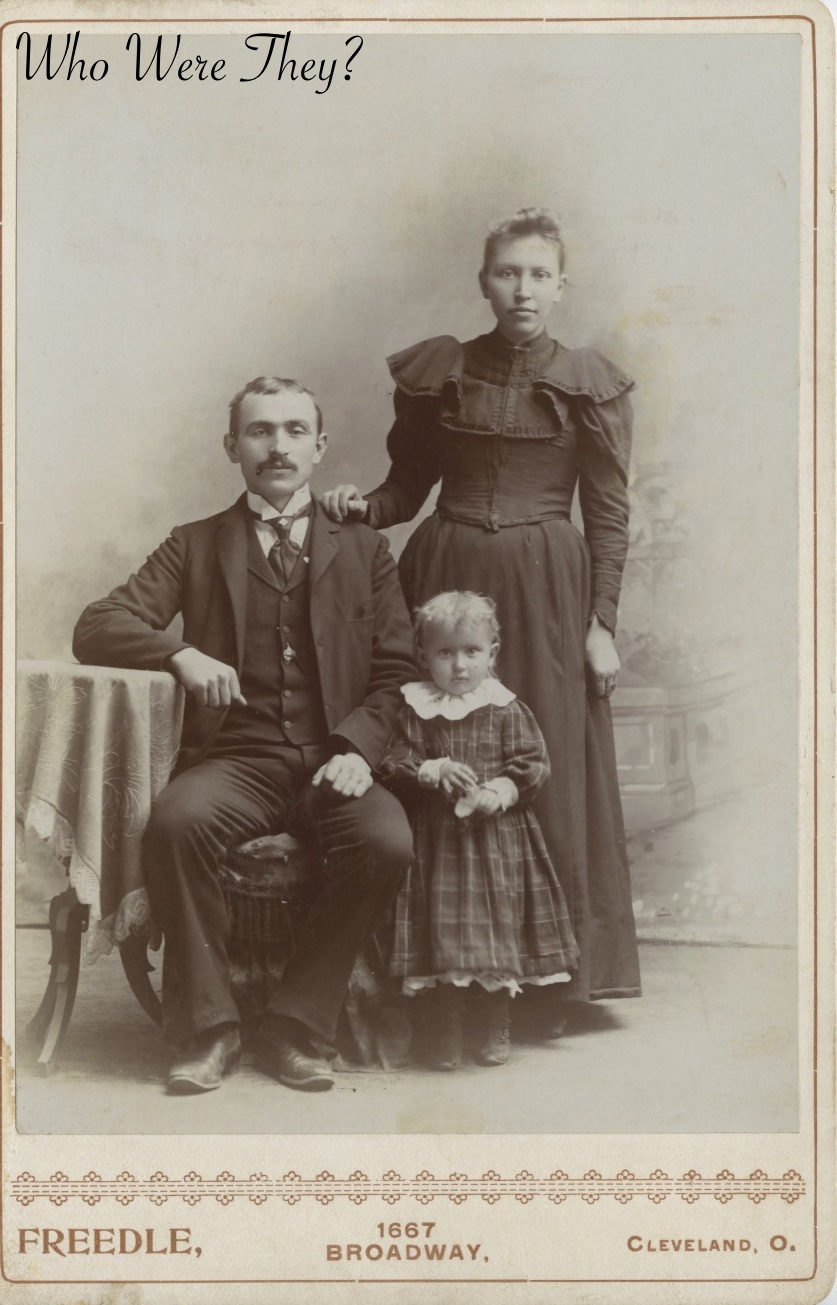
I can’t quite tell if the child in this photograph is a boy or a girl. The usual clue of the part in the hair is either not well defined or the parents chose to eschew that tradition. The child is sweet and round faced, with soft hair with maybe a bit of a curl? Baby is also holding some sort of a toy in their hand. When my daughter was learning to walk I would give her something to hold because when she was distracted she would walk just fine; when she was thinking about it she fell all over the place. I do not recognize the parents from any of our previous photos in the Leaf Album.

The photographer was the family-preferred Freedle in Cleveland.