Who Were They?

Lost and forgotten photos from the past

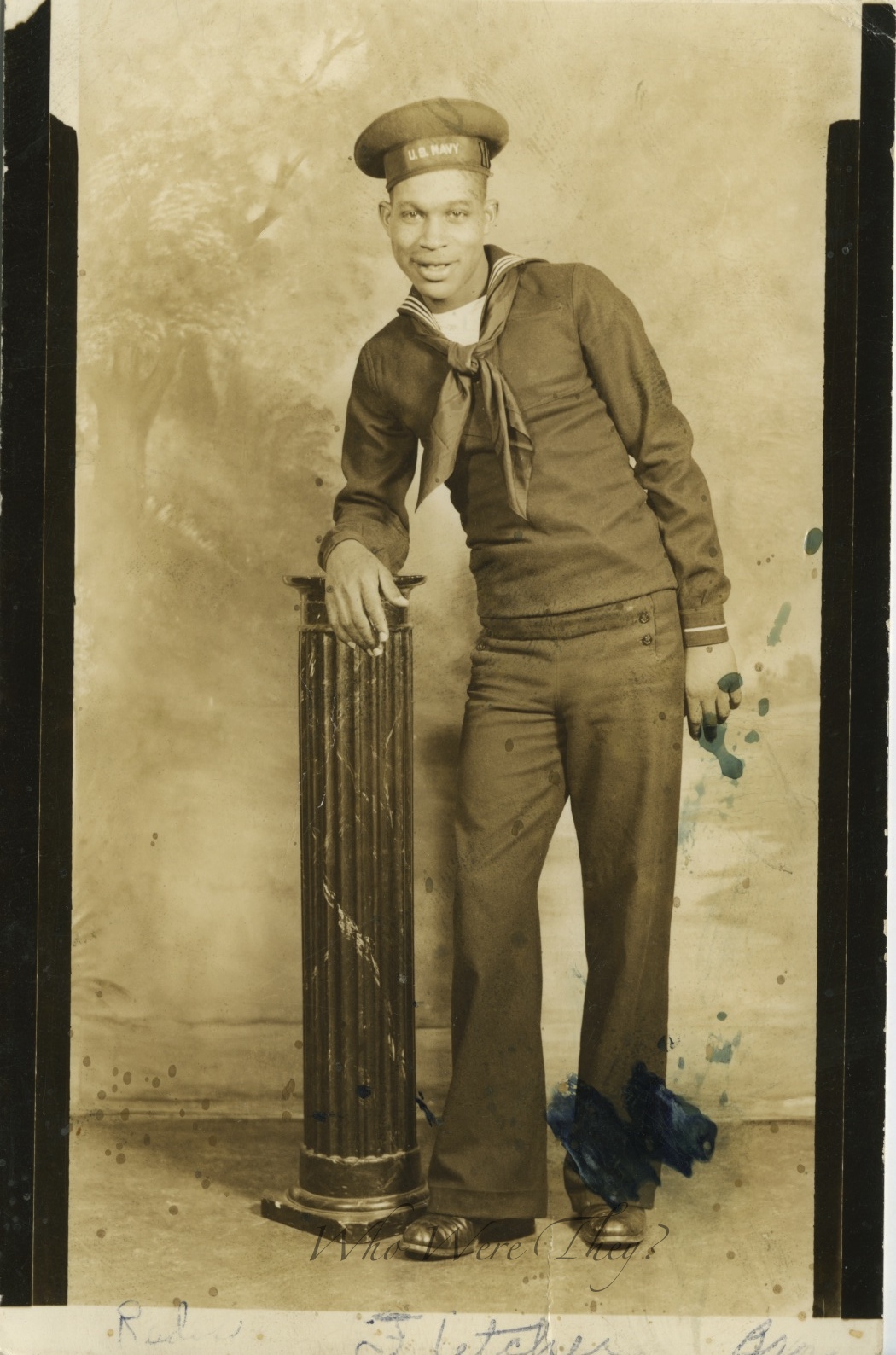
Sailor

This is a great find – a black sailor named Rudolf Fletcher, posed by a column and looking confident. I am guessing this photo dates to the World War II era. Working on that theory, I did a little research and found a few Rudolf Fletchers.

  • Rudolf Fletcher, born October 10, 1928, died June 10, 1981. Entered the service April 9, 1946, left February 7, 1948
  • Rudolf Fletcher, born January 5, 1926, died September 15, 1986. Entered the service January 3, 1944, left January 12, 1946
  • Rudolf Fletcher, born April 13, 1934, died December 10, 1992. Entered the service February 19, 1952, left May 3, 1955

There is also a laundry list of Rudolf Fletchers who served in the Navy throughout the 1935-1950 era.

UPDATE: Iggy found that the Rudolph Fletcher I crossed out up there was a white man, so that eliminates him from the running for this photo. He also discovered Rudolph Valentino Fletcher Sr (1924-2002), who was buried near Oakland, CA. At least there is a connection here, as I bought the photo in California. Hopefully one day Mr Fletcher’s family will stumble upon this picture and be able to tell us if it is he. Thanks, Iggy!!

Sepia Saturday challenges participants to see photographs in a different perspective at times. And some days, when the photo appears to meet the prompt exactly to theme, sometimes the meaning of the photos doesn’t. Or can’t. Or, has been lost. So often we see old photographs for sale on ebay, in antique shops, thrift stores, and even thrown into the trash, because they don’t mean anything to the current owner. Photographs are taken, shown to friends, placed into an album or shoebox or drawer, then to be forgotten by the person who took them in the first place. When they aren’t identified, it is especially difficult for descendants to figure out exactly what caught the eye of the photographer. My sister and I threw away probably a hundred photos of trees that our grandfather took on a trip somewhere, some time, with some people….but we didn’t know any of the details. Grandpa Jim liked scenery. Grammie Hennie liked people. The few photos we did save had a giant frame of scenery, with down in the corner or off to the side…a person. It was their compromise. :-)

So, as a “curator” of old photos, I seek out these lost treasures, the memories lost to time, and share them with you, all for our speculation and enjoyment. This week’s Sepia prompt shows blurry landscape. If I still had all those photos by Grandpa Jim, I’d share them, haha. But instead, I have a series of 14 5×7 photographs, from someone’s trip. To somewhere. To visit someone. The photos were not identified, but they were numbered. They may have been self developed as the weight of the prints varies. Some are on firm paper, others quite flimsy.

This slideshow requires JavaScript.

I will pull out a few for closer examination, below. Click any photo to enlarge it.
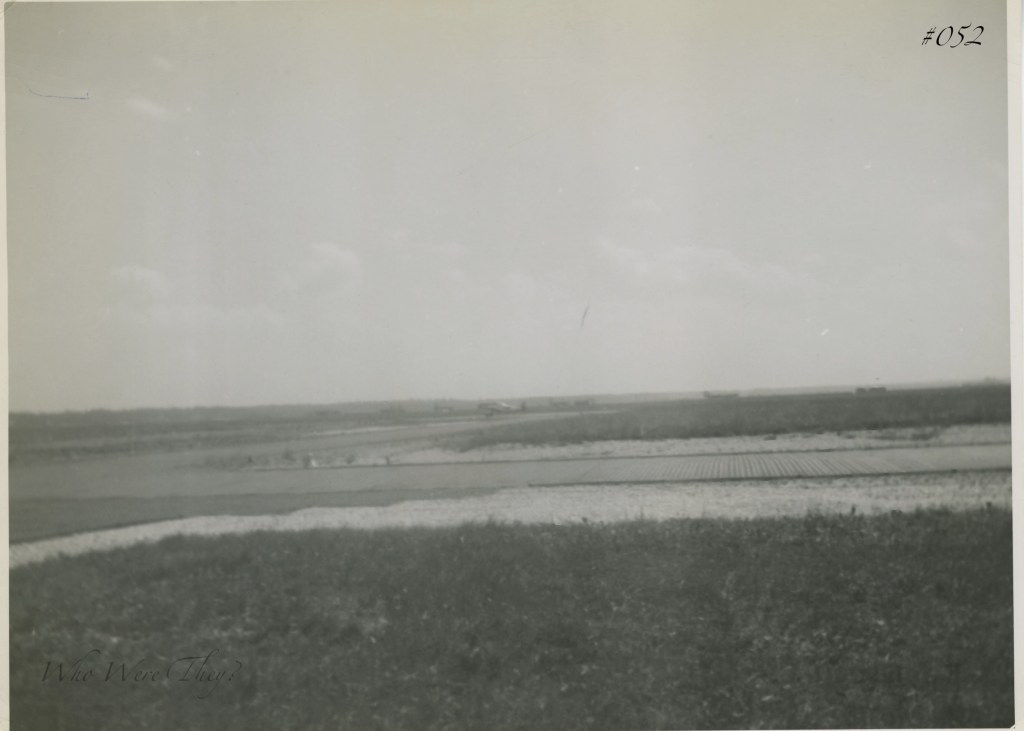
An airstrip, small plane in the distance

An airstrip, small plane in the distance

At first glance, this is a picture of the tarmac at an airstrip. But, looking closer, there is a small silver plane in the center of frame.

Photo taken over the wing?

Hay making, horses used

This photo, taken over the wing engine of a plane I believe, shows a team of farmers collecting hay. The bales are large round ones, and to the left of the hay you can see a man, a horse, and in the distance more horses. There is also a man standing on the top of the main hay pile.

View out the window

These don’t look like American houses, so I’m guessing “European”

The view out the window, I suppose. Houses that do not look American. Hills rising in the distance. An electric cable right through the middle of the shot.

Great party

Look on the left wall, there is some sort of mural there

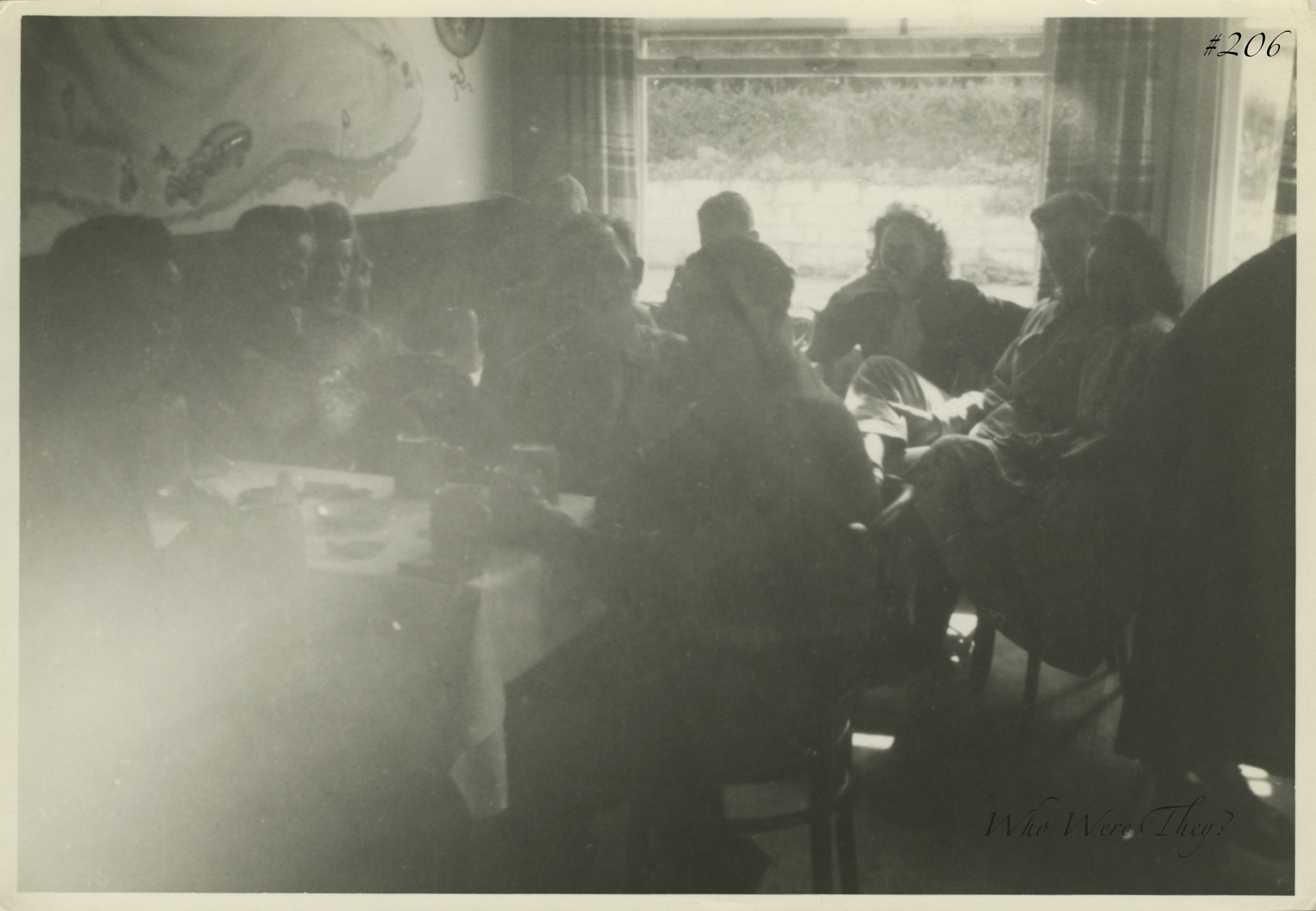
An image of a party or restaurant, unfortunately badly backlit by the windows. Looking to the left wall, there is a mural painted there. It shows a truck, a car and possibly a motorcycle, all on a road that appears to be along the edge of the world.

All the photos are intriguing because their meaning and origins are lost forever. Perhaps someone can identify the type of houses, or landscape. I’m thinking a military base, possibly in Germany, but that is a total guess. The slideshow displays the images in their numbered order, so that might tell us something about the progression of the person’s trip. But, just who was visiting whom…..we shall never know.

For more blurred memories and images, click over to Sepia Saturday. You will be happy you did!
Visiting abroad
pretty, pretty

pretty, pretty

From the late 1880s-1890s, this cabinet card shows a pretty young girl showing off her dress. She is nicely groomed with curls, a fancy dress with lace trim, black stockings and shiny black shoes with buckles on them. I learned recently about an interesting aspect of 19th century photography, which is that colors photographed using wet plate technology do not photograph the same as our modern technology. For instance, a modern yellow dress would photograph as gray or white using modern photography (e.g. modern black & white film). However, a yellow dress photographed by a wet plate camera would photograph as dark gray/almost black! I found a fascinating article about this on The Sewing Academy, a website dedicated to reproduction sewing using historical techniques. So, while this young girl’s dress is most likely white, this new information casts a whole new light on the clothing in every other 19th century photograph I have seen. Reds photograph as black, greens photograph as shades of dark gray. Blues show up as light gray.

I recall a previous photo I posted which had written on the back “gray and orange.” I am going to have to reevaluate the dress with this color information in mind!

Reading in bed

Reading in bed

This unknown boy is using a nice bed tray to properly elevate his book for optimal reading posture. I have often wondered about the purpose of the photo. It is a matte print that reminds me of a professional photograph. Perhaps it was for an advertisement or magazine. From the time I found the photo to the moment I saw the prompt for this week’s Sepia Saturday, I kept thinking it reminded me of something, but I wasn’t sure just what. Finally it dawned on me that it reminds me of the Robert Louis Stevenson poem “The Land of Counterpane.”

When I was sick and lay a-bed,

I had two pillows at my head,

And all my toys beside me lay

To keep me happy all the day.

And sometimes for an hour or so

I watched my leaden soldiers go,

With different uniforms and drills,

Among the bed-clothes, through the hills;

And sometimes sent my ships in fleets

All up and down among the sheets;

Or brought my trees and houses out,

And planted cities all about.

I was the giant great and still

That sits upon the pillow-hill,

And sees before him, dale and plain,

The pleasant land of counterpane.

I always liked the imagery in the poem. Even as a child of the 1970s, I knew that a counterpane is a bed spread, that small boys used to play with toy soldiers, and that imagination could rescue you from boredom. I sometimes thought I would like a set of toy soldiers and trees and houses, but alas, that did not come to be.

For more introspection and images from around the world, click over to Sepia Saturday. You will be happy you did.

A laying in

Cute Kids.1

Early “Jiffy Pop” fashion

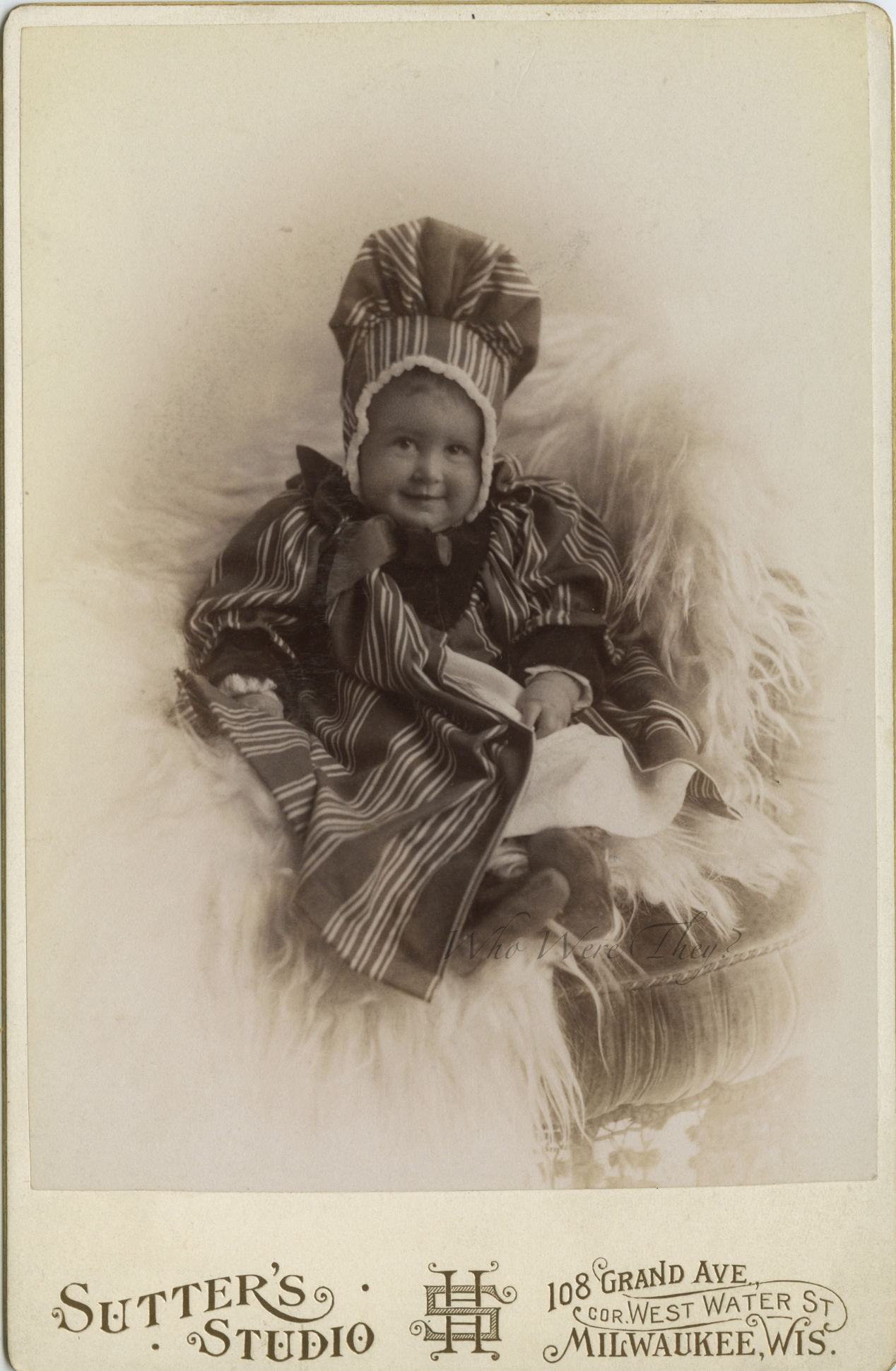
This small child photographed at Sutter’s Studio in Milwaukee, Wisconsin, is wearing an ethnic costume, likely from Poland. After 1870, Polish immigrants were second in population to German in the city. There was great promise for jobs in the city’s industrial area. According to The Making of Milwaukee, the Polish neighborhoods were known for small houses and large churches.

The reason I think this might be Polish is that the bonnet is distinctive in its style and the way it is worn. I found one other photograph that came up when searching for Polish traditional costume. Being as there are something like 25 distinct ethnic areas and costumes in Poland, one match is a great stroke of luck!

Polish costume

There are other similar styles as well, but none of them had the distinctive poufy portion of the bonnet. Anyone with additional information about this type of costume is encouraged to comment.

The photographer was Mrs. Helen Sutter. She was known to be in business in the 1890s, per the city street directories. I could not find much else about Mrs Sutter.