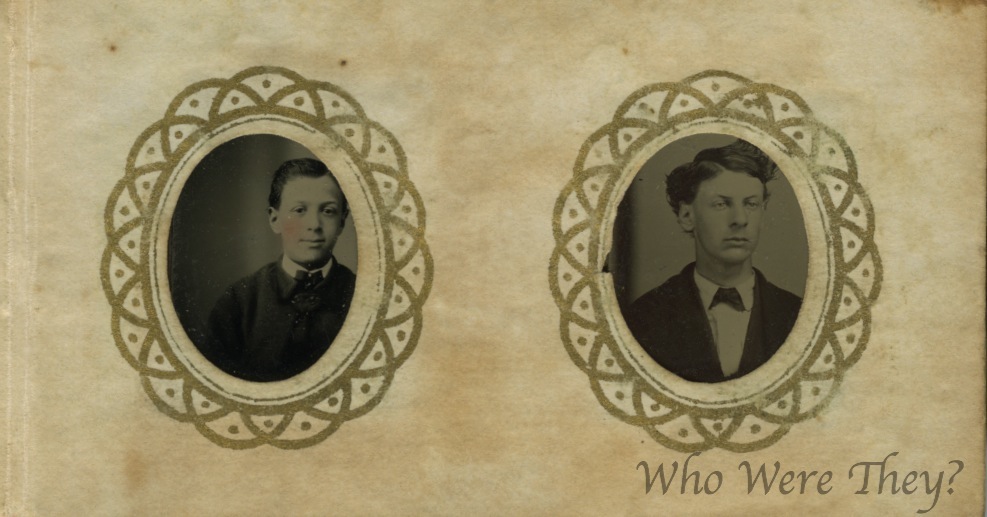
Two young men, one younger than the other, share this page in our Red Gem album.
Youthful
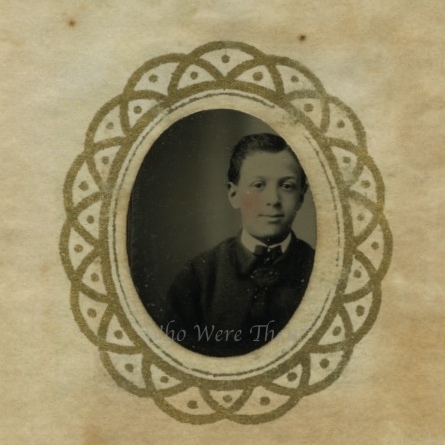
It is unfortunate that these gems seem to tend toward off center, because I’d like to see the whole person. This young man, maybe an early teenager, has nicely slicked hair and a tidy suit. His bow tie is small above a dark colored coat. The unknown photographer tinted his cheeks to show the bloom of youth on his face.
This is quite a hair do
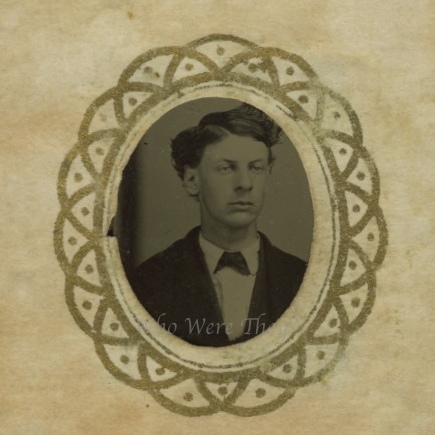
This fellow has a slightly different tie than his page-mate. It is a style that tucked under the collar of his shirt, a style that was popular throughout much of the Victorian era. His hair, though, is what captures my attention. When a man has curly hair, it is sometimes difficult to keep it under control. Heck, when a woman has curly hair it is sometimes difficult to keep it under control, haha. Haircare products in the 19th century were nothing like they are today. Hair was pomaded and waxed with various treatments made with wax, grease, oil and various other preparations intended to bend the hair into the form the wearer desired. While they were often given fragrances to help an individual smell good, they still could be heavy and weigh down the hair. This particular gentleman does not appear to have used any sort of hair oil. His hair is really puffy! One wonders why he didn’t just cut it very short, but we must remember that men’s hair was worn a bit longer at this point in history. Prospective lady friends must have thought his hair was dreamy and romantic.
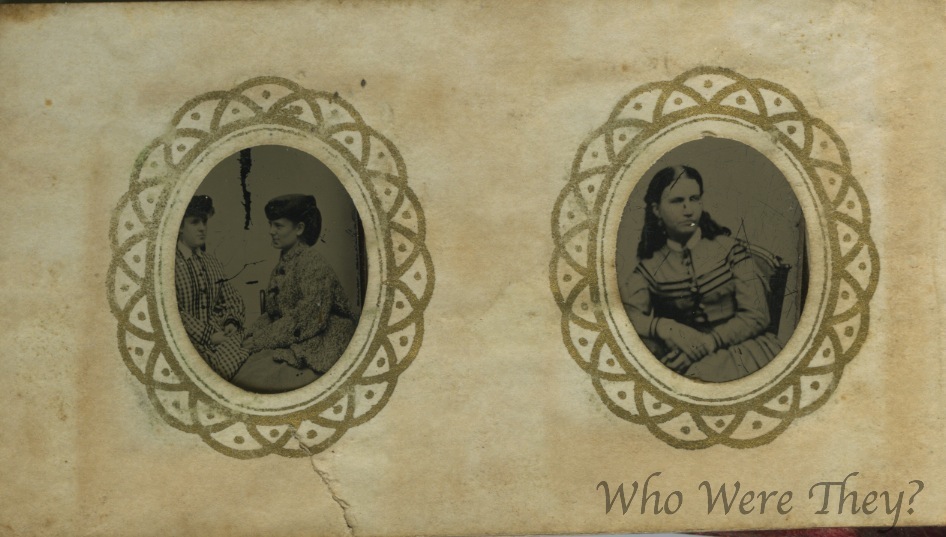
I love looking at these images because I can learn so much about historical clothing (which I love). Today’s page from the Red Gem album shows us a pair of ladies on the left and a single young lady on the right. Let’s take a closer look, shall we?
Pill box hats
It is unfortunate that the photo seems to have been made slightly off center, because we can’t see the left hand woman as well as the right hand one. But there is so much to see! The lady who we can see well, on the right, is wearing some sort of saque coat made of some sort of fluffy material. First, a saque coat is a coat that buttons with one or two buttons close to the neckline. They are large and loose garments, perfect to go over large sleeves or embellished bodices. Of course there is no reason one could not have worn a saque coat over a simple bodice with narrow sleeves, just that the unfitted body of the coat lent itself to covering without crushing. I can’t quite tell what kind of material it was made from. I asked some of the historical clothing experts I know, and discovered it could be Persian lamb or some sort of novelty woven wool. Now I’m picturing the novelty faux fur fabrics at the local fabric store. Whatever it was, it has an unusual look, and might have been included in the photograph for that reason. Her hair is pulled back to the back of her head and she is wearing a pillbox hat. Her companion has on a lovely checked fabric dress with a straight buttoned front and white collar. I have a dress similar to this in blue and white check, so that is of course how I picture this dress. The Checkered Lady also has on what appears to be a pillbox hat, or possibly something with a very small brim. My friends who helped out with the ID on the saque coat estimated the date of this photo to be just after the war, so 1865 or 66.
The girl next door
Their page neighbor wears a very typical and fashionable example of 1860s clothing for young women. The trims going across her bust and shoulders were intended to emphasize width in opposition with the large skirt, thereby making the waist look small. She has coordinating trim at the wrists of her sleeves. It is difficult to tell if the buttons of her bodice were functional or not, but they appear to be large and may even have been made of the same fabric as the dress. Her hair is parted in the center and drawn back over her ears, then allowed to fall loose down her back.
While I don’t have any fun links for you today, if you are on Facebook and wish to learn more about civilian clothing, you might be interested in a group called The Civilian Civil War Closet. There are several fashion historians on the site (like, literally historians who work at museums and stuff!), as well as experienced seamstresses and experienced living history demonstrators. It is extremely educational and I have learned quite a lot from them!
The image on the left side of the page shows two women in a comfortable pose. One is seated while the other rests her arm on the first woman’s shoulder. Their clothing is typical 1860s styling. The woman standing is wearing fashionable style that might have been made to look like two layers. Or, it could be a light bolero style jacket over a Garibaldi waist (what most people today call a blouse or a shirt), which would have been haute couture. They both have their hair parted in the center and pulled back into chignons or buns. At the time, a chignon was considered to be any style of hair arrangement on the back of the head. Today we associate that term most closely with a smooth French twist that results in a vertical roll of the hair in back.
Young lady with missing nose
Here we have a young lady, probably on the cusp of womanhood – which at that time would have been the late teens or early twenties. Wearing ones hair down was considered a fashion forward look for women, but a typical style for girls and teens. You can see she has her hair parted in the center as was common, but pulled to the back somehow. She has some type of band or decorative item on the very crown of her head. Her dress is fitted. Upon enlarging the image, I was able to see where the stripes in the fabric come together in a line just at the positioning of a dart on many period bodices. She has a large bow and a long necklace, as well as a brooch. Unfortunately for her, this very pretty image was spoiled by the absence of her nose, which was probably due to the skill (or lack thereof) of the photographer. He did manage to tint her cheeks quite nicely.
Moving right along in this little gem album we have this pair of young adults. A woman and a man, both dressed nicely. I do wonder if they were related, married, or somehow knew each other. It is of course possible they had never met.
Buttoned up
Our lady here has a typical 1860s bodice, fitted to her with a buttoned front, white collar and a brooch of some kind. The buttons look to have been functional as opposed to a bodice closed with hooks and eyes with decorative buttons on the front. Both were acceptable methods of dress closure. Possibly at the waist, the opening had a dog-leg and the skirt closed to the left of center. This made it easier to get into and out of dresses without tearing a seam. Also of note is that this lady’s hair is dressed with something on top, maybe a cap?, and ringlet curls in the back. While it appears she had a side part, in actuality the angle of her pose to the side makes it look that way, and in fact she has a center part.
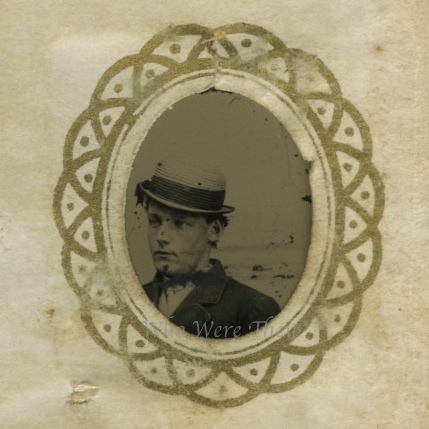
Howdy do, ma’am
I do so love this straw hat. It looks like a narrow brimmed bowler, made in straw with a wide band around the crown. The bowler hat was invented in the 1850s, and was originally made of metal as a riding hat. The fashion soon became popular because top hats were not practical for riding. Bowler hats were produced in beaver, felt, silk, straw, and probably wool. At first look, I assumed there was a scratch on the image, but on enlargement, I think he had a bow or cockade of some kind on his hat (see the left side of the brim).
I recently became acquainted with Heather Sheen of Creative Cockades. She made me some beautiful reproduction President Lincoln mourning cockades from black silk ribbon and reproduction gem tintype buttons. She has dedicated quite a lot of time and energy to researching and reproducing these interesting textile accessories in an historically accurate manner. Throughout history, from ancient Rome to modern political campaign buttons and ribbons of support (pink ribbons, red ribbons, etc), cockades have been used to show political affiliation, membership in a group, military awards, or patriotic fervor, among other things. Sheen told me that not only were cockades used to make a public statement they were also incorporated into military insignia and regalia. Whether indicating nationality, rank, or regiment, a man’s cockade told other soldiers important information about him. During the American Revolutionary War, officers were made to wear a cockade on their hat so others would be able to quickly identify ranks – important in an army that lacked uniforms! Our modern medals and ribbons worn by soldiers on their dress uniforms may have, in part, evolved out of this tradition. Sheen says that in particular, if a medal has colored rings around it, it likely has evolved from a traditional, historical cockade.
While we cannot tell what this man’s cockade signified, we can romantically surmise.
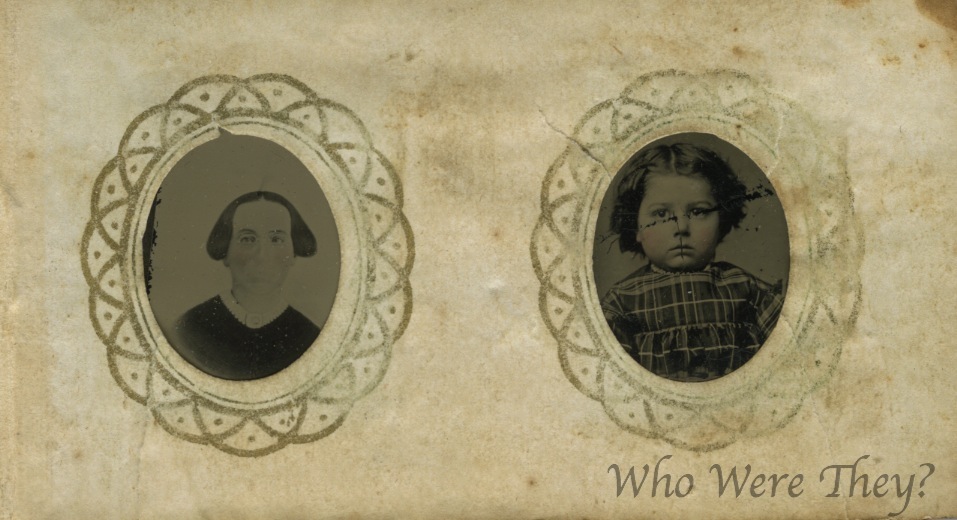
Here are two faces peering out from the page. One is lost in the poor detail and the other is scratched across the eyes – the window to the soul, some say.
Where is her mouth?
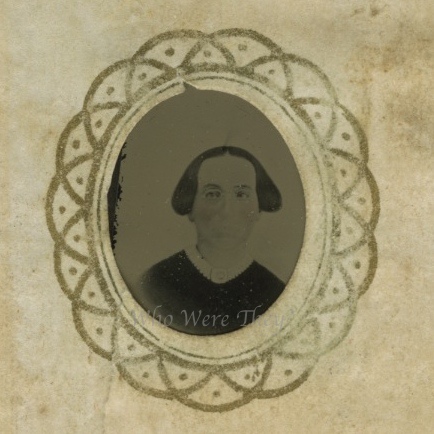
This image is probably a reprint – or more correctly a photograph of – a daguerrotype. They hair style and general characteristics of the image lead me in that direction. During the 1840s and 1850s, women dressed their hair in such a way that it wrapped around their ears and then toward the back of the head. Hair was parted in the middle and oiled so it would be smooth and shiny. Also a hint, the backdrop of the image seems to fall away from the person’s body, which is something I have noted in daguerrotypes. Unfortunately, the original image might have been light, and in the remaking of it, much of the facial features were underexposed. If you look closely you will eventually see the chin, jaw and mouth appear in the face.
Baby girl
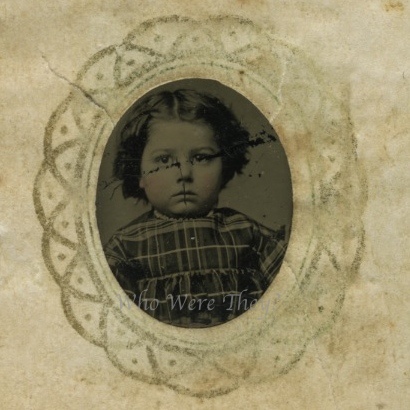
Juxtaposed with the lady above is this plump little face of a toddler girl. The center part in her curly hair tells me this is a girl. The cheeks of her face were tinted with a touch of pink, and while some people on the internet will swear that tinting is an indication of a deceased subject, this image clearly shows a bright eyed, living child. You will notice that the plaid on her dress is the same pattern as our previous child, shown here. A clever mother used every inch of yardage making these dresses for her girls. I imagine they were very lovely together!
I have been very curious about the tools used by photographic artists to make the tinting on these tiny gems and other small images. Working on the theory that they learned their trade from portrait artists who also painted miniatures, I looked into how to paint a portrait miniature. The art is still alive today, although very niche. I found a really interesting article about painting a miniature portrait here.
I’d imagined the size of the brushes to be quite small, so I looked at art supplies online, only to find that the US Department of Fish & Wildlife is causing some difficulty for artists by blocking the importation of brushes made with sable hair. Most US suppliers are out of stock of these high quality brushes with extra fine tips. From what I could gather, the brushes are hand made, and so there will be some variation to size and shape of the handles. Wow. I had no idea a simple paint brush could be so controversial!





 Who Were They?