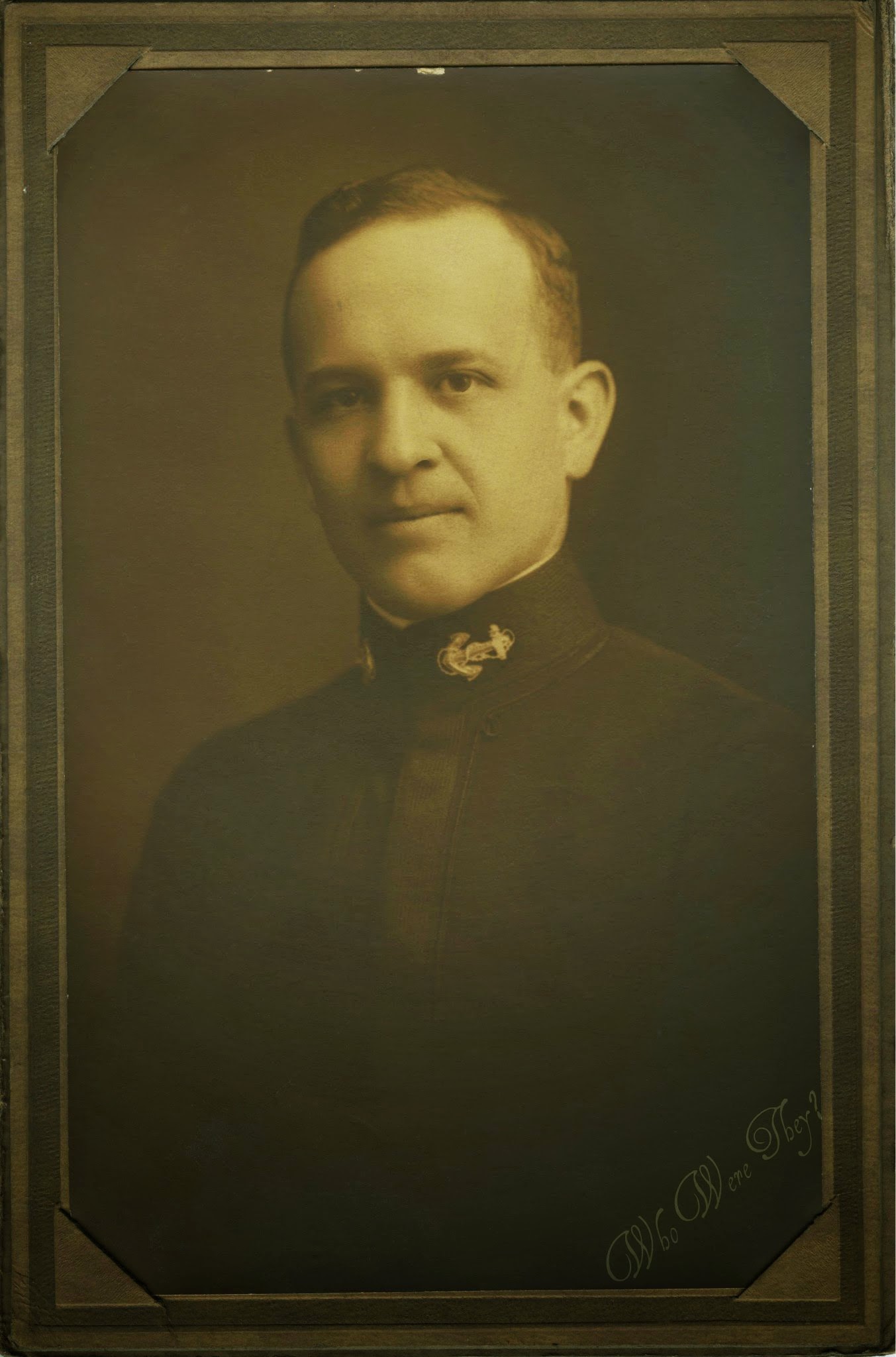
This handsome Navy man was photographed in the 1920s at the Paeszler Studio in Ada, Ohio. The photographer, Clara Paeszler, opened her studio in 1897 in the Ada area. She took many photographs during her tenure, but died in 1921. In 1922, the photographer, her studio was sold to her assistant, Brian F. Frederick and he maintained the studio name. From what I can find, the studio was prolific and successful up until that point. After that there is very little mention with dates.
I do so wonder, after having updated my Farrell Infants post whether this is Richard W. Farrell the navy officer? The uniform looks a bit like a cadet uniform to me. Anyone who can comment further is welcome!
I have posted in the past photographs that were obviously hand tinted – a black & white photo that was painstakingly painted to look colored. Hand tinting was an art form in and of itself, and was very popular in Asia, Japan in particular. The photo above originally looked like a hand tinted image. Now looking at the enlarged and scanned image, it looks as though it might be a very faded color photo. What do you think? Take a look at some other hand tinted photos here, and compare them to this one. I’m curious what others think.
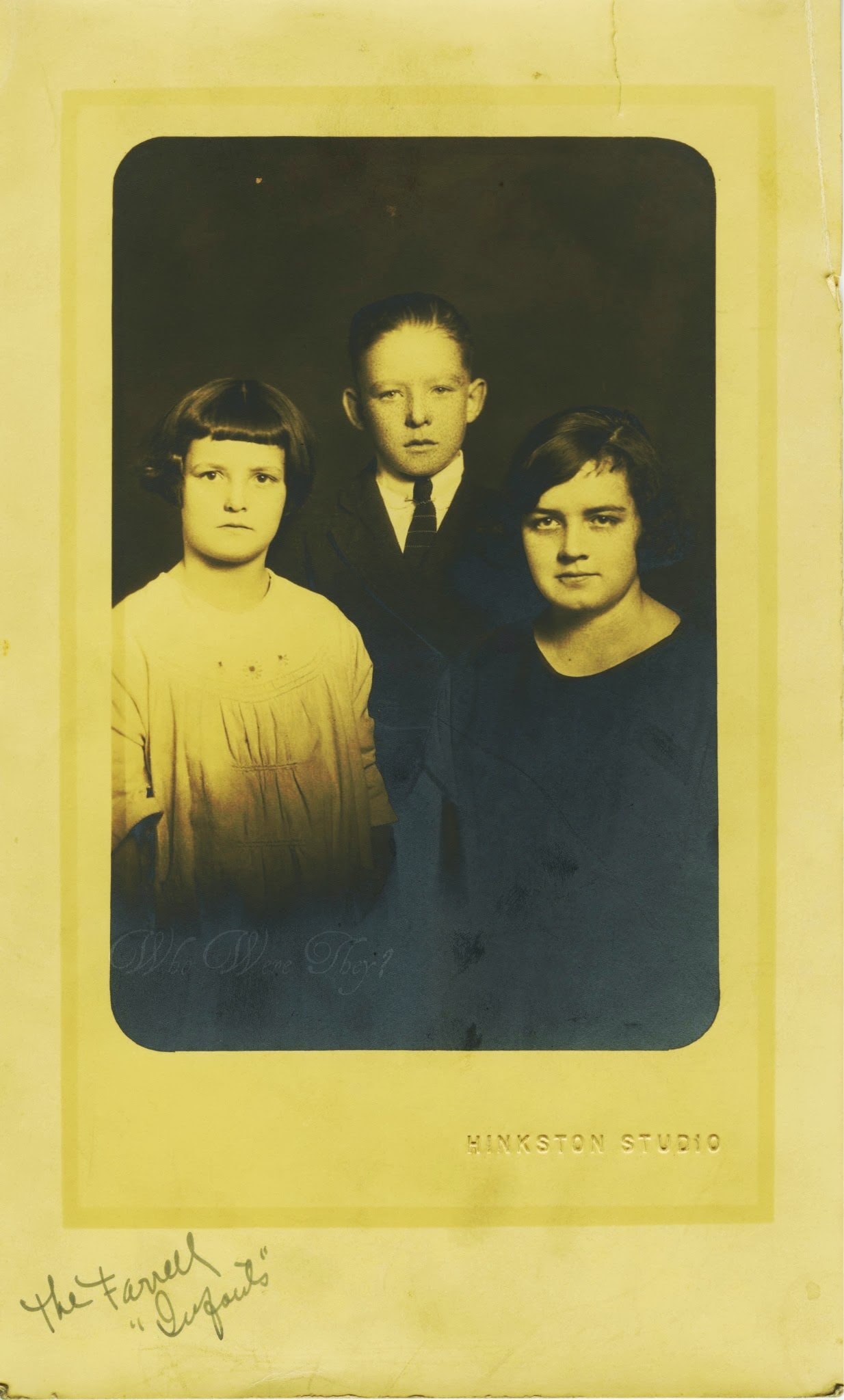
Looking a bit yellowed, here is a nice portrait of three children, labeled “The Farrell Infants” by someone, in pencil. I read it as tongue-in-cheek, as though the recipient of the photo thought of these kids as quite young, only to find they had grown in the blink of an eye. It could also be a nod to the novel Les Infants Terribles by John Cocteau, which features two siblings who basically are horrible and hurtful to one another. There is a lot more happening in the book, but I shan’t go into it here.
The photographer was Hinkston Studio. I found a reference to a Hinkston Studio in Michigan, which then led to a 1922 Northwestern High School yearbook from Detroit, MI. This further led to a reference to a 1938 photographic convention in Chicago, in which Mrs. Eva L. Briggs of the Hinkston Studio was either managing lectures or presenting lectures, on reception room management, business promotion and telephone solicitation (listed in The Focus, v 14 1938 – v 16 1940). The studio is also listed among known Polish businesses in Detroit by the Bently Historical Library at University of Michigan, within the Edward Martin collection of materials (covering 1852-2004).
UPDATE: Well, I really ought to look at the backs of the photos before I post them! I just found the names of these three: Betty, Dick, Rhea Marian. Dick was probably Richard. With this information, I turned to Ancestry and found Richard W. Farrell, born about 1913 in Ohio. Sister Rhea was born in about 1910 in Montana, and sister Elizabeth “Betty” was born in about 1914 in Montana. Their father was Bert M Farrell born about 1881 in Ohio, and mother was Clover “Cloe” born about 1884 in Ohio. Bert gave occupations of civil engineer and poultryman in the two census documents I found, which is incredibly diverse. In 1920 and 1930 they lived in Detroit. Also, in 1920 when Bert was a civil engineer, they had Kent P Anspaugh (sp?) and Neil C Anspaugh living with them, who are listed as Bert’s brothers in law. Both were born in the 1890s.
After this, it’s difficult to trace Richard and family because “Richard Farrell” was a popular name in the 1910s. I found one Richard W Farrell living in San Diego, CA in 1940 with wife Eleanore and daughter Jo Ann. This Richard was a Navy officer. Another Richard W Farrell lived his life in Ohio married to Edith and was buried at St Mary Cemetery in St Bernard, OH as a WWII Army veteran.
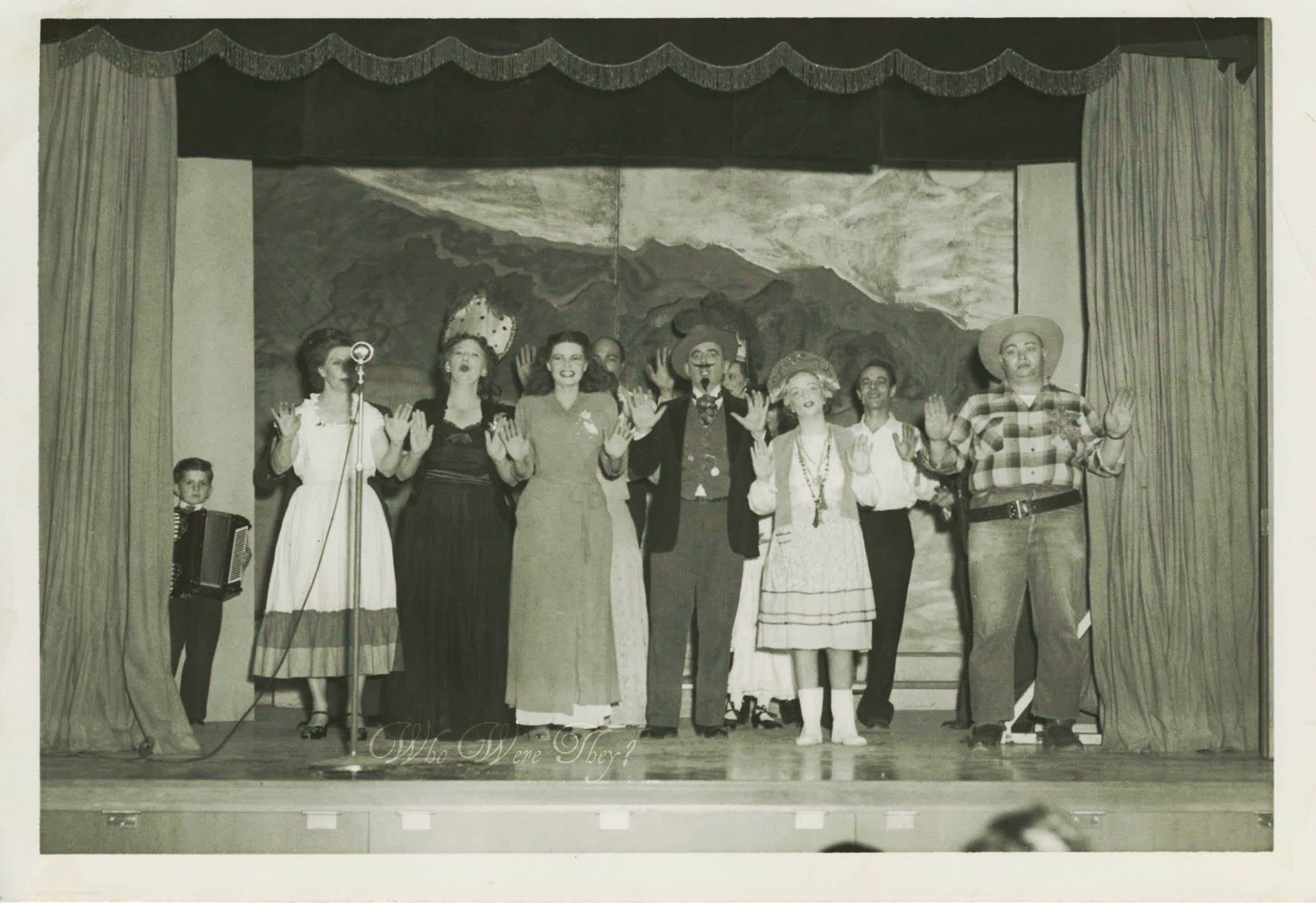
Do you applaud after a great play’s finale or do you pound your chair into the ground so much the leg breaks off? When the curtain is pulled aside and the actors rush in, do the “legs” of the theater break? Is there a gladiator you wish to keep his life rather than to perish in a grand spectacle, and so you wish he would just break a leg and be eliminated?
These and more are theorized as the origination of the idiom “break a leg” which is wished on an actor prior to a performance. Although the photo above is clearly of a play and there do not appear to be any broken legs, there is a cute little kid with an accordion. Although it is unidentified, this photo says The Wonderful Wizard of Oz, to me.
But, back to the breaking of the leg. It is said that in the theater, it is bad luck to wish someone good luck on stage, and so you wish someone bad luck in the hopes that they have good luck! Apparently, stage actors of previous centuries were quite superstitious. Thanks to Wikipedia, we have a variety of origin stories for this phrase, but there were not many written apocryphal references, only modern ones. The phrase may have come about in the 1920s, as understudies wishing the lead actor would become injured, thereby bringing up the understudy.
No matter the origin, “break a leg” is a means to wish an actor good luck. For more actors from far and wide, click over to Sepia Saturday. You will be happy you did!
My great grandparents owned a dairy farm, which ties in neatly with this week’s Sepia Saturday prompt of a man on horseback, entitled “Off to the Creamery.” Granted, the fellow in the picture was carrying only one vat of milk with him. Perhaps he was going to buy milk rather than drop it off. It seems that one vat wouldn’t be much of a contribution, but a community creamery would accept milk from all comers. Poppy & Granny had many more than one cow on their farm, and also had the various farm animals you find on a working farm, plus they grew crops. To look at family photos, they spent a lot of time dressed up in their Sunday best, but I doubt that was the case! They just liked to have a nice time together – work hard/play hard, you know.
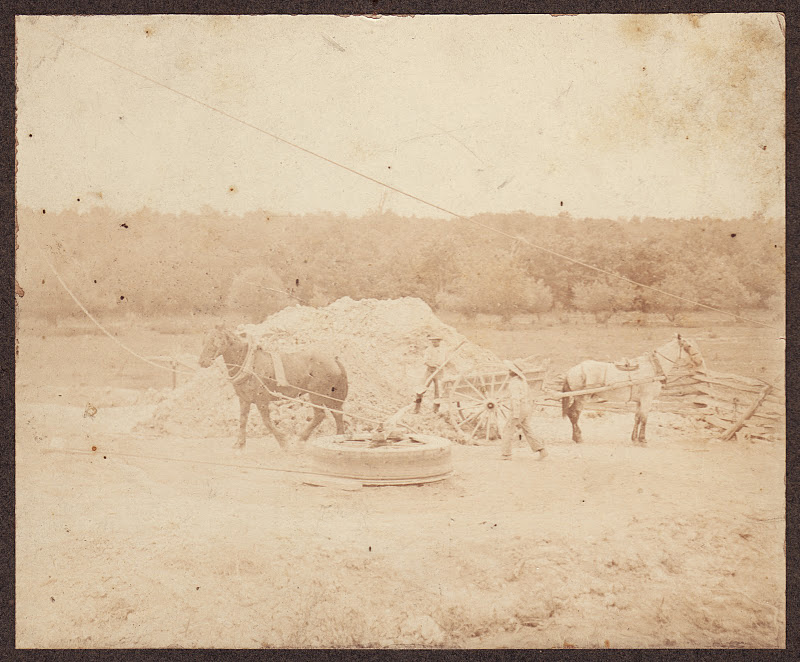
Clay processing
All right, so this is neither a cow, nor anything related to dairy. These horses are at the clay processing station on one of the farms owned by the family. The pile behind the horses is raw clay. The dark colored horse turned the mill and the clay was ground into a finer consistency. Once it was milled, the light colored horse carried it in the cart down to a fine china manufacturing plant for further processing. It was then made into dishes. There are two men in the image who were responsible for keeping the processing running smoothly.
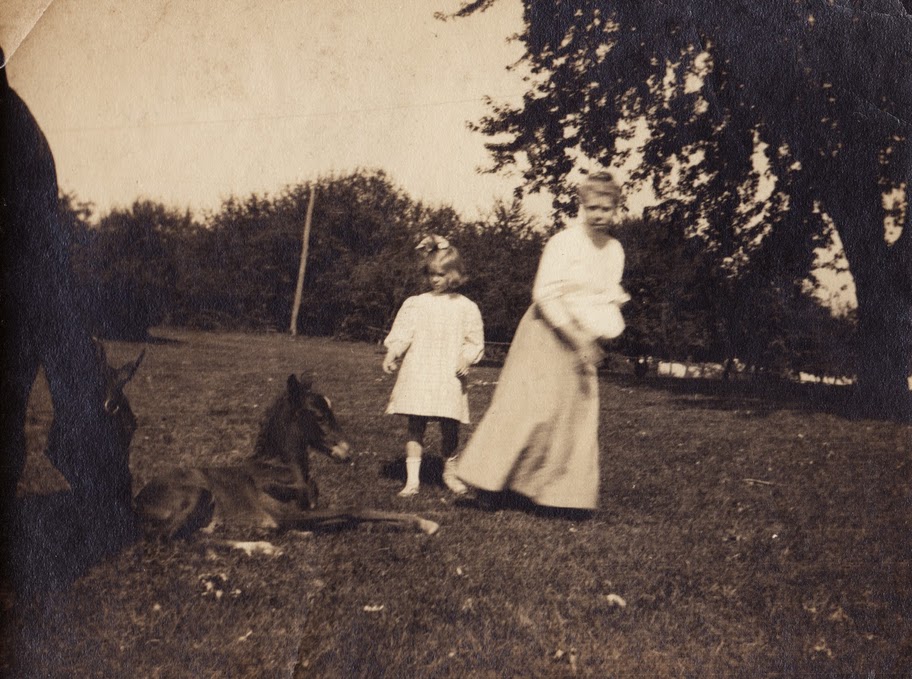
A cousin, a nursemaid and a foal
All of these images were scanned and shared by Cousin L. She noted on this particular image that the little girl was on of Granny’s nieces, so my grandmother’s cousin. Cousin L is really my dad’s cousin. In a large family it can be rather confusing!
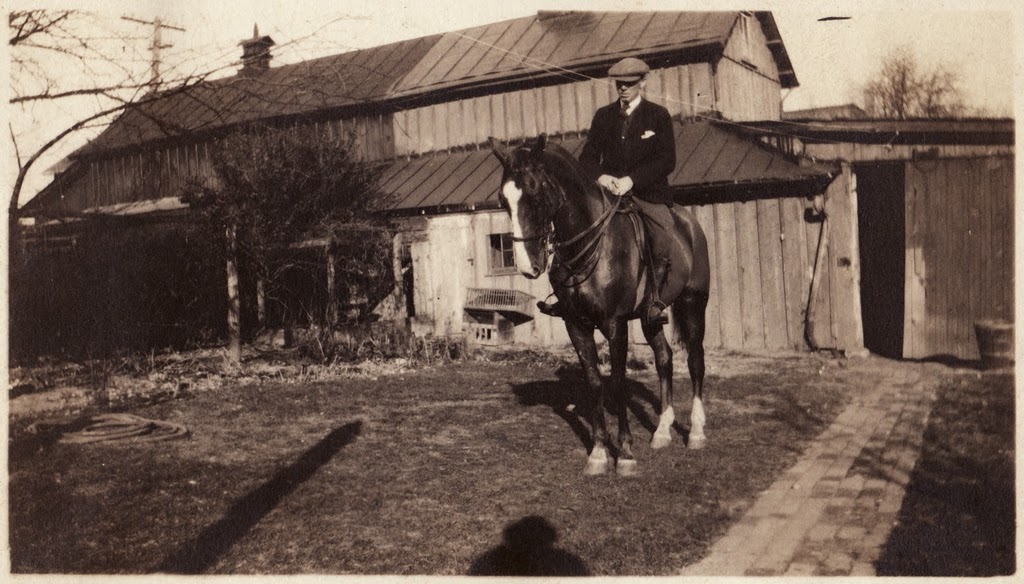
Poppy & Diamond
This is Poppy on his favorite horse, Diamond. That’s the barn behind him, and the little window is on the tack room. The entire family rode horses I believe. At least at some point.
Jeannette & Ted
This is Poppy’s sister Jeannette and her horse, Ted.
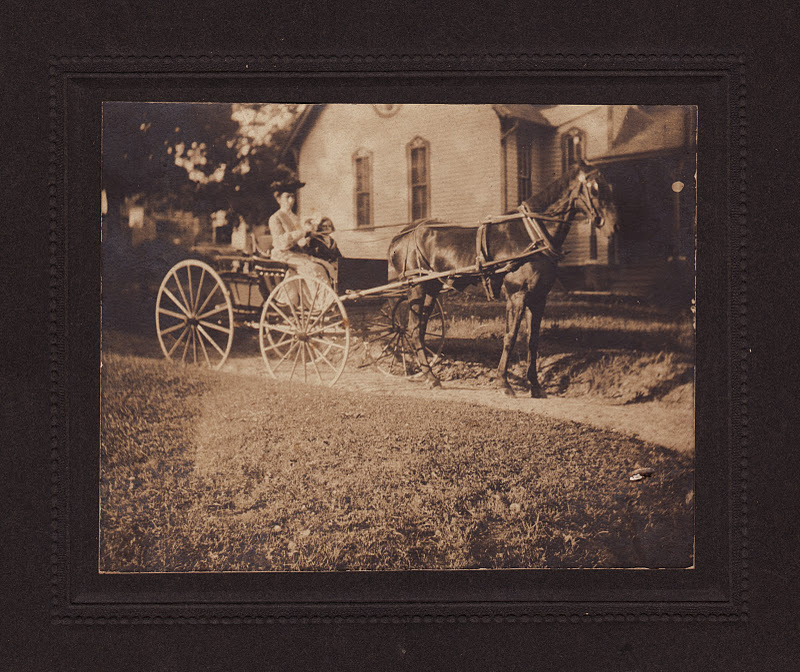
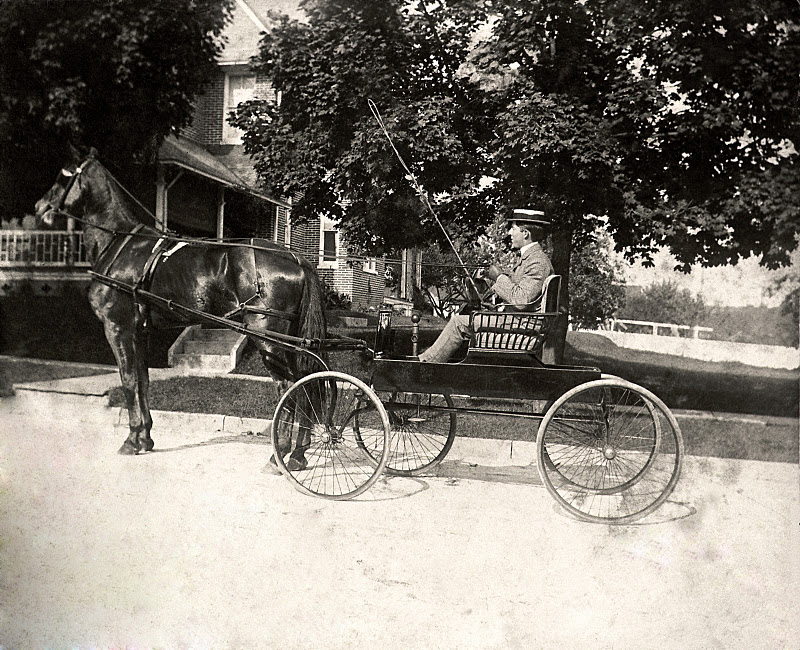
Poppy and his cart
Not to be outdone, here is Poppy and his horse cart. The cart was custom built for his wedding, I believe.
Well, there was nary a cow to be seen, but plenty of horses for your consideration. Many thanks to Cousin L for scanning and sharing the photos! For other images of horses or otherwise, click over to Sepia Saturday. You will be happy you did!





 Who Were They?