Who Were They?

Lost and forgotten photos from the past

Liberty Bell 6

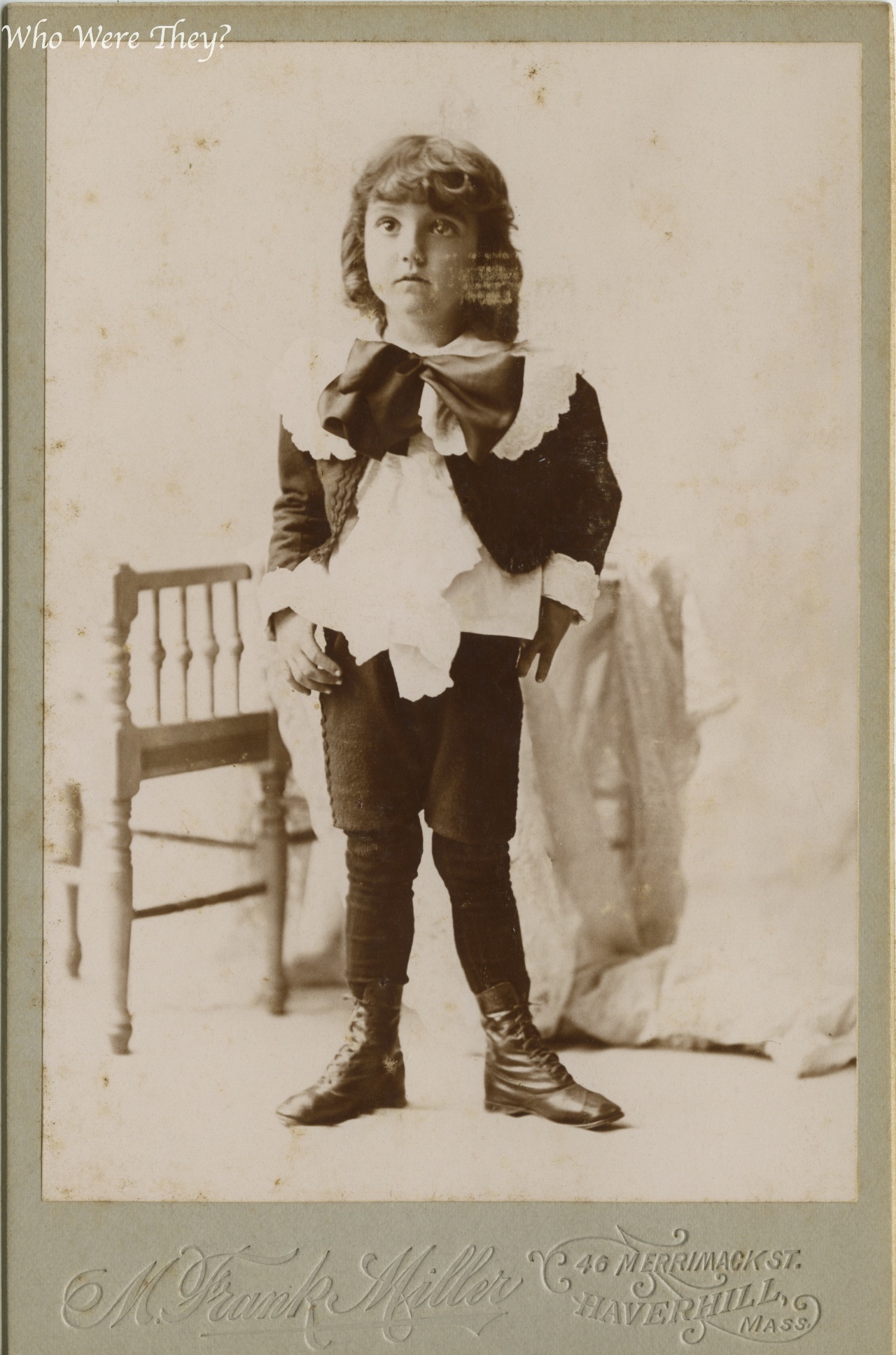
Little Lord

This cute boy was photographed by M. Frank Miller at 48 Merrimack Street, Haverhill, MA. Haverhill is only about 17 miles from Exeter, NH. 48 Merrimack Street is located one block off the Merrimack River, near the Basiliere Bridge. Today the location is an Indian cuisine restaurant. The boy’s outfit reflects the popular “Little Lord Fauntleroy” look that was popular in the 1890s. The big bow, lacy collar and long curly hair was seen as quite fashionable, and led to any number of schoolyard beatings, I’m sure.

M. Frank Miller was noted to have provided photographic services to the Haverhill Police Department in 1896, at the cost of $7.50.

Liberty Bell 5

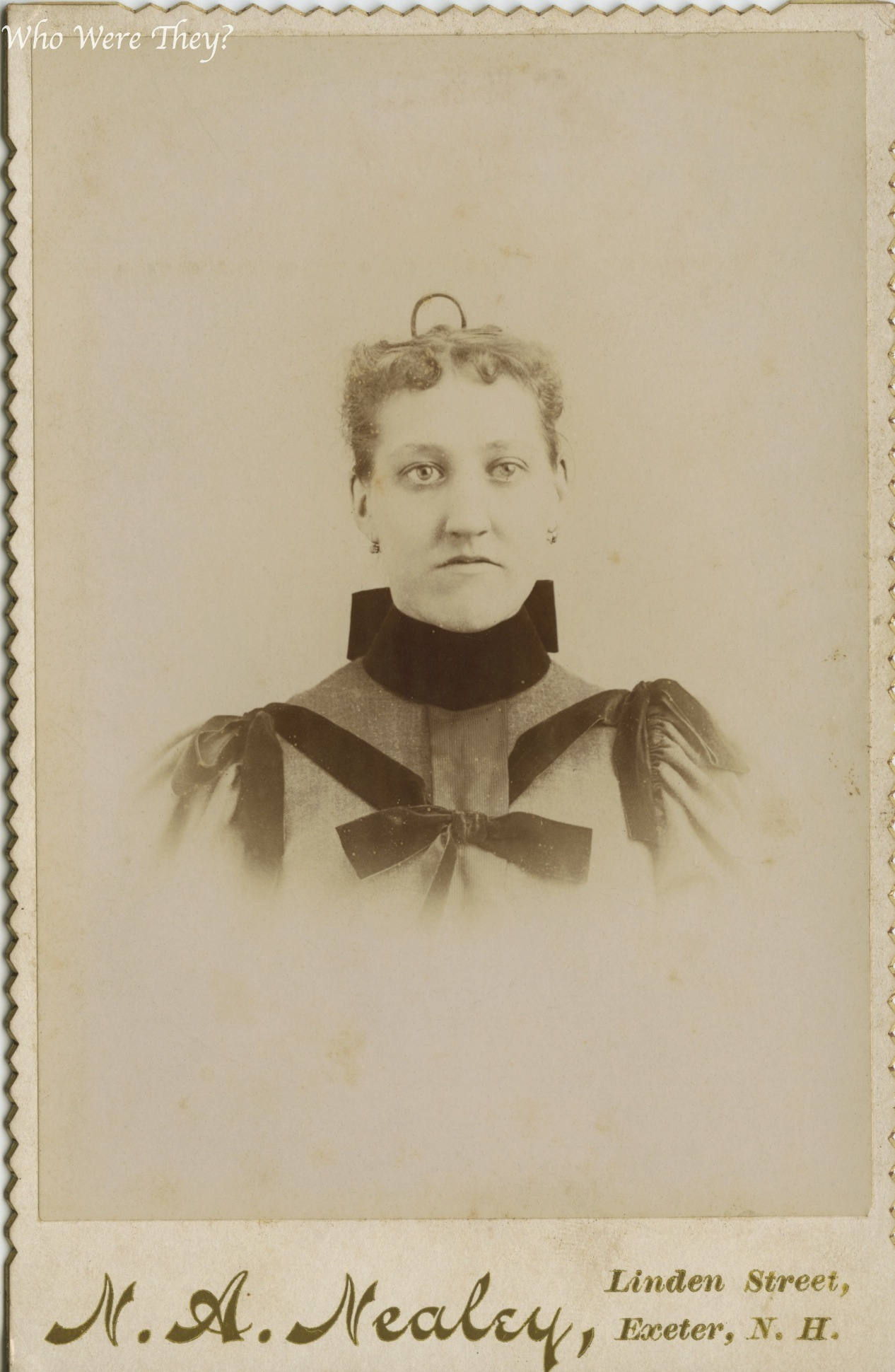
Velvet necked dress

This next portrait from the Liberty Bell album shows us a dress with a bow motif. You can see the first bow rather easily on the bodice. Next are bows on the shoulder tops. Finally the velvet collar of the blouse has a big bow on the back. This is finally a dress that I don’t think I could comfortably wear!

The photographer was N. A. Nealey on Linden Street, Exeter, NH.

Liberty Bell 4

Pleasantly plump in New Hampshire

Next up from the Liberty Bell album is this photograph from the 1890s showing a round-faced woman with quite a lot of lace and ruffles adorning her dress. Her hair is slicked down to her head with small curls around the hairline. These were called frisse I believe. From what I can see of the dress, the styling is from the mid 1890s, with lots of layers, tucks, bows, ribbons, and probably more that cannot be seen. The photographer was N. A. Nealey of Linden Street, Exeter, NH.

Liberty Bell 2

Fading likeness in Exeter, NH

Our next image from the Liberty Bell album shows a mustachioed man with trimmed lapels and a vest, whose photograph is unfortunately faded around the head. While he is disappearing into the background of his photograph, he likely was not a wallflower in real life. His eyes bespeak a man of intensity.

His chosen photographer was Folsom & Carlisle at 94 Water Street, Exeter, New Hampshire. The studio is known to have operated in the 1890s. However, further searching for the principals is compounded by the famous immigrant to the town, Nathaniel Folsom and his extensive progeny. There is also the Folsom Tavern, which was in operation in approximately 1775 and hosted President George Washington in 1783 and 1789. There are also numerous Carlisles, but I cannot find one reference to a photographer with either surname.

Liberty Bell 3 Liberty Bell 1

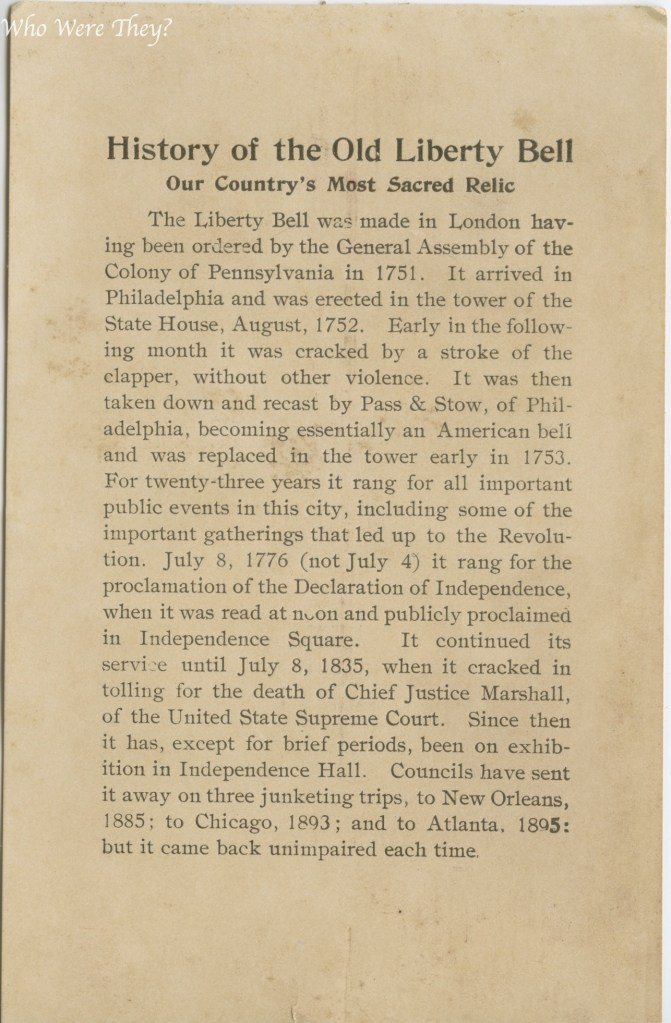
Inside the Liberty Bell album, I found the 4×6 page of historical information behind one of the photos. The album must have been made after 1895 as it references that year in the information. Having just visited the Liberty Bell in December 2013, this is particularly intriguing information to me. The park ranger leading our tour of the Pennsylvania State House aka Independence Hall told us the bell cracked on the tolling for George Washington’s birthday, not the death of Chief Justice Marshall as noted above. According to the National Parks Service webpage for the Liberty Bell, the 2000 pound bell had a crack immediately after its casting. The crack was repaired according to techniques at the time, and was even recast in 1753. At a ringing of the bell to celebrate George Washington’s birthday in 1846 the bell cracked irreparably and has not been rung since. A replacement bell was cast and hangs still in the bell tower of Independence Hall. The new bell weighs 13,000 pounds, one thousand for each of the original 13 colonies. Up until the 1980s, visitors could touch the original bell, however that is no longer possible due to the minor vibrations that could further damage the relic. Anecdotes indicate the bell always sounded “off” and didn’t have a very pretty sound to it. The “new” bell continues to ring every day.

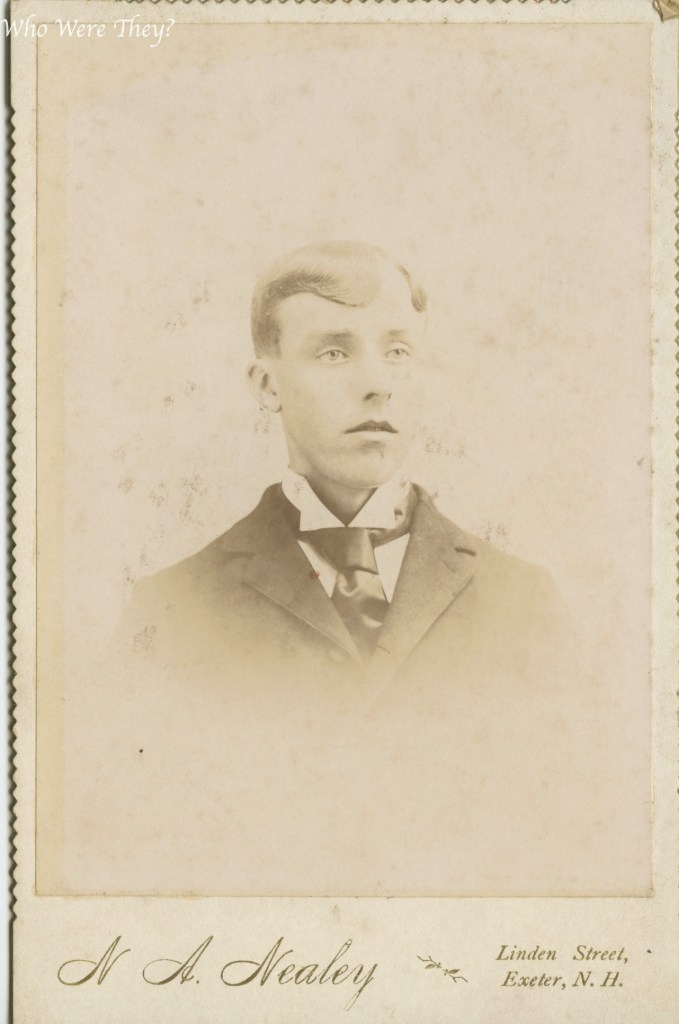
In front of this slip of incorrect but well intended information is the photograph above. An unidentified young man, photographed in his late teens or early twenties. The photographer was N. A. Nealey of Linden Street, Exeter, New Hampshire. He was known to be in business in the 1880s and 90s. The sawtooth edges of the card tell us it was made in the 1890s.