Who Were They?

Lost and forgotten photos from the past

Gems 2

Lady with ringlets and the plaid girl

Page two of the Red Gem Album gives us a new image and a repeat. I have seen this phenomenon before and I don’t know if it was just a way to fill up empty openings, or if there was some other meaning to it.

Are you my mother?

Are you my mother?

This lady is wearing ringlets in her hair, which I know was in fashion in the 1850s. I am uncertain if this is a throwback to how she felt prettiest, or if this image is a bit later than 1860s vintage, as the ringlets came back in some regards in the 1870s. I’m leaning toward “she liked this style” from the ’50s. Her dress, although difficult to see because it photographed dark, has a white collar and trim in a triangular shape, pointing downward toward her waist. She also has a brooch at her neck and something else, maybe a necklace, below that. The photographer tinted her cheeks. Again, remembering how small these images are, the brushes must have been tiny. The tinting is really only apparent when the image has been scanned and enlarged. The actual image doesn’t appear to the naked eye to be tinted.

Reading more about photography and its origins, I am reminded again that daguerrotypes mimicked the artistic style of traditional portraits and portrait miniatures. Miniatures were quite popular in the 18th and 19th century, with access to photography probably bringing about their decline. They were painted on a variety of surfaces, such as stretched vellum and ivory, usually in gouache (a type of paint) or enamel. The benefit of a portrait miniature was that an individual could send their image to another, as a memento, memorial item, or even as a way to let others know what you looked like. Distant family might never meet, but through having a likeness of a cousin or other relative, the family could fix an idea in their mind. Portrait miniatures were often made into jewelry, snuff box lids, and other sentimental items. As we learned previously about gems, they were also made into jewelry and sentimental items. Seems like “everything old is new again” isn’t such a modern concept!

There is a wealth of information available on the web, but I highly recommend the Victoria & Albert Museum. If we are talking Victorian era, you may as well start with the originator of the trend, right?

Additional Reading on Portrait Miniatures

Victoria and Albert Museum 

Artists and Ancestors, an Internet Art Collection

The Metropolitan Museum of Art

Wikipedia Article on Miniatures

Gems 1

A girl and boy, were they related?

Today let’s start our dive into Victorian Gems. This is the first page as you open the little Red Gem Album. It’s a nice way to start an album, with two pretty children.

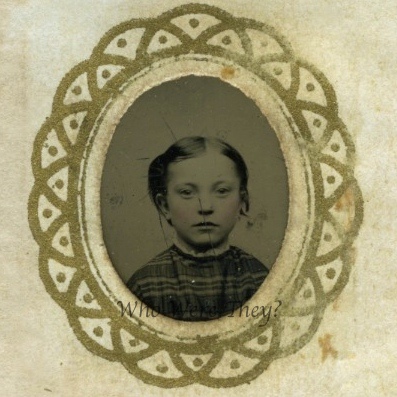
Plaid Dress Girl

Plaid Dress Girl

It is unfortunate that the scratch goes right across her face but otherwise this image is lovely and well preserved. She has her hair parted in the center as was customary for girls in the mid 19th century. I can’t tell if the hair is short, but it appears there is a tendril poking out from behind her ear on the right. Her dress is plaid which was not uncommon for children. Plaid hid dirt and stains better than solids. The fabric was possibly a wool/cotton blend. The dress also has a fine lace at her collar, befitting a little girl. Based on the dropped shoulder seams of her dress, I’d place this image in the 1860s. It appears also that the photographer tinted the cheeks of this subject to highlight her youth. She looks to be around 8-10 years old.

Gems 1 Boy

Handsome boy

Her page mate has the side part in his hair expected of boys of the era, and also has an unfortunate scratch across his face. His serious expression probably hides the exuberance locked within while he sat calmly for his portrait. His sack coat is also very common of the period. A sack coat is a catch all name for any coat that was loosely fitted and buttoned at the collar. It could have coordinated with trousers and was likely wool. He has a shirt of some kind underneath and you can just see the edge of its collar behind the folded lapels of his coat. He looks to have been 10-12 years of age. I do wonder if he and the girl were siblings.

No photographers information is included in this entire album, so I am going to forgo stating that in every post.

You might think we are talking about jewels here, or something really awesome, as some use the word gem to describe something really wonderful – or ironically when something is really not wonderful – but in fact, we are talking about photographs. The tintype (also, tin type, used interchangeably) was invented in 1856 by Adolphe-Alexandre Martin in France, and shortly thereafter patented in America by Hamilton Smith (1858) and in UK by William Kloen. The process involved a dark background that was exposed and the light captured the details of people, places, animals and more. For a full description of the photographic process, please check the links at the end of this article. I am not a photographer, and do not want to botch up the history trying to summarize it.

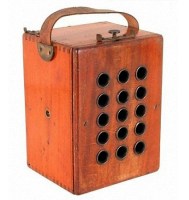
Repeating lens via http://www.kehblog.com

Tintypes were an inexpensive alternative to the formal daguerrotype which had introduced the masses to photography for the consumer. Daguerrotypes were unfortunately not cheap, and the earliest daguerreotypes required up to 10 minutes exposure. While the wealthy could afford this luxury without too much trouble, common folk might have to save an entire day’s wages to afford one. From 1838 when the daguerrotype was introduced, to 1856 when the tintype was introduced, daguerrotypes were made by artists in bright, sunlit studios, and were considered treasures. The image was exposed directly onto a glass plate, with a dark background behind that. They came in special cases to protect the glass from breaking or otherwise becoming scratched or damaged. Surviving daguerrotypes are often faded and difficult to see, but still lovely in their composition and artistic arrangements.

Then along came the tintype. It was made on japanned iron – japanned in this sense meaning “lacquered iron” in imitation of Japanese furniture lacquer. Being as sheets of iron were used, these types of pictures were originally called ferrotypes. The lacquer was an important part of the processing and it secured the image onto the iron. The plates were in various sizes and usually were in a paper sleeve, later placed into a photo album or frame. There is some suggestion that a tool called a tin snips was used to cut the iron plate into the smaller sizes, and that is how the name tintype came about. It is also fun to consider that tintypes of any shape or size were actually a mirror image! So, if your Great-Granny Flagg’s portrait is looking wistfully off to the right, in actuality she was looking to the left in the studio. This also led to the popular myth that Billy The Kid was left handed. The mirror image tintype would have shown his gun in his right hand, but reversed by the photographic process. There were also no negatives of tintypes, as the image was printed directly onto the plate. Popular sized plates were

Gems at 1/2″ x 1″

1/6 plate at 2 3/4″ x 3 1/4″

CDV at 2 1/2″ x 4″

Bon-ton up to 4″ x 5 3/4″

Consumers frequently cut the plates themselves to fit into frames, which can help to explain why there is only a general measurement of any plate size! Also, since photographers were cutting them at carnivals and fairs, they were frequently cut crooked and out of shape. Tintypes were a sturdy and durable method to not only capture the image – they were not breakable glass plates after all – but they could fairly easily be carried in a soldier’s haversack, mailed home to families, and otherwise transported with less delicacy than its predecessor. They arrived on scene just in time for the American Civil War, and were incredibly popular with the military due to their durability. The tintype was used side by side with the carte de visite printed on paper throughout the remainder of the 19th century, with a falling off of popularity in the 1890s. Gems were very popular because they could be produced a dozen at a time by use of a repeating camera often attributed to Simon Wing (who held the patent in USA). The lens could create twelve to sixteen identical images on a plate, to be cut apart by the photographer – and some versions of the camera could produce upwards of 700 images at a session by use of the repeating lens and a slide to move the plate! The repeating camera could also produce larger images, but the gems appear to have been very popular, giving rise to Gem Galleries – specialized photography studios for gem tintypes. Gems were often mounted in the center of a paper frame, worked into lockets and pins, buttons (think political figures and military generals), and mounted into special gem photo albums – sometimes referred to as fairy albums.

I became aware of the gem photo album a few years ago when I first saw one in an antique shop. The tiny album featured a red leather cover and was about 1 1/2″ x 3″. It was expensive! These little albums often survive fairly well because of their small size. They could easily be stashed in a box of mementos, jewelry, office stuff, whatever, and overlooked when the larger family albums were usually stored in the living room.

As it turns out, there is a wealth of gem tintype albums on ebay. Of course! You can buy just about anything on ebay. I found one for a reasonable price that looked virtually identical to the one I saw in that antique store. Of course, during my move I forgot to photograph the front of the album and as it is packed I can’t easily get it out to take a photo now. You will have to trust me on this one. It looks similar to this one:

Mary P. Getchell’s gem album via http://www.mcbridesite.info

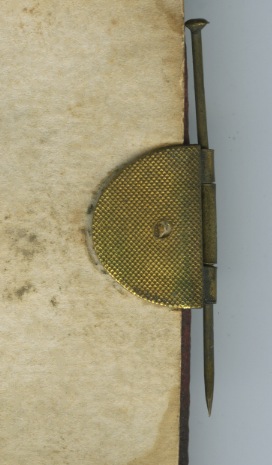
Interestingly, a previous owner managed to repair the clasp of the album with a sewing pin. I did take a picture of that.
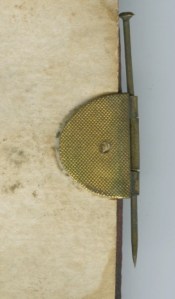
Gems 25

The clasp still works although some of the pages have separated from the spine and it is very delicate. It was with the greatest of care that I scanned each page!
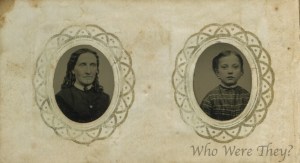
Gems 2

Two gems per page

Keep in mind, the page is only slightly higher than the height of a sewing pin – maybe 1 3/4″. Gems are tiny! Some of them feature tinting on the cheeks, which is a throwback to the daguerrian age of artistry in photography. The photographer must have used a magnifying glass and tiny paint brushes to tint the cheeks or any other part of the image before setting the images with lacquer. As you can see, this particular gem album features oval shaped openings for the image views. Some have a rounded rectangle, others a standard rectangle. There were surely many choices for consumers to choose from! Much like standard CDV sized albums, the openings for gems were decorated, often with gilding, and the pages of the album were gilded on the edges as well. Embossed leather was almost universally used for the album covers. People frequently wrote the names of the photo subjects under the image, but as is the case with so many full sized albums, this one does not have any names. I plan to feature one page of two images at at time and highlight some of the interesting details in the various photographs. Check back over the next few weeks for this intriguing and romantic little photo album!

Tintype Information and Additional Reading

Tintypes on Wikipedia

Phototree case study of a Gem

Collectors Weekly

Colorado Genealogy Web

Timeline of the History of Photography
Liberty Bell

Close your mouth, son

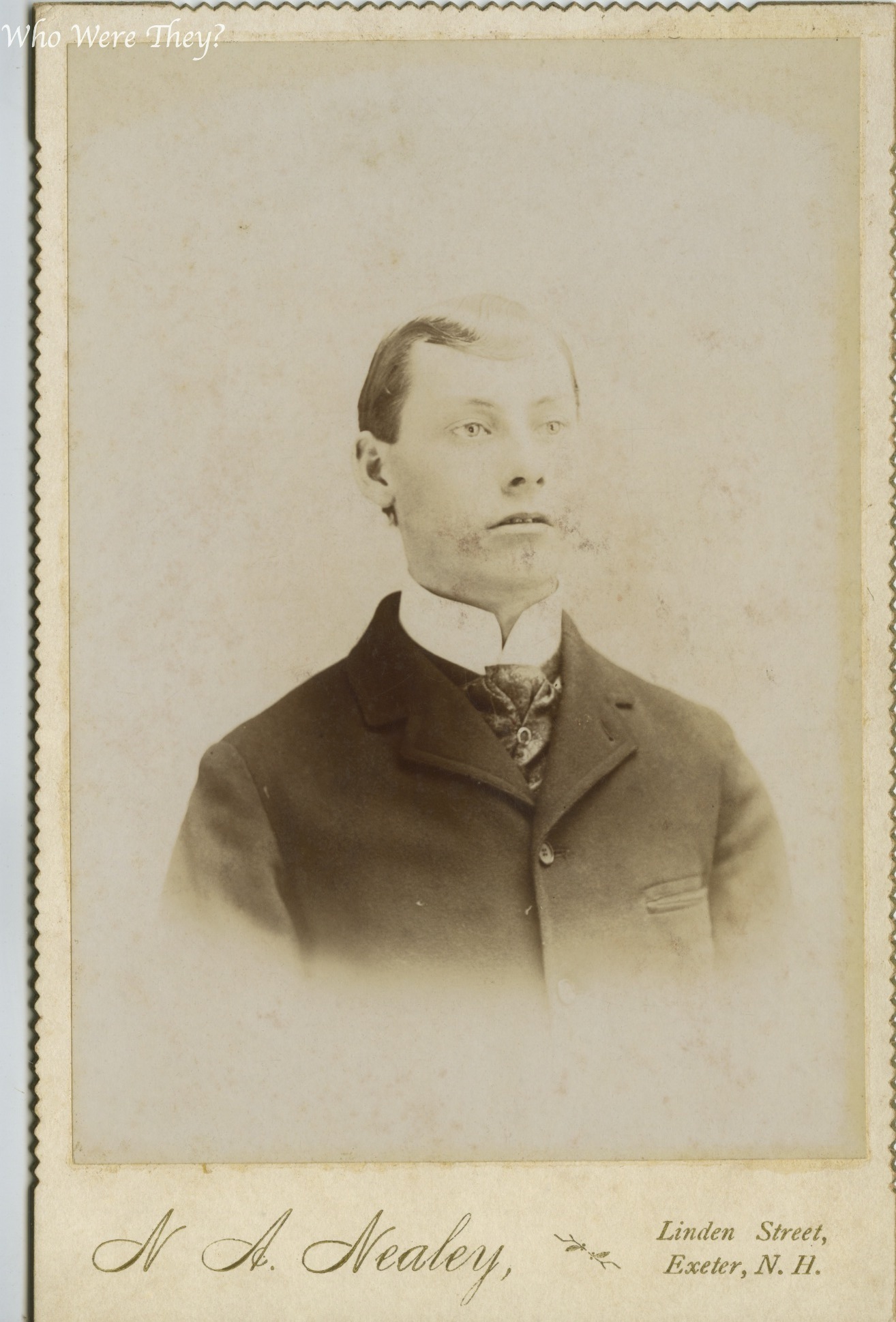
Well, here it is. The last photo from the Liberty Bell Album. It began in mystery and has ended that way. Site reader John Roberts did find some information on our one name, Bertha Ham, which through my own disorganization I don’t have linked to the face of the photo. One day I will be able to unpack it and match the name to the face, but until then, we only know the following:

1900 Census, Bertha M Ham, single, age 25 (born Nov 1874), living with her mother, Mary J Ham, age 64 (b Oct 1835) at 36 South Street, Exeter, New Hampshire. Mary and her deceased husband both were born in New Hampshire (as well as Mary’s parents), and Bertha was born in Massachusetts. While her occupation isn’t listed on the census sheet, Bertha is listed as an ‘Operative’ in city directories produced around that time.

Using that information, I was able to find a family tree listing her family.

Joseph Ham (b 1835, d 1875) married Mary J Currier (1835-1914) Nov 25, 1858. They had four children:

Joseph (1860-????)
Mary E (1861-????)
Frederick S (1865-1914)
Flora Bertha (our subject from above)

Frederick and his mother both died in March of 1914 within 3 weeks of each other, but I wasn’t able to determine why.

And there you have it. Perhaps someone searching on Bertha, Frederick, Mary E or Joseph Ham will find this page and make the connection to their family tree!

This last photo was made by N. A. Nealey of Linden Street, Exeter, NH. We previously saw images made by Nealey, click here and here for the women. You will notice that this, the last photo in the album bears a remarkable resemblance to this, the subject of the first photo in the album! Is that a funny coincidence or ironic placement by the original owner? We shall never really know.

Coming up in a few days I have a real treasure to share with you…a gem album! I found it online and it has been a real delight to examine. We will learn a little bit about gems and a lot about the faces.

Liberty Bell 28

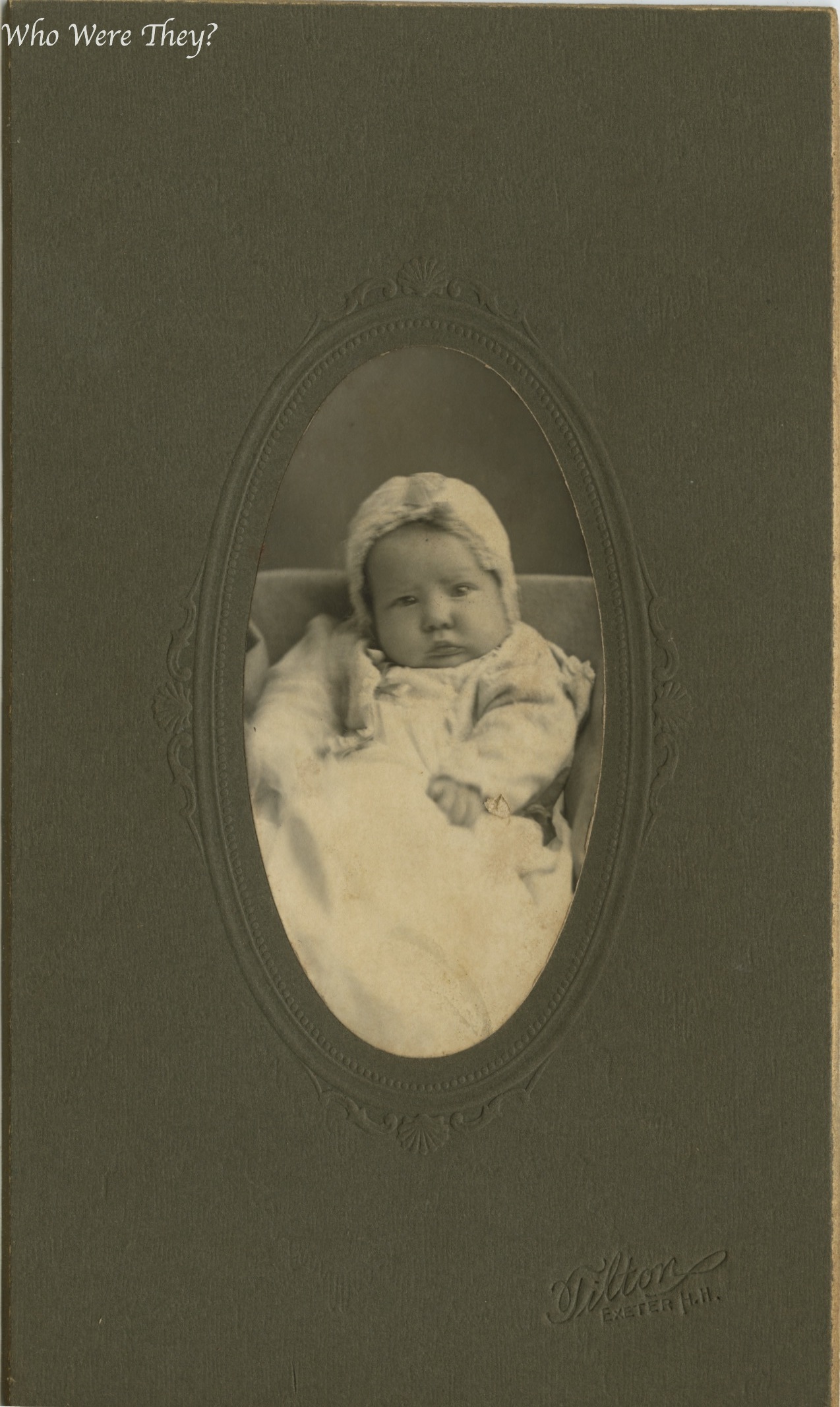
Sweet baby in a bonnet

Today we have a sweet little baby in a bonnet. While we retrospectively think these bonnets are cute and were for show, they served a very practical purpose of keeping the baby’s head warm. Even today, there are caps, knitted beanies and all sorts of cute adornments for an infant’s head. The infant mortality rate even in the early 20th century when this photo was made was still quite high, and the belief that cold weather could make a person sick was still fairly common. It makes perfect sense to turn the utility & safety of a baby bonnet into a wearable piece of art with fine stitching, tiny ribbon bows and various other vintage sewing techniques. Family heirlooms survive to reveal the care and expert needlework that went into making these fine garments.

Baby was photographed by Tilton of Exeter, NH. To see all the family’s photographs by Tilton, click on the category Tilton or W. P. Tilton Jr.