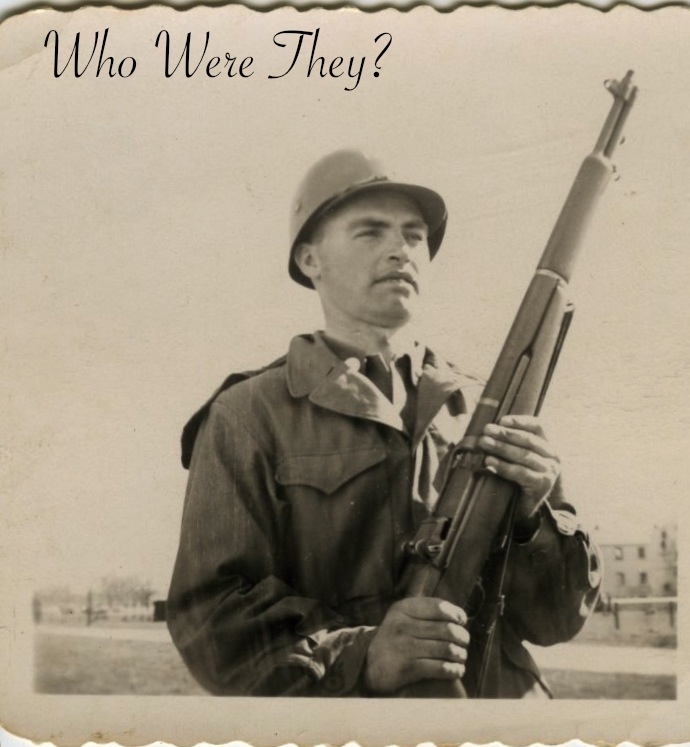
This tiny snapshot is smaller than 2″x2″ and features what I believe to be a Korean War era soldier showing off his rifle (and we all know the difference between a rifle and a gun, don’t we?). He looks a lot like a very old friend of mine who served in Korea as well. Iggy feel free to educate us on the weapon.
Today is America’s Independence Day (the real name of the holiday) and we usually celebrate by flying the flag, having a barbeque with friends, and watching a fireworks show in the evening. Today is a good day to try to put yourself into the minds of the dissidents and insurgents who wished to overthrow British rule and establish their own government here in the new world. One way I have found is to read the text of the famous poem written by Francis Scott Key while he was imprisoned on a British ship during the bombardment of Baltimore, outside Fort McHenry in 1814 just shy of 40 years after the Declaration of Independence was signed. Instead of reading line to line, read it punctuation to punctuation, aloud and with feeling. It will give you a new appreciation of our national anthem and for the deep sense of patriotism that ran deeply among many Americans. Patriotism isn’t a bad thing and we could learn a lesson or two from our forebears. Click on the title of the poem for lots of great information from the National Museum of American History. Happy Independence Day!
O say can you see, by the dawn’s early light,
What so proudly we hail’d at the twilight’s last gleaming,
Whose broad stripes and bright stars through the perilous fight
O’er the ramparts we watch’d were so gallantly streaming?
And the rocket’s red glare, the bombs bursting in air,
Gave proof through the night that our flag was still there,
O say does that star-spangled banner yet wave
O’er the land of the free and the home of the brave?
On the shore dimly seen through the mists of the deep
Where the foe’s haughty host in dread silence reposes,
What is that which the breeze, o’er the towering steep,
As it fitfully blows, half conceals, half discloses?
Now it catches the gleam of the morning’s first beam,
In full glory reflected now shines in the stream,
’Tis the star-spangled banner – O long may it wave
O’er the land of the free and the home of the brave!
And where is that band who so vauntingly swore,
That the havoc of war and the battle’s confusion
A home and a Country should leave us no more?
Their blood has wash’d out their foul footstep’s pollution.
No refuge could save the hireling and slave
From the terror of flight or the gloom of the grave,
And the star-spangled banner in triumph doth wave
O’er the land of the free and the home of the brave.
O thus be it ever when freemen shall stand
Between their lov’d home and the war’s desolation!
Blest with vict’ry and peace may the heav’n rescued land
Praise the power that hath made and preserv’d us a nation!
Then conquer we must, when our cause it is just,
And this be our motto – “In God is our trust,”
And the star-spangled banner in triumph shall wave
O’er the land of the free and the home of the brave.