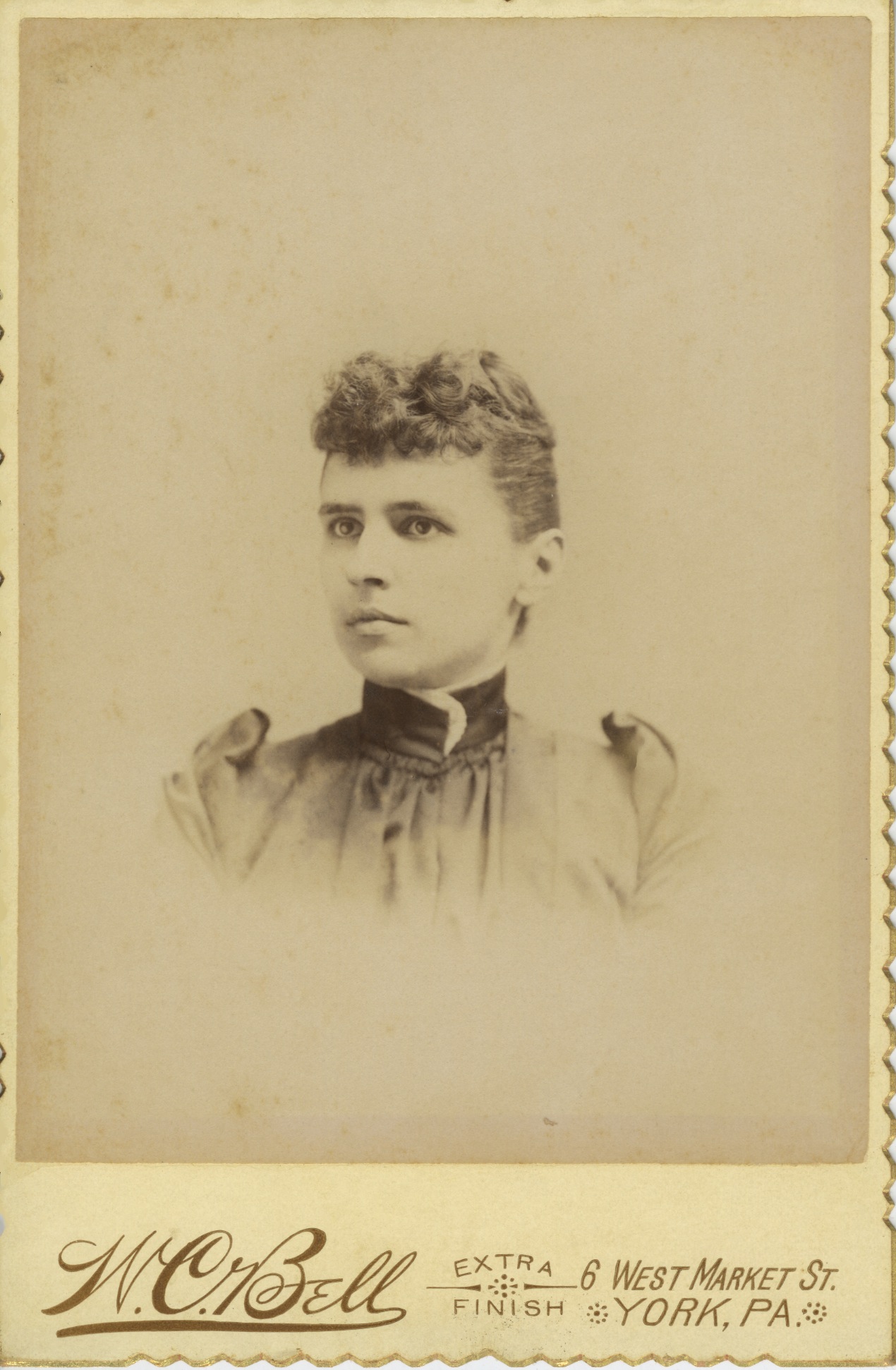
This photo from the Mearns Family Album is identified as Minnie Johns. I don’t recall seeing this name among the many relations that Iggy has found, but it’s entirely possible I am just not remembering well. The photo can be dated to the 1890s because of the scalloped edges of the card. You can also see the puffed sleeves of her dress and the high collar that were both popular in the 1890s. The photographer was W. C. Bell at 6 West Market Street, York, PA.
UPDATE: Iggy found that Minnie Johns, daughter of Rev. John Henry Johns of the Presbyterian Church of Zion, married Robert Grove on February 5, 1890. In August 1890, Robert passed away after an illness and Minnie was suffering from a bout of typhoid. Minnie’s father and husband are buried next to each other in the Zion cemetery that Iggy visited earlier this year, and the graves are not far from William L. Mearns. Rutledge Gifford was an usher at Minnie & Robert’s wedding. Happily, Minnie survived the typhoid fever and went on to remarry W. R. Stephens on February 5, 1893. What an odd coincidence that she selected the same date for her second wedding as her first! The same minister preceded over both wedding services as well. Check the comments for more detailed information and excerpts from newspapers. Thank you Iggy!!
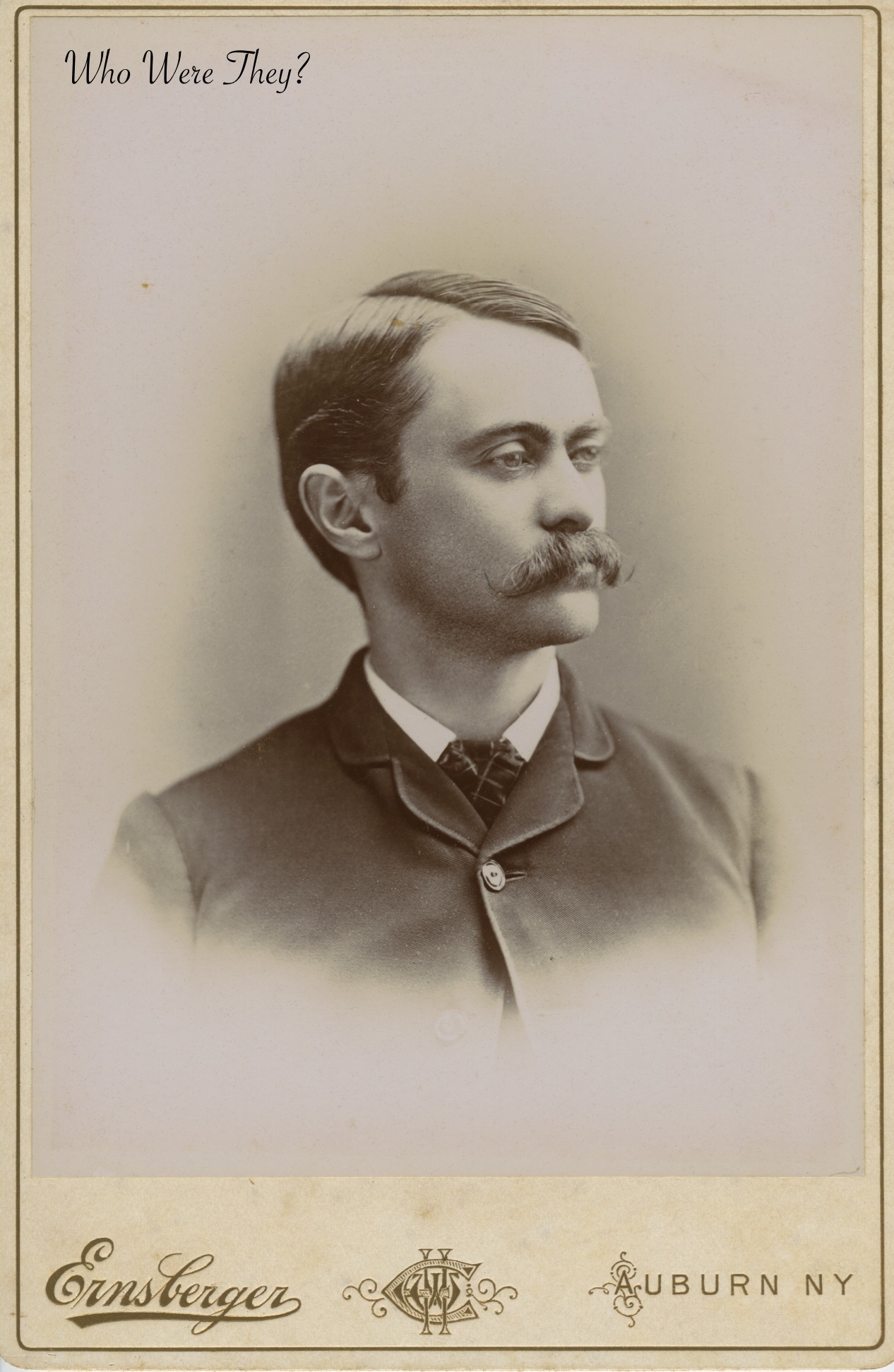
Today’s entry for the Mearns Family Album is a collodion print of a gentleman with a fancy mustache and the slightest fringe of beard under his mouth. It’s strange. He has classic facial features and a regular appearance, but that odd beard makes me think there was something wrong under his mouth that he is trying to hide. Perhaps a scar?
The photographer here was Ernsberger of Auburn, NY. He was known to have photographed a relative of Rutherford B. Hayes and also Harriet Tubman in 1908. However, being as this is a collodion print, that dates it after 1894. After the turn of the century cabinet cards evolved to resemble the more modern photographs mounted with a wide margin of matte surrounding the print, or with an embossed oval around the print. So I will date this after 1894 but before 1900 just to be tidy.
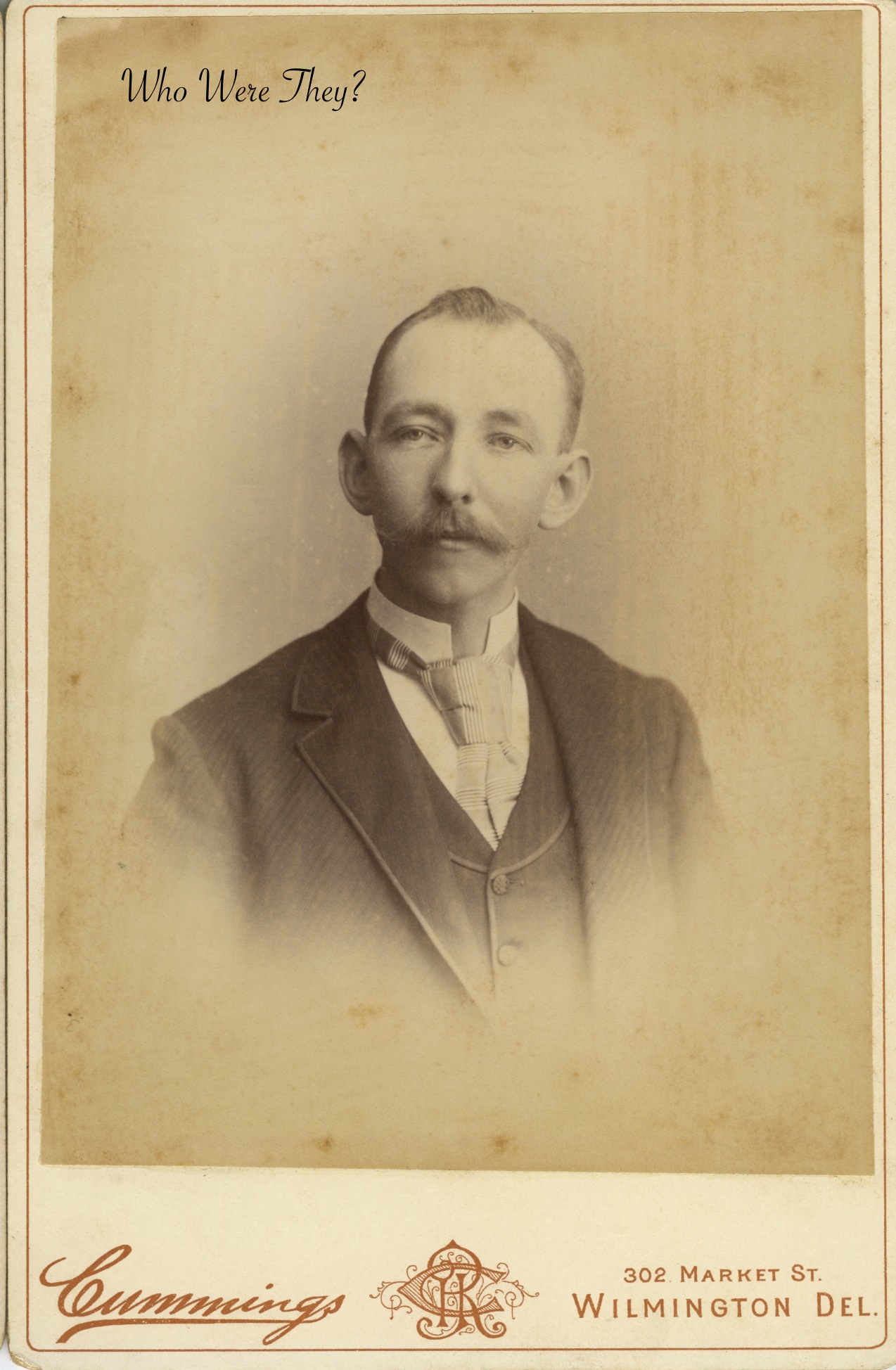
For our latest addition to the Mearns Family Album we have this fellow in what I think of as a stylish suit. Although I have commented that men’s fashions are nearly unchangeable through the second half of the 19th century, that is not actually true. Thankfully for you guys! At some point – again I beg pardon for my lack of men’s fashion knowledge – it became fashionable to trim the edges of the lapels with…something. I am uncertain what but the closest approximation I can come up with is twill tape or twill bias. The same fabric would be used to cover buttons if the buttons were fabric covered. This man’s suit is an example of that style. The knot of his tie is quite large, more like a cravat even, and his collar stands up straight. He sports a fine mustache that one would be proud of, perhaps he hoped it would draw attention way from his ears, which stand out like a pair of taxi doors. His expression seems to be a bit smug, as though he was feeling quite proud of his natty appearance.
The photographer was J. R. Cummings at 302 Market Street, Wilmington, DE, who was known to be in business in 1889, which is the year I will select for this photograph.
I’ve been away from Sepia Saturday for quite some time, but after looking at the prompt for this weekend, I felt I could jump back into the fray quite easily! The prompt is a photo of a couple just about to kiss, it seems, leading me to love and romance. Well, you know the Victorians would have never been caught dead kissing so their portraits were, um, rather stiff. Here are a variety of wedding photos through the years.
Early 1860s
This first photo is a CdV with no borders and no props for the subjects. The corners are also square and the paper is a bit flimsy. This all points to the photo being made in the early 1860s. A general rule is the absence of borders puts in in the 1860-1862 range. Her dress is a gathered front bodice, which was a popular style at the end of the 1850s and lasted through the early 1860s. One thing I find interesting is that her under sleeves appear to be dark, suggesting that she is in mourning. I suppose it is possible the couple were married while she was still in morning for a father or brother, but it doesn’t seem to fit with the mourning customs of the time. The photographer was Ewing & M’Laughlin in Cumberland, MD.
UPDATED 4/2014: Since I originally wrote this, I have discovered that colors photographed differently on wet plate images than our modern black & white. This dress could be anywhere from blue to yellow and still show up dark!
1864-1869
Our second couple was photographed in the mid-1860s. Her dress style is from a bit later than the previous subject and the V shape trimming of her bodice is consistent with the mid-decade. Also, the presence of the lines on the border put the photo in that range. The corners of the card were cut to make putting the photo into an album easier. After 1870 the corners became rounded. The gentleman is sitting on a nice padded chair, which became more popular in that time frame. Don’t they look delighted? The photographer was Hill & Benson in Troy, NY.
Natural Form
Here is a gorgeous example of the “natural form” costume which was popular from 1877-1885. The woman’s dress is straight and there is not a bustle behind her. I’d guess this is from the beginning of the period as the elaborate decorations were symmetrical, while toward the end the asymmetrical trimmings became more popular. The natural form gown was designed to show a woman’s “true form” although modified with corsetry, of course. It was the anti-bustle dress. The photographer was Stone’s Great Northern Photograph and Copying House in Potsdam, NY. The CdV is edged with gold.
Allie & Wm Busse 1885
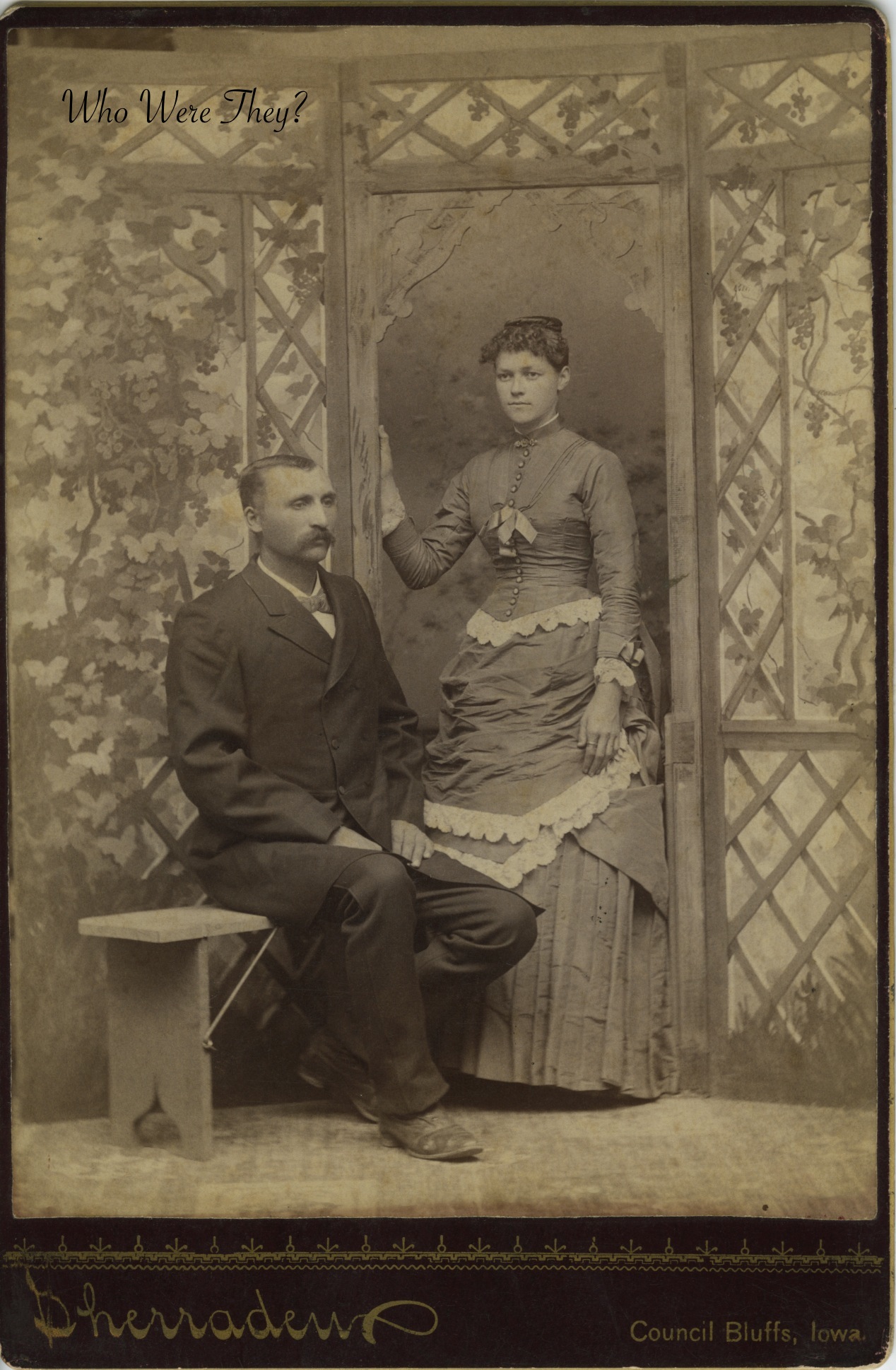
Next we have a cabinet card on a lovely maroon card with gold imprinting. On the back was written “wedding picture of Mother and Dad about 1885, March 4th. Allie Florence Jenkins & Wm Henry Busse.” This dress is consistent with the bustle dresses which returned in 1885. Also she has a ribbon or bow tied at her bosom, which was one method of dressing up for a wedding portrait. Remember, women wore their best dresses for their wedding, not the modern white dress. Most women of the middle class either had a dress they could wear and decorate with additional frills and bows, or they had a good dress made which later became a church or social dress. The photographer who made the Busse’s portrait was Sherraden in Council Bluffs, IA.
About 1887
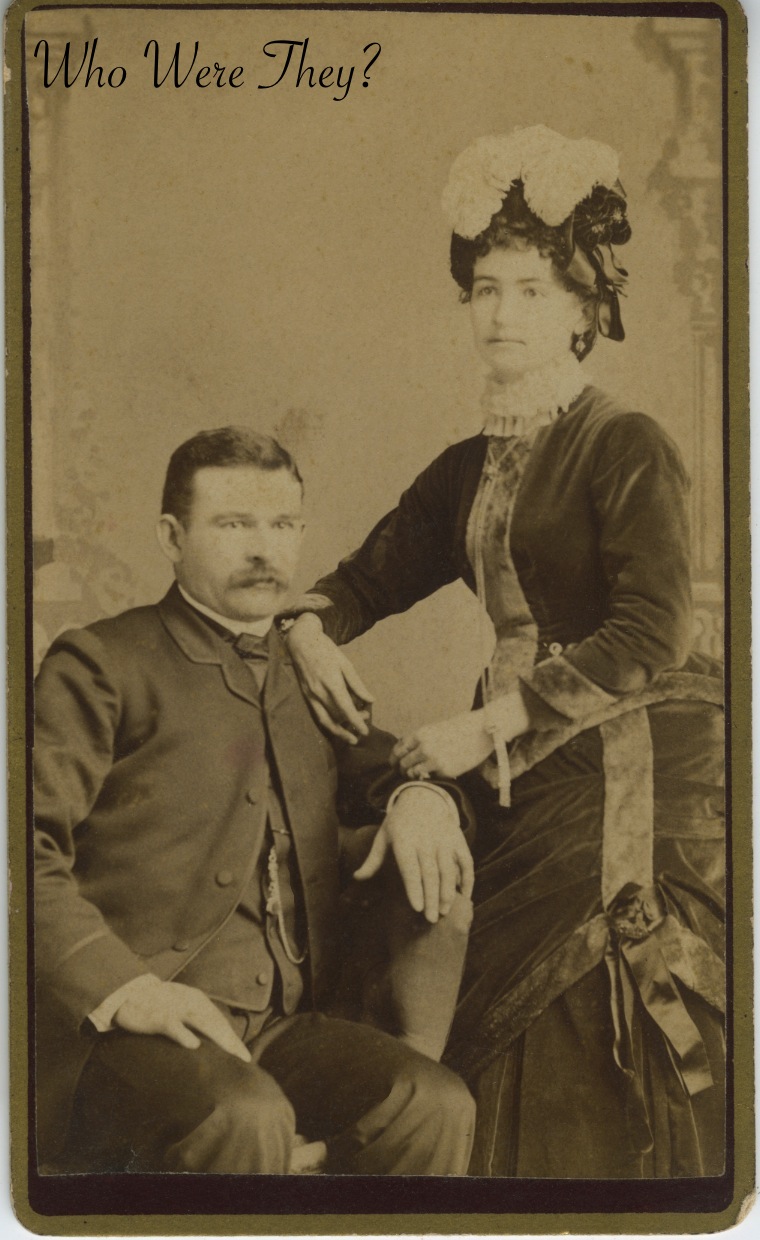
Our final image of wedded bliss has the added bonus of the lady’s headgear. You can see that her dress is velvet (probably silk velvet as that was the standard of the day) with much trimming, consistent with a bit later in the second bustle period. You can see the edge of her bodice pointing out of frame which suggests to me that she has quite a bustle behind her! Her hair is coiffed under a fancy and feathered hat, and on her left hand you can just see quite a large ring. Our gentleman has his coat buttoned at the top. I read somewhere – but have now lost track of exactly where – that it is possible to date men’s clothing by the way they buttoned their coat. Buttoned at the top means one era, buttoned all the way means another. While men are almost universally unshakable in terms of fashion during the 19th century, their coat buttoning preferences say something. The CdV is mounted on a maroon card and the photographer was Sawtelle.
I hope you will click through to Sepia Saturday and make the jump to love and romance around the world!
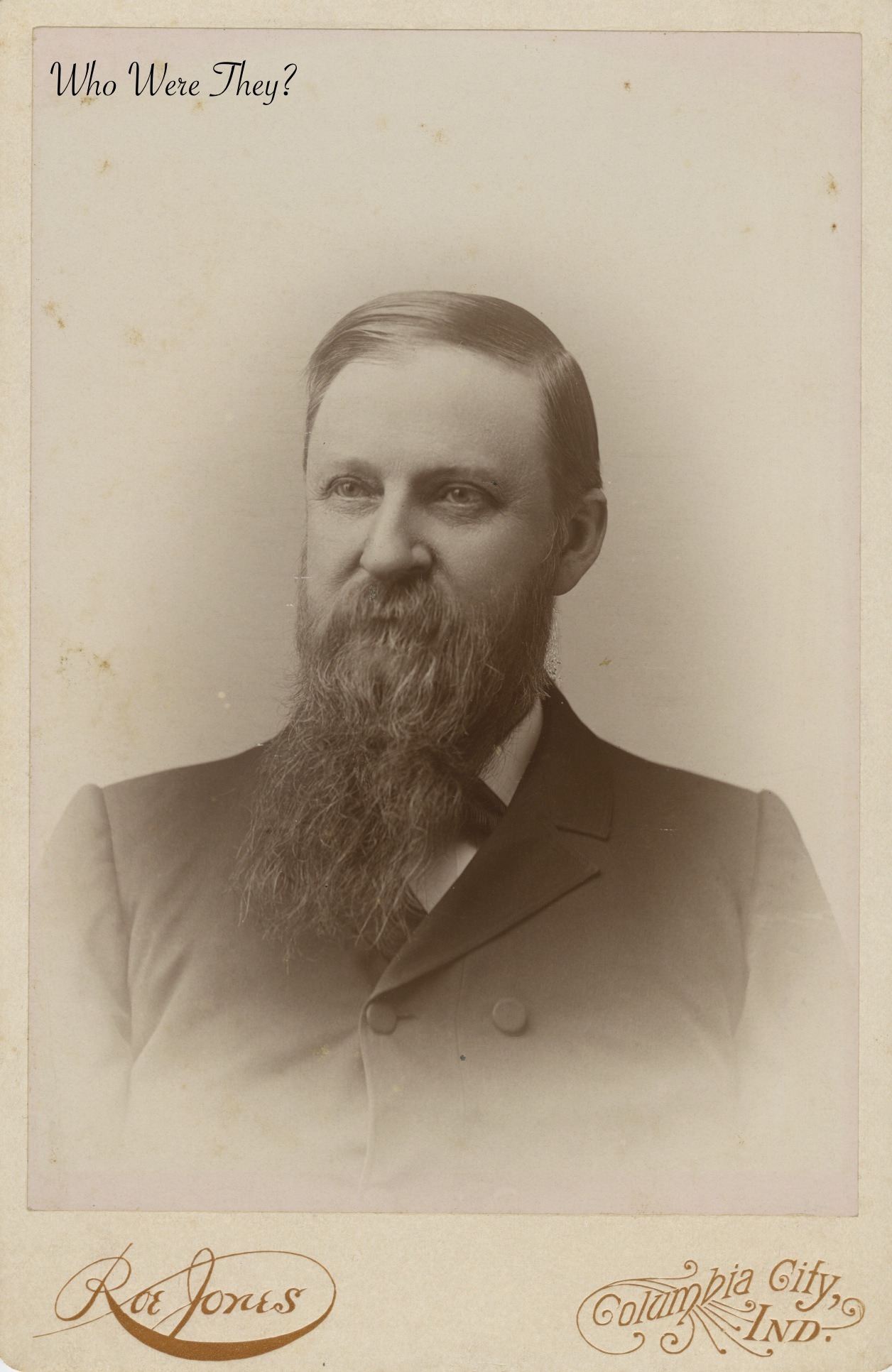
This photograph from the Mearns Family Album is unidentified, but comes from the area of our previous photo. As Iggy pointed out, Columbia City and Fort Wayne are close by to each other. My guess is this is a relation to the lady yesterday, probably her husband? He has an unfortunate combover but quite an impressive beard! His suit coat is double breasted although it looks like it’s pulling on that top button. My mother tells a story of when she and my dad were newly married. He wore a double breasted coat to some function. A short while later they were going out and she had to convert the coat to single breasted because married life and my mom’s good cooking was treating him well!
The photographer was called Roe Jones, although that was not his name. Levi Monroe Jones was born in 1854 and became a photographer for his trade. He lived until 1945. The back of this cabinet card is fairly decorated, putting it toward the latter part of the era, so I will date this 1890 with a margin of error of 5 years either direction. Men’s fashions just stymie me!