Who Were They?

Lost and forgotten photos from the past

This week’s Sepia Saturday prompt is of the gigantic kitchen in Windsor Castle, England. I immediately thought of this photo of my father-in-law, Ray. He was a professional baker. His family had owned a bakery, where he learned the trade, then he and my mother-in-law opened a little bakery of their own. Some time after that, they moved here to California and they opened the Cake Shop in Whittier. The Cake Shop was a very successful bakery until one night it burned to the ground! Although it could not be proved, arson was suspected of one of the neighbors. While they did rebuild, that loss of the bakery stole Ray’s health. He passed away shortly after at a much too young 54. My mother-in-law is still in love with him to this day! This picture was taken right around the time they were married. Had he lived, they would celebrate their 56th wedding anniversary this year. I’m sad that I never got the chance to know him, but I am deeply grateful to know and love his son.

For more kitchens and the stories that tend be told in them, click over to Sepia Saturday!

Cooking up something good

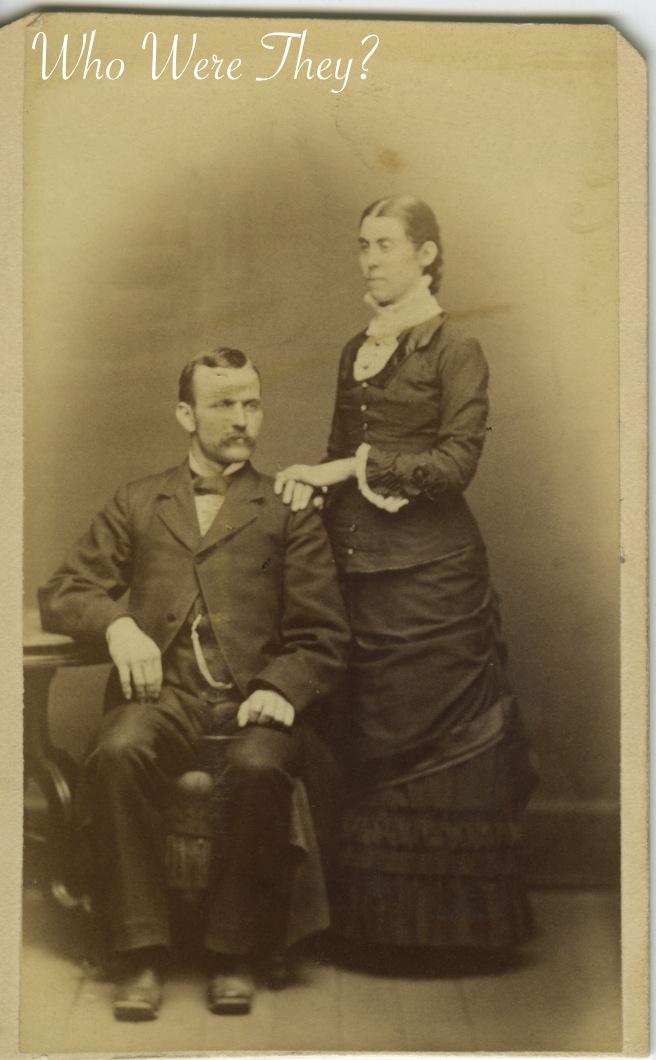
 

This CdV is of an attractive couple posed in such a way that we see 3/4 of each of their faces. The dress leads me to believe this is from the 1870s. It reminds me very much of the early Natural Form era. There is no bustle to be seen, no flounces behind her, yet plenty of pleated trim and lacy cuffs. The skirt is relatively straight and the bodice appears to dip below the waist, which was on trend with the Natural Form look – to elongate the body.

The photographer was Hotchkiss in Kankakee, IL. I thought I had another Hotchkiss photo posted but apparently I don’t. I’ve decided to handle the photographer category a little differently. Since I was developing a very long list of names with only one image attributed to them I felt it was taking away from the layout of the site. So, in future I will only post a photographer name if I have two or more images by that person. As always, the search bar at the top of the page can be used to search for names, places, pretty much anything on the site so if you don’t see a photographer name on the right hand side bar, do a quick search and that will tell you once and for all if that person is represented here.


The photographic tax stamp was applied between the years of 1864-1866 as a means to recover costs incurred during the American Civil War. The first income tax in America was also a means of paying for the war, however this photographic tax was specific to the luxury of photographs, ambrotypes, daguerrotypes and any other form of photography.  The amount of the tax was based on the cost of the photograph.

Photographs up to 25 cents = 2 cent tax

Photographs 26 to 50 cents = 3 cent tax

Photographs 51 cents to $1 = 5 cent tax

Photographs greater than $1 required additional 5 cent taxes for every dollar or fraction of a dollar

When you consider that the photograph might have cost 20 cents, a 2 cent tax was a whopping 10%, just for a photograph! And so, the luxury tax was born. The photographer was expected to collect the tax, cancel the stamp by some means such as writing his initials across it, and then submit the taxes to the Federal Government in Washington DC.


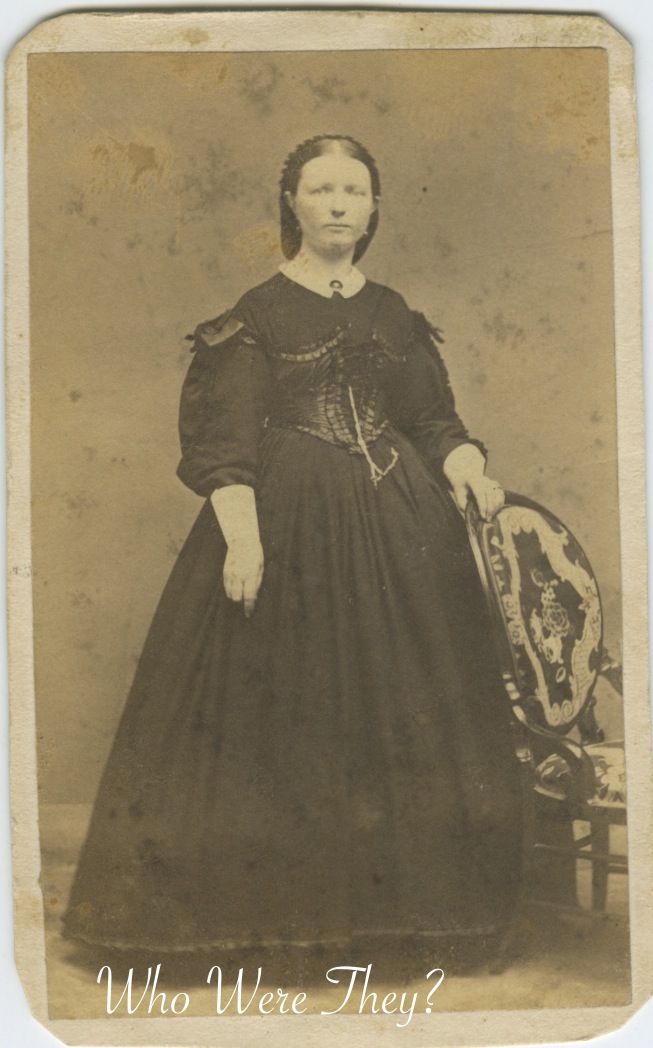
This CdV from the 1860s is identified as Catherine Shull. I picked this one up because I found her dress bodice to be really unusual. It almost looks as though she is wearing a black corset on the outside of her dress. Since I know that would never happen, my next guess is that she has on what is called a corselet/corslet, Swiss body or Swiss waist. For young women, a popular fashion was this large belt-corset hybrid.

The corselet was boned in the center front and and back, laced in front, and they were worn on the outside of a garment, quite often over a Garibaldi style blouse. They first were shown in fashion magazines as early as 1860 (Peterson’s), but were called girdles or belts. Later magazines called them a corselet or corslet depending on the editor’s preference, and others referred to the blouse fabric as being Swiss and another referred to it as “a body in the Swiss style”. To further confuse matters, a “waist” was what we now know as a blouse. This is a difficult item to research, and I have discovered that many people in the historical reenactment and costume reproduction community prefer to call this a Swiss waist for some reason. 19th century corselet’s were made of all manner of fabrics, with velvet, silk satin, silk taffeta and silk brocade being popular choices. Some had little sleeve caps that went on the upper arm while others simply cinched the waist. I imagine that this garment was a particularly titilating item, as it caused the waist to appear small and the bust to appear large.

Miss Shull posed for the Collins gallery at Number 8 South Salina Street, Syracuse NY. The gallery was located over Everson’s Hardware store. There are a number of Catherine Shulls living in New York with a birth year in the 1840s. I am guessing she is between 15-20 years of age in this photo. Unfortunately, there are so many Catherine Shulls, it is unlikely we can truly identify which one this one is.

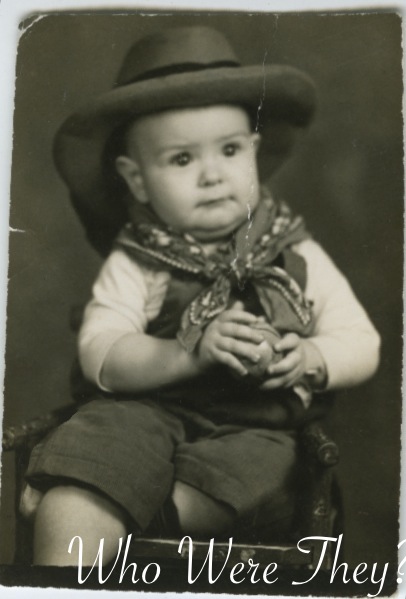
This is another tiny photograph I could not resist. It’s about 1 1/2″ wide by 2″ high and pictures an infant boy dressed in cowboy duds. The back of the photo is dated January 11, 1945, but I could see this as a modern photo in soft focus, one of those mall kiosk things. It is amazing how everything old is new again.