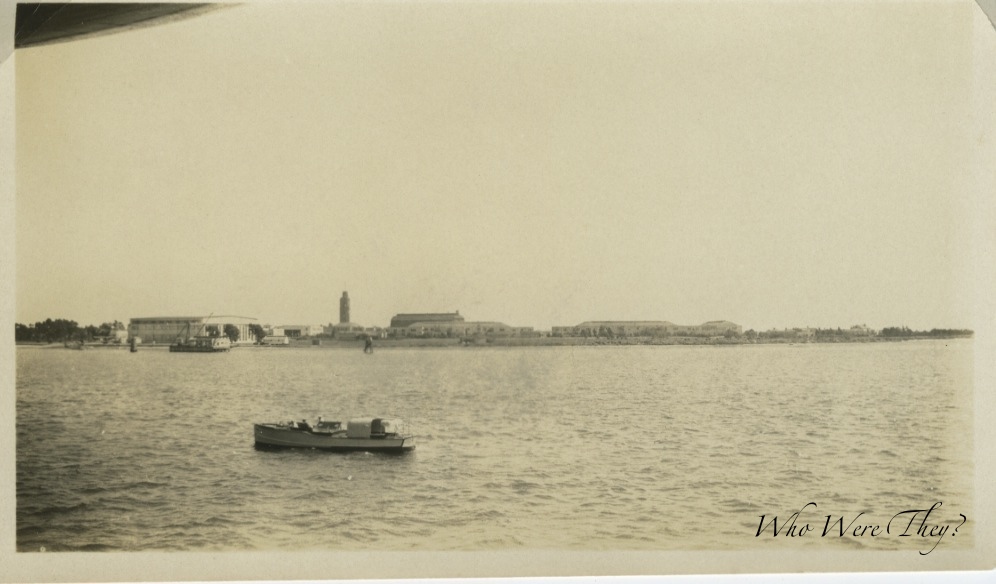
For a Sepia Saturday post, I found this nice shot of North Island Naval Air Base, in San Diego, CA. While I do not have a date for the photo, it looks like something from the 1940s or 50s. North Island Naval Air Base was founded in 1917 and is recognized as the birthplace of American Naval aviation. But before we discuss the Naval aviation history, let’s look back at the island itself.
In 1886 the island was one of two – North Coronado and South Coronado. The two together were formed from a sand spit and were purchased for development to become a residential resort for the wealthy. South Coronado was developed but the North Island remained wild. It was used for horseback riding and hunting by guests at J. D. Spreckles’ hotel, which later was christened the Hotel Del Coronado. A fellow named Glenn Curtiss took out a lease on North Island and operated a flying school until 1914. Then, a newcomer to the aviation industry named George Martin started flying from the island and showing off his aircraft. Martin of course later became the owner of Martin Aircraft, one of the world’s best aircraft companies for many decades.
Among the many “firsts” at North Island was the first parachute jump in the San Diego area, first sea-plane flight, first mid-air refueling and the first nonstop transcontinental flight in 1923. Prophetically, Curtiss also trained the first Japanese aviators, including a young pilot named Yamada who later became Admiral of the Japanese naval aviation forces in World War II. Charles Lindbergh’s first transatlantic flight in the Spirit of St Louis originated on North Island after the aircraft was built in San Diego.
Another brief touch of fame for the base resulted from the first commander Lieutenant Commander Earl W. Spencer Jr., USN after his ex-wife Wallice Warfield became the wife of King Edward of England in 1936 and the world was shocked when he abdicated his throne to be with her.
North Island and South Island were originally separated by a waterway but during World War II this was filled in, allowing better access to the entrance of the base.
North Island was the home of the Navy’s first four aircraft carriers: USS LANGLEY, USS LEXINGTON, USS SARATOGA and USS RANGER. Lexington fortuitously departed Pearl Harbor on December 5th, and Saratoga was in San Diego on December 7th. Along with the two other aircraft carriers the Navy had in the Pacific, they missed the terrible bombing attack on Pearl Harbor December 7th which drew the US into World War II.
The base is still in operation today and can be accessed by the amazing Coronado Bay Bridge.

Coronado Bay Bridge
For more amazing Sepia Saturday images, where the theme is ships, crowds, travel, sailing and more, click over and jump off from there!

Anchors aweigh!







 Who Were They?