Who Were They?

Lost and forgotten photos from the past

tn-vintage-pix-9

This fine image is a tintype I found in the great Tennessee vacation haul at the World’s Longest Yard Sale. There was another woman and I who seemed to be on the same route, each of us rushing to find the photos at each individual stall. I felt lucky to find this great piece, because look at all the character here!

We have a stringy beard and hard, hard gaze on our seated fellow; a bowler hat hiding at the side of the young gent to the left; a droopy mustache on the standing fellow to the right; and oh, so much angst in the face of the kneeling dude.

These characters make me wonder and imagine what they were up to…was it no good? Did they go on to rob a bank or help the poor? They sure look like a group of vintage bad boys to me! It is impossible to know, but these great old pictures make us consider just who they were, don’t they?

tn-vintage-pix-14

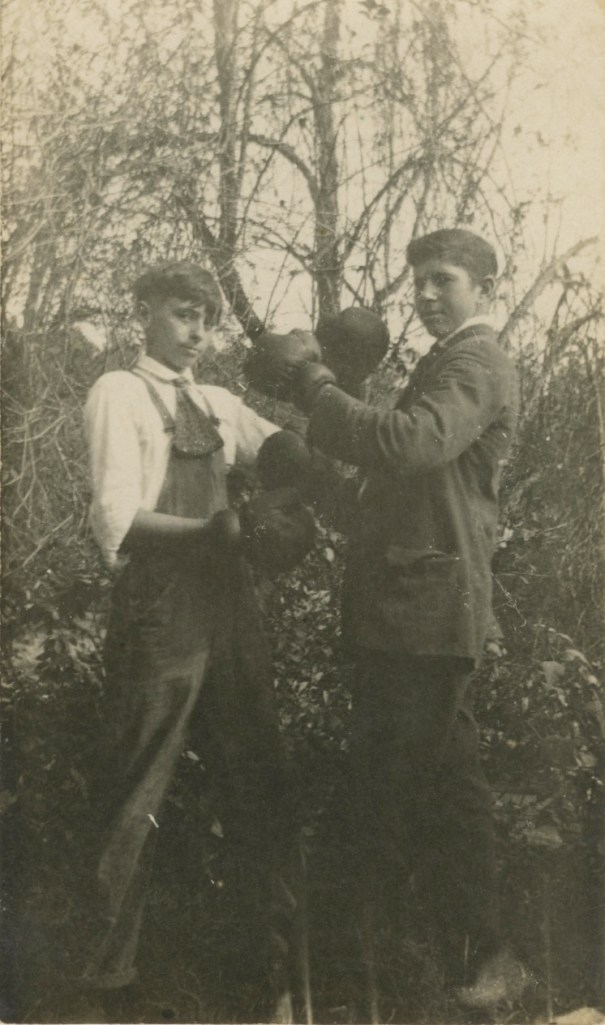
Two pugilists

Two boys show off their boxing stances in this vintage snapshot from the 1920s or 30s. One boy wears dungarees/overalls and an untied bowtie, while the other wears his coat and slacks. These seem to be unusual togs for a boxing match.

Boxing can be traced as a sport back to ancient times, with Greek, Roman, and even Minoan & Assyrian records showing it was a popular spectator sport. The Romans of course took it to an extreme with the boxing glove having metal studs embedded into it, fights going to the death, and all sorts of brutality. One bit of nomenclature we brought forward from Roman boxing, though, is the term “boxing ring.” Early matches were fought in a circle drawn on the ground. During the gladiator period, boxing was outlawed as being too vicious (that’s saying something!) and it wasn’t really resurrected until the 17th century.

Prior to the 1900s, boxing was part of an unsavory world of gambling and illegal fighting. Many of us have heard of Marquess of Queensbury Rules, which were established in 1867 London as a way to bring bare knuckle boxing under a little more control. It was still considered a brutal pastime and was relegated to gambling dens, eventually becoming a “scandalous” sport of violence, betting and rowdy behavior among men. Fights among the spectators were known to break out, and riots could occur. Boxing was illegal in certain parts of Britain and America. It resembled boxing as we know it today, but not in every sense. For one, not all matches were fought to a win/decision. If one fighter wasn’t knocked out, the fight could be decided by spectators, journalists, and others. It sounds like statistics for early 1900s boxing are nothing like what we imagine they should be! Boxing could also be called prizefighting at that time, because the participants were fighting for a monetary prize. We still refer to a boxing match today as a prize fight.

1900 – 1920 saw a refining of boxing with many fighters coming from the poorer cities and areas, including many Jewish and black fighters. It is interesting to consider that fighters who were considered heavyweight fighters during that era would probably fall into the lightweight and welterweight categories today. Our modern heavyweight class has heights of 6′ 4″ and weights well over 250 pounds.

But the boys pictured above were probably thinking more of fighters like Jack Johnson, Jack Dempsey, Rocky Marciano, Joe Louis and Jake Lamotta (the Raging Bull). These men helped define boxing as we know it today, although still on the small side weight-wise. Without these fighters, we would probably not have seen Muhammad Ali, Sugar Ray Robinson or Sugar Ray Leonard, all the way to George Foreman, Evander Holyfield and Mike Tyson. The big names of boxing today owe it all to those skinny, bare knuckle brawlers who helped resurrect boxing from the back alley and bring it into the living room. While boxing is still a prize driven sport, it is well known globally for its big purses, big fighters and big crowds – both in the arena and on pay per view.

I hope you will take some time to read further into the history of boxing. I myself enjoy a good boxing match, and encourage folks to learn about the “sweet science” that is more about technical and strategic moves than it is about blood and injury.

Additional Reading

Early 1900s boxing – via proboxing-fans.com

Boxing – via wikipedia

Why is boxing called the sweet science – via isport.com

Jake Lamotta, the Raging Bull – via biography.com

A list of famous boxers – via biography.com
tn-vintage-pix-15

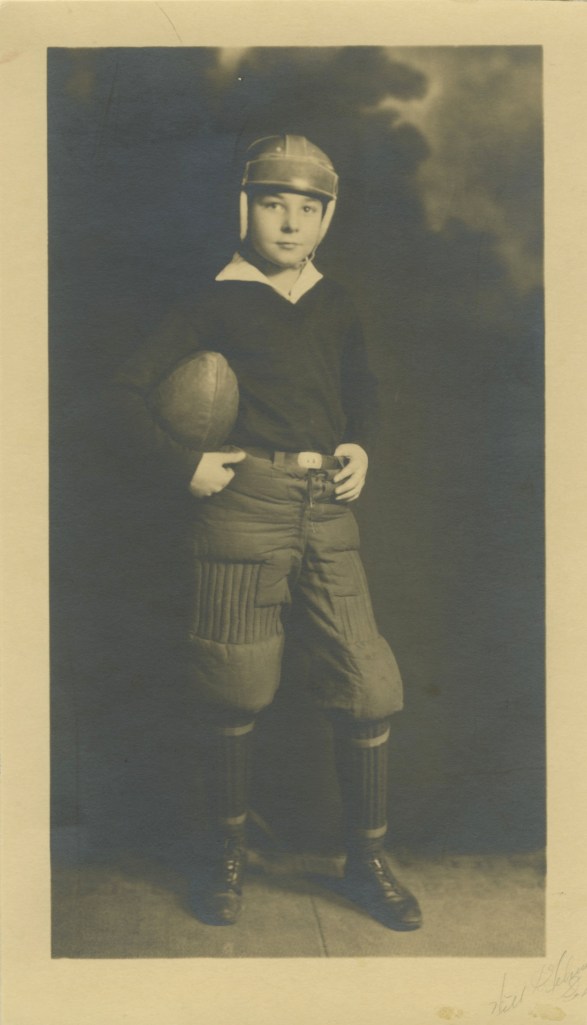
Now that the Cubs have won the World Series, it’s time for football! This is from an era when padding and helmets were not anything like what our players wear today, and CTE was not even on the radar as a possible complication for boys in their futures. This young fellow looks ready to hit the gridiron and score! Do you think he was the QB or a lineman? Based on the photo style, I’m suggesting the 1920s or 1930s. I can’t make out the photographer’s signature in the lower right corner.

tn-vintage-pix-19

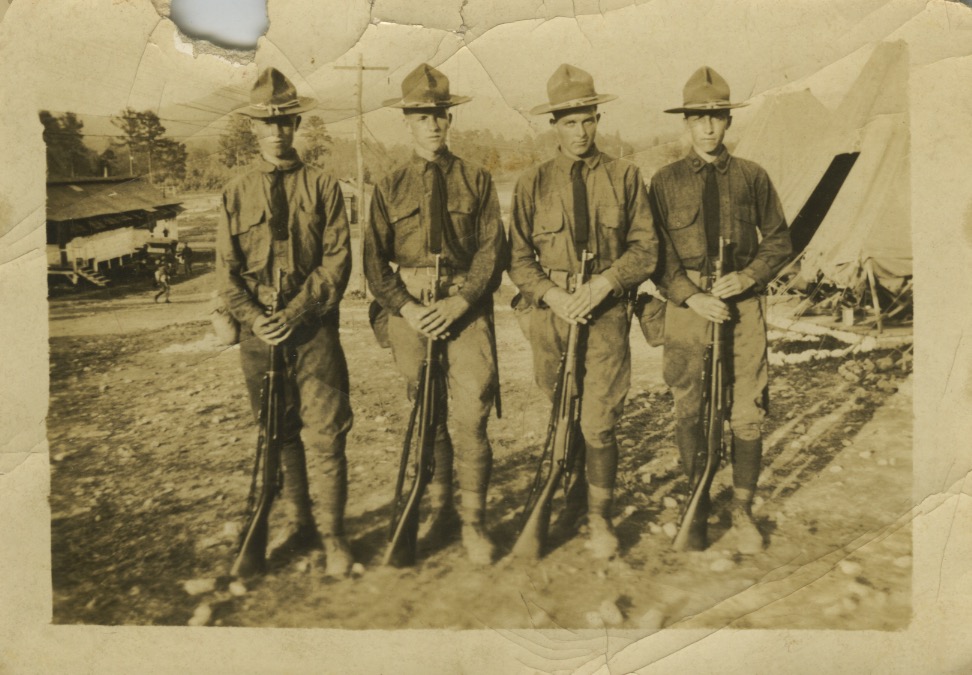
Four Great War soldiers

Today is Veterans Day, November 11. You may have heard that Veterans Day originated with the Great War, the war to end all wars, World War I. Originally called Armistice Day, it was a moment of silence observed at 11:00 a.m. on November 11th, because that was the time designated in the Armistice Agreement for an end to hostilities on the Western Front. The eleventh hour of the eleventh day of the eleventh month, 1918. In the days before internet communications, explicit and defined times and dates were important so that everyone got the message loud and clear. The armistice was a success and World War I came to an end with the signing of the Treaty of Versailles in June 1919, and ultimately the fall of Berlin.

The Great War sadly was not the war to end all wars.

One hopes that these four soldiers returned home from battle, healthy and able to pick up their lives, but we can never know. The photo carries no identification on the reverse. World War I also gave rise to the term “shell shock” which today we would call post traumatic stress disorder. 100 years ago, there was no treatment for this syndrome. Men were expected to deal with it and get on with their lives. I can only imagine how terrible it must have been.

Thank your local veteran today, for their sacrifices and service to your country. It is not an easy job to perform, and in America, can be woefully under paid, under supported and unsung. While we find it easy to wear yellow ribbons, the colors of our flag, or put up signs saying “we support our troops,” our Veterans Administration is underfunded and our Veterans hospitals are understaffed. Not only do our active duty military suffer daily, but their families make deep sacrifices – deployments separating parents, family deployments to foreign countries and frequent moves, children changing schools annually – and sometimes, they make the greatest sacrifice of all in the death of their military family member. Veterans are frequently affected with long term consequences of their deployment and the action they have seen, both physically through illness/injury, but mentally through PTSD and the deep scars left by the missions they conducted. It cannot be an easy life to live, and we must appreciate every man and woman who choose to live it.

Read more about Veterans Day and the history of this holiday

History of Veterans Day – via Office of Public Affairs, US Dept of Veterans Affairs

Why do we wear a poppy? – via The Telegraph UK

In Flanders Fields – poem written about WWI

The Remembrance Poppy – via Wikipedia

SD CDVs 4

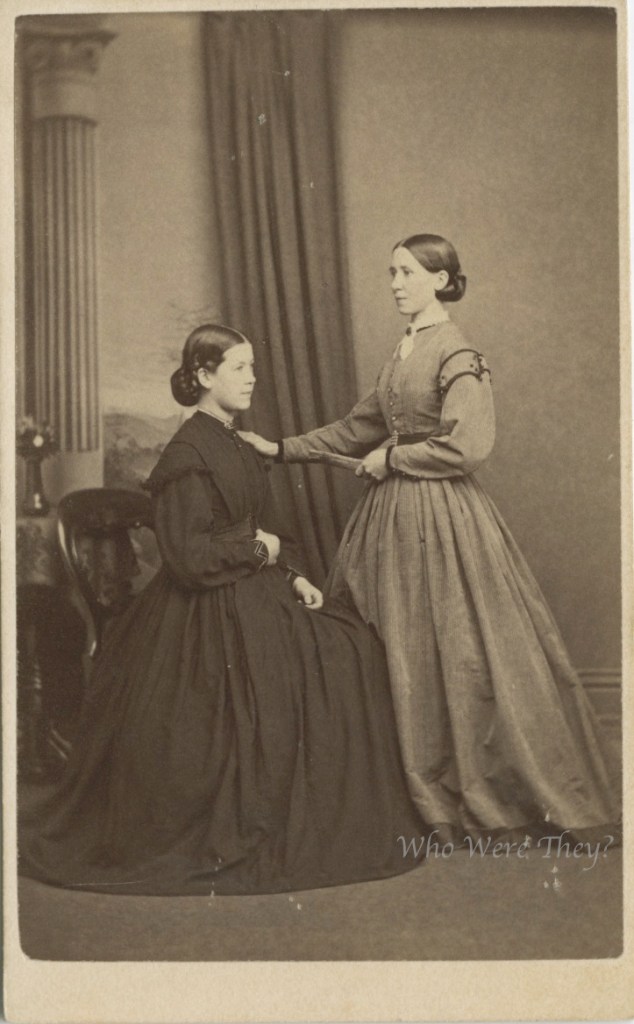
This is a very nice mid to late 1860s image of two women. They appear to be mother & daughter. Note the lovely details:

  • Dropped shoulder seams with sleeve caps, and look at the trim on the standing woman!
  • The darker colored dress features a ribbon trim design at the sleeve cuff
  • Coat sleeves on both dresses to enhance the elbow area
  • Both women have some type of jewelry at the neck of her dress and the lady on the right looks to have a belt.
  • Fine, slicked back hair which was the fashion, parted in the center and dressed in back.
  • The standing woman is holding something in her hand, maybe a fan. She also has a wide band of trim at the hem of her dress.

As we know, colors did not photograph the same way they do today, so these dresses are quite likely beautiful colors and the one that appears lighter might actually be darker than the one that appears darker. I only wish we could see them in their true colors to appreciate the colors these ladies chose.