Who Were They?

Lost and forgotten photos from the past

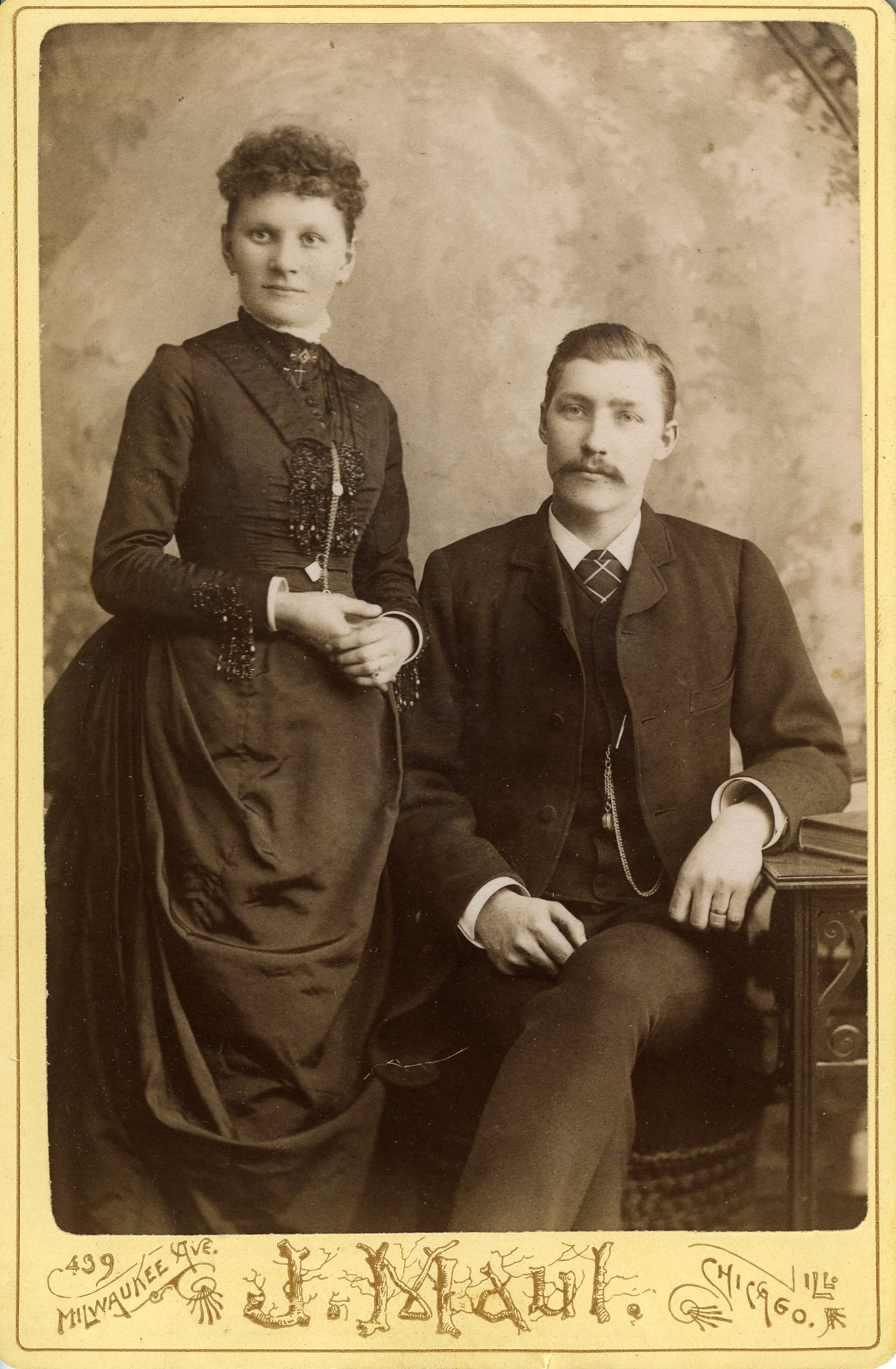
A beautiful example of a bustle dress from the 1880s. This handsome couple is on the right hand page from our previous photo of the young/old youthful/matron in the Dobb Long Book. I believe this to be our “first impression” woman from the very first page of the book. She is a year or two older here, and dressed very well. This couple had some means. First, her dress is a fine example of a bustle dress – you can see the bustle sticking out behind her, to the left of frame. She has quite a lot of beading on the cuffs and at the center front of the bodice. She has a chain hanging across said beading in front, with a watch dangling there. Upon close up inspection, she has a fancy pin at her throat with a cross pendant. Her husband has a lovely tie, watch and chain, and well fitted suit. You can see his wedding band on his left hand very easily.

The photographer here was J. Maul of 439 Milwaukee Ave, Chicago. Mr Maul was awarded a first prize in the Chicago Photography Club’s competition in 1889 – in which he was listed as an amateur, and was awarded a first prize medal for prison and police photography in the 1889 Exhibition of the Photographic Society of Chicago – a prize which listed him as a professional.

I think it’s safe to date the photo to 1889 or thereabouts.

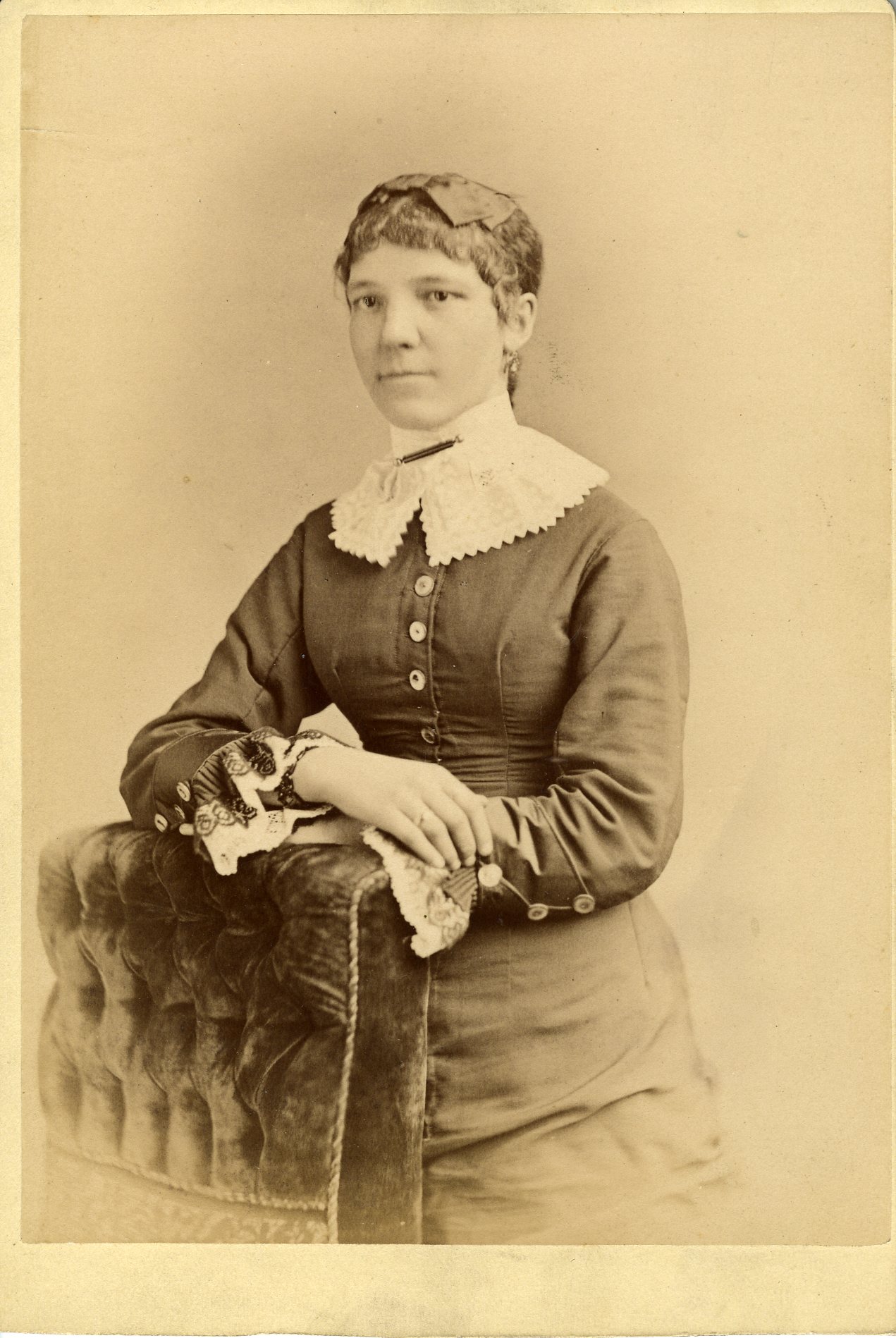
It’s difficult to tell the age of this subject, as she looks mature, young, matronly and youthful all at the same time. The hair bow on the top of her head makes her look like a child in some ways and it’s not a flattering look. Her wide collar reminds me of the types of collars early teens wore in the 19th century, but at the same time her dress follows all the lines and style of a woman’s dress. She is an enigma, I’d guess about age 20. This is the top left of the second open page of the Dobb Long Book.

Speaking of the title of the book, when I was looking at it tonight I noticed it very specifically says Dobb “Long Book” suggesting that it isn’t two families, as Iggy speculated. I don’t know how I missed this when I introduced the book to you.

The photographer here was Hartley at 309 West Madison St, Chicago. A later example of the back of a cabinet card by Hartley can be found here showing “three immense floors alive with the best photographic talent possible to procure!” I believe this image in our collection to be from the early 1880s.

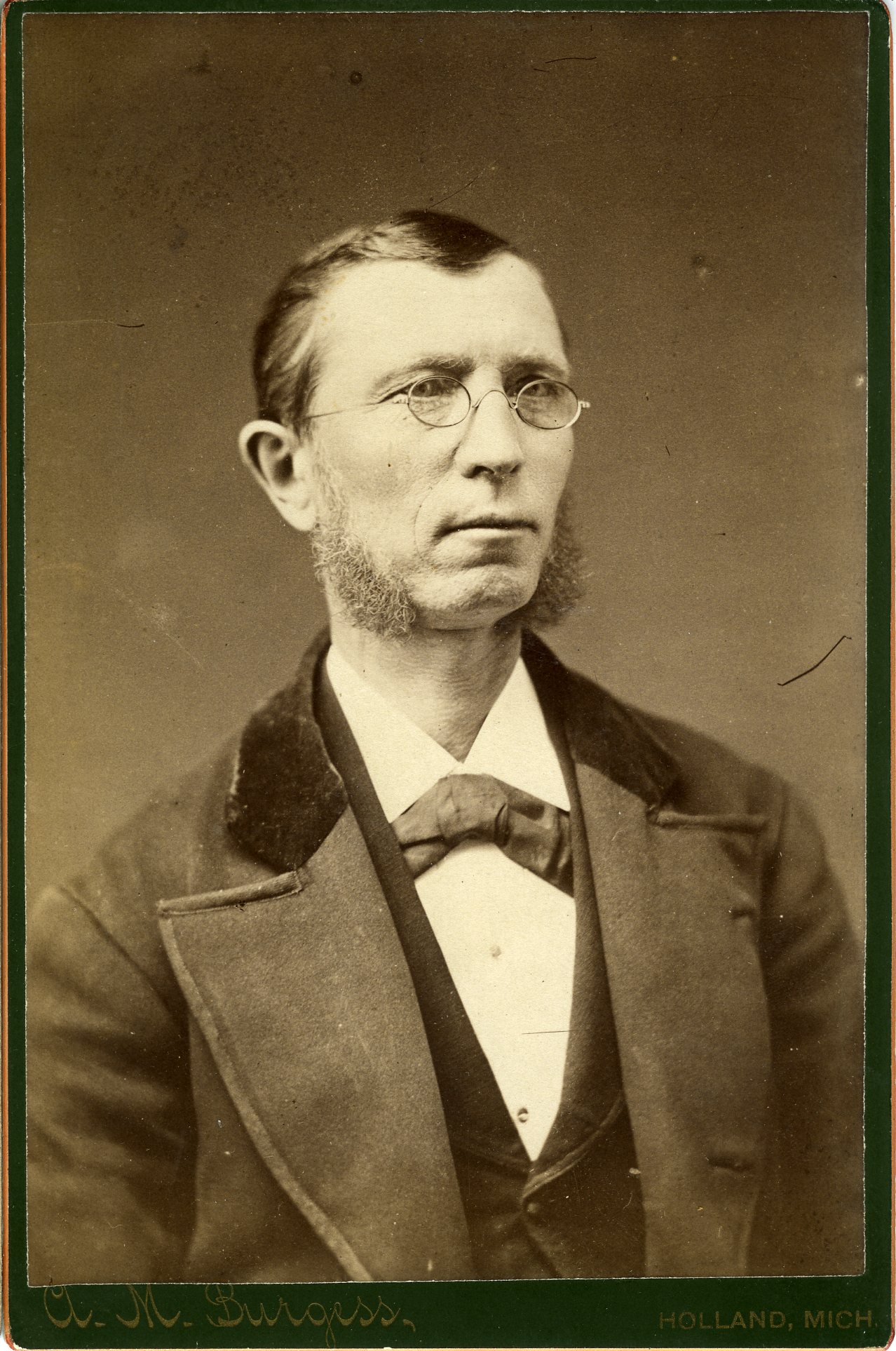
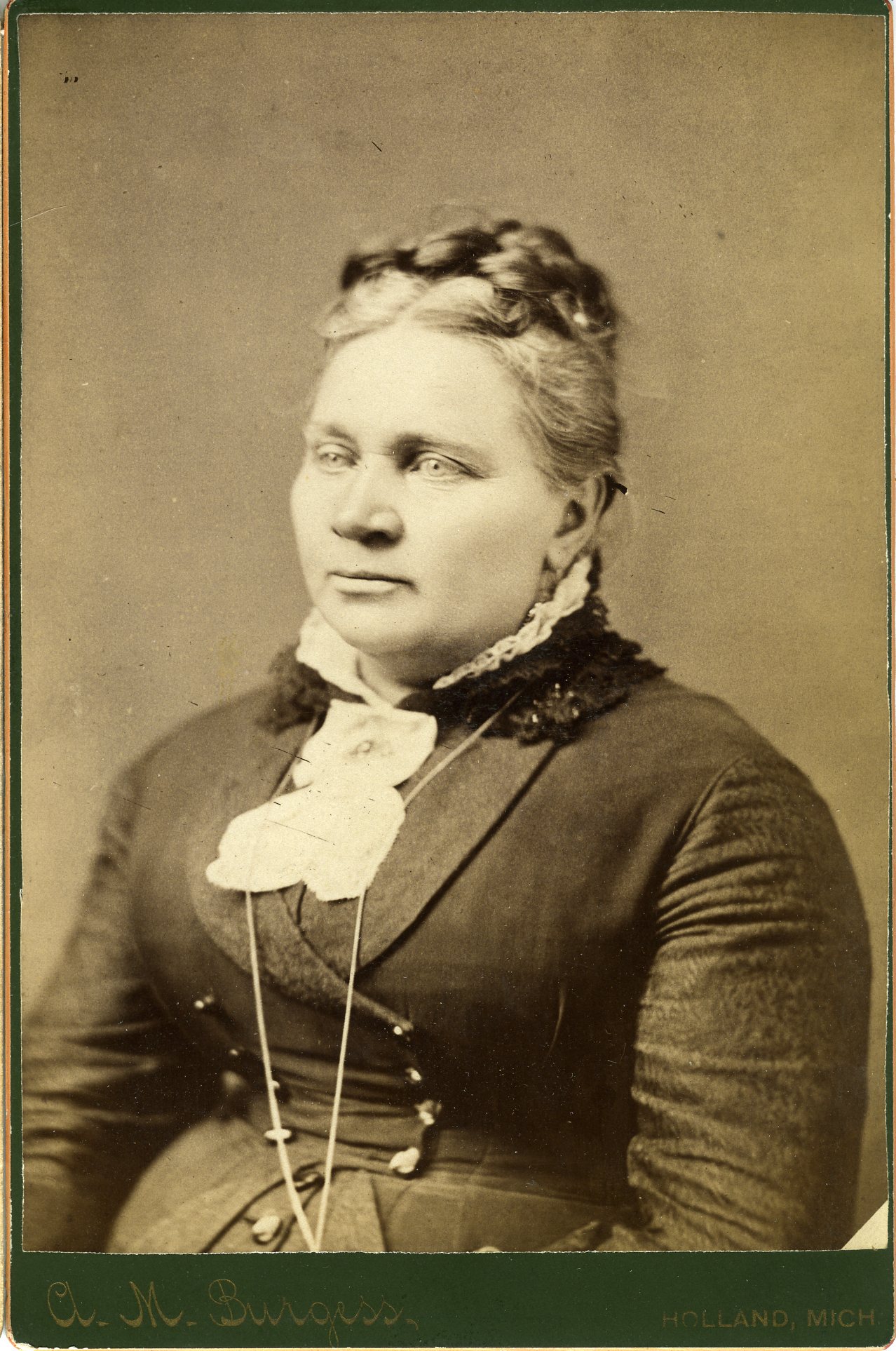
Here we have couple number two, lower left and lower right of the first open page of the Dobb Long Book. The gentleman is what I would call austere. He is not a man I would want to debate as to whether work can be done on the Sabbath, if you get my impression. His wife is plump and serene of face, with a rather tight fitting bodice and a bit of adornment. I find it interesting that the pattern on the fabric of her sleeves matches the pattern on her lapel, but the body of the dress does not have a pattern. I have not seen a lot of contrasting sleeves. Not being able to see the colors of the dress it is not possible to guess how it looked. These cabinet cards are on green backing, which we know to have been in use in the mid-1880s. Green cards were more expensive than the more common maroon and black cards, so therefore are less commonly found. Lucky us, we have two!

The photographer was Azariah M. Burgess, who was a photographer in both Holland, MI and Muskegon, MI. There is an obituary for Mr. Burgess dated January 18, 1894, indicating that Mr. Burgess had crossed the street from his studio to visit at the store. While there, he said he did not feel well, and then seemed as though he was going to fall down. He was assisted back to the living quarters portion of his studio, where he died ten minutes later. Unfortunately, his wife was visiting out of state and was not with him at the time of his death. Mr. Burgess had only returned to Muskegon six months prior to his sudden death, although he had lived there previously. Very sad.

This is a proud Sepia Saturday post! Please click through and enjoy sepia images from around the world.

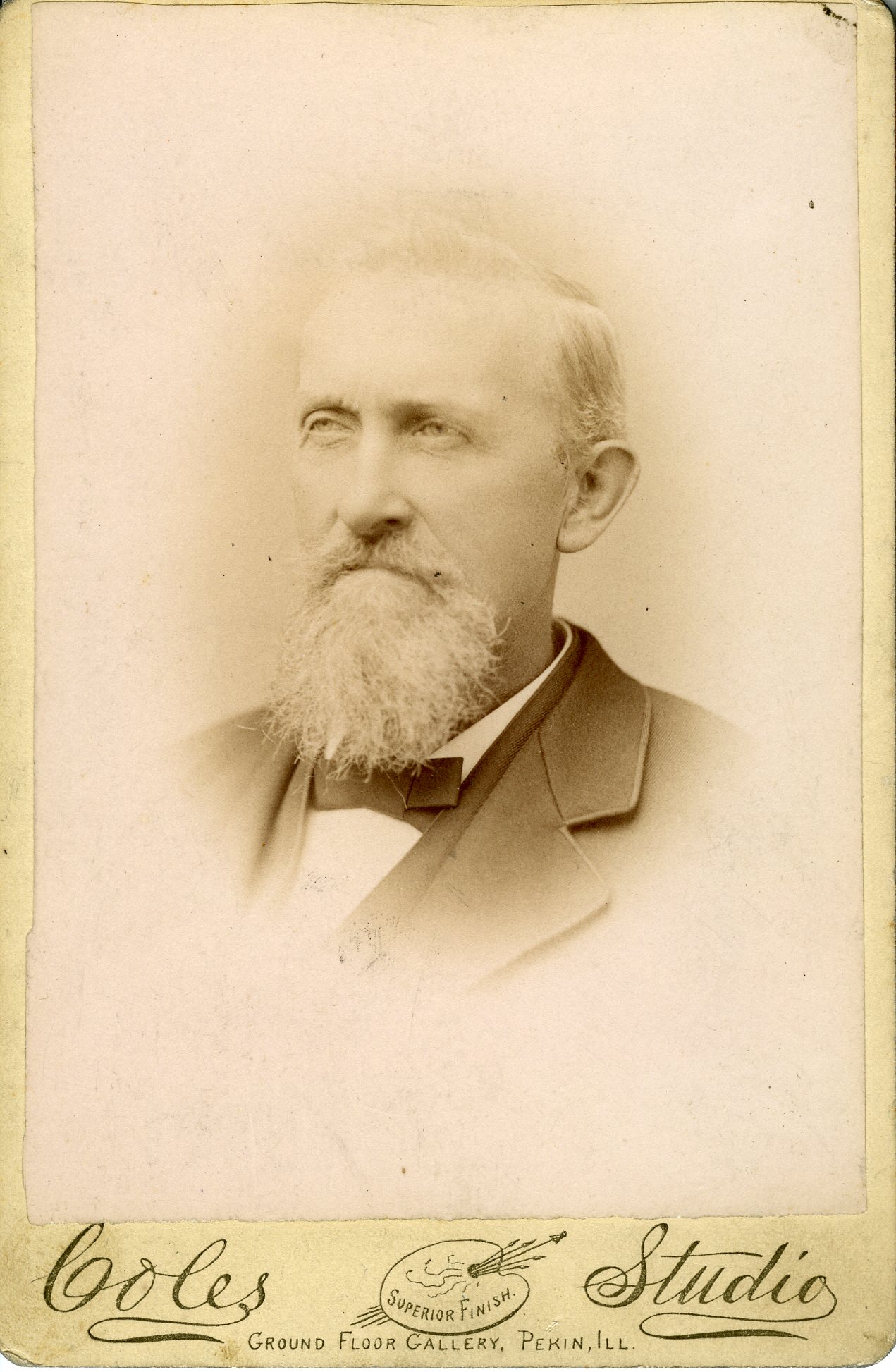
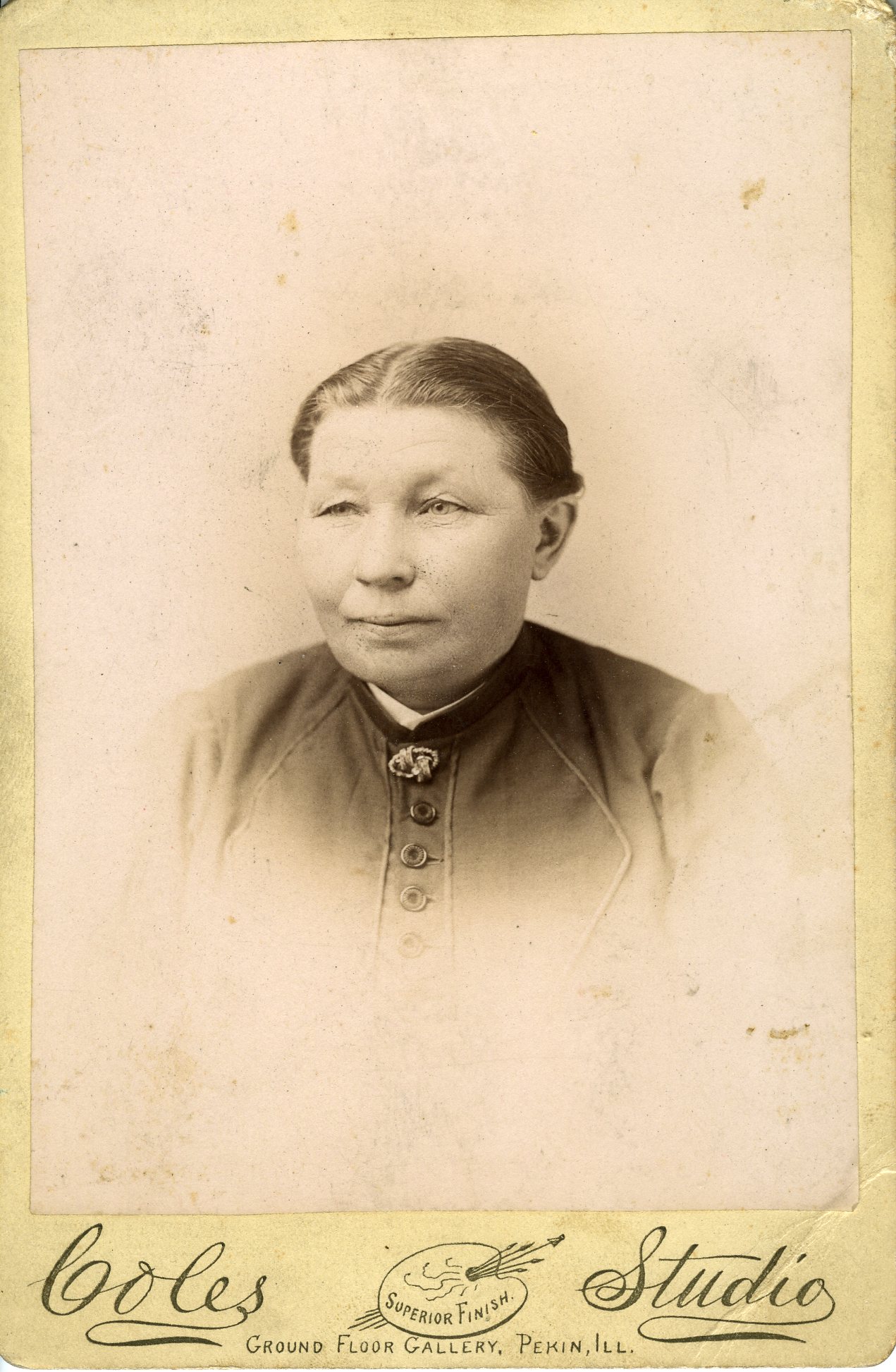
The Dobb Long Book allows for two photos on the left hand page and two on the right hand page. These photos are the top left and top right of the first open page. Since they are next to each other and by the same photographer, I am making the assumption that they are a couple. I will date the photos to 1880.

The photographer was H. H. Cole, who had studios in both Pekin and Delavan, IL. Click here to see a confirmed photo of the photographer. Readers, is it just me, or does our photo of the gentleman above look remarkably like the photo of H. H. Cole?

The Tazewell County Historical Society has several of Cole’s photographs in their collection. Cole established his business in Pekin in 1879 and was there at least until 1900. Cole had previously been a daguerreian photographer in Peoria, IL having purchased a business there from John J. Harper in 1857.

UPDATE: I have heard back from Mike, the site administrator at the Tazewell County Historical Society and he does not believe we have a photo of H. H. Cole. He did tell me that H. H. Cole once photographed Abraham Lincoln, when Lincoln was running for Illinois State Senate against Stephen Douglas (he lost), and later was a delegate to the convention that nominated Lincoln as the Republican candidate for President. Apparently Cole had to come home without his hat as he had thrown his silk top hat into the air to celebrate Lincoln getting the nomination and the hat was never returned. Thanks Mike for all the interesting information about H. H. Cole!

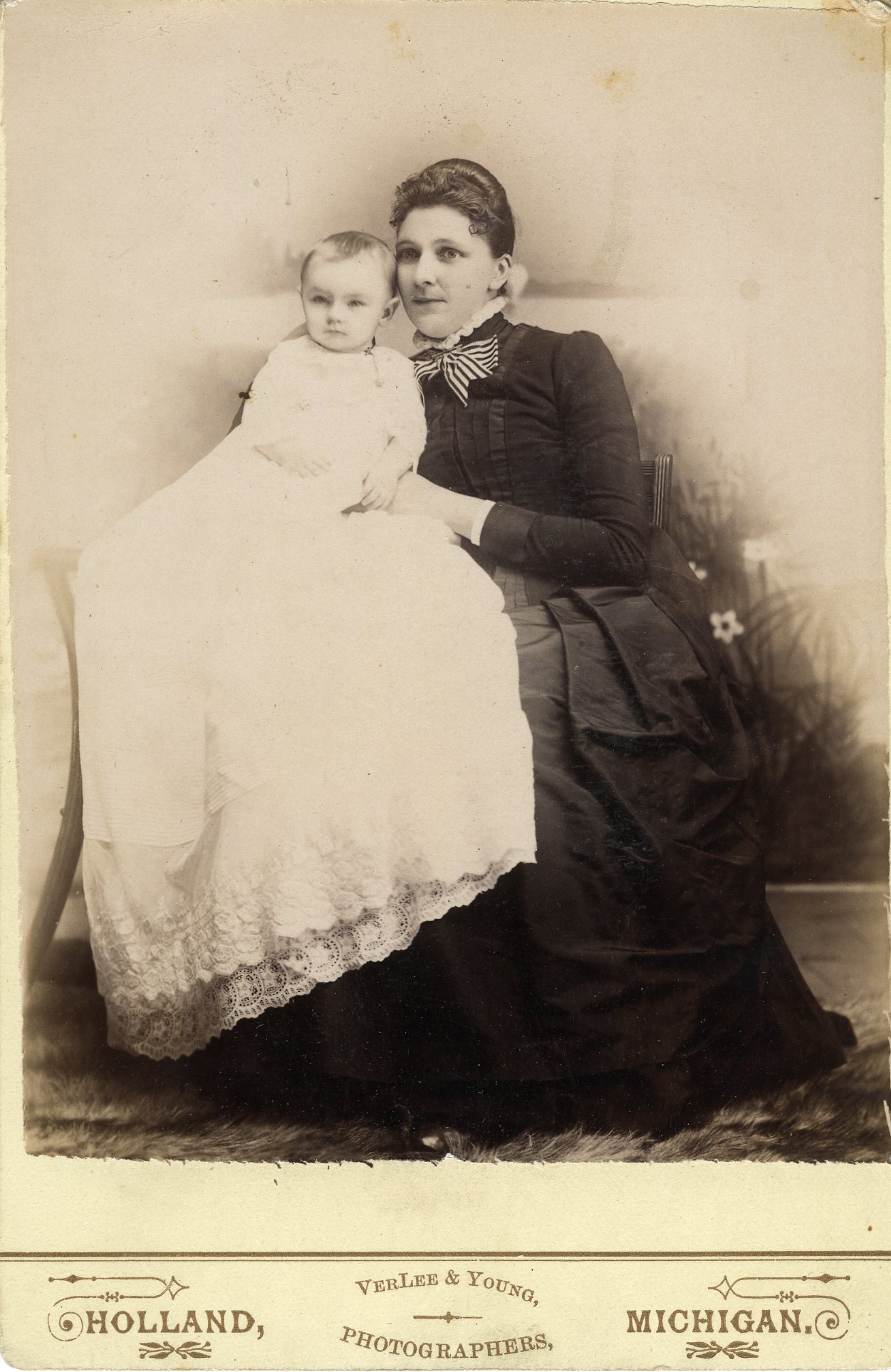
This is an incredible christening dress! The baby looks to be a boy with a bit of a side part, but baby hair can also just do whatever it wants, so who knows, this could be a girl. Regardless, this dress, this dress! Look at the lace edging on the hem. It appears to be a lighter, outer layer, embellished with tiny horizontal tucks mid-body which lead to the lace edging, with a second, longer layer also with a deep lace hem. Often times lace was hand made or was expensive machine lace from England and/or France. The dress must be 3 1/2 feet long from the shoulder and very full. The baby looks incredibly tiny surrounded with all that dress. At first I thought it amazing that the baby held still for so long, but then I noticed something over the baby’s shoulder, and I think it’s the mother hand holding the baby’s head in place.

Mother has a lovely dress as well. Some sort of dark fabric (I’m picturing deep green), perhaps a silk taffeta for the main body and skirt, with velvet trimming on the bodice, a smart striped tie and tiny ruffled trim on the neck. Her hair is coiled into a chignon of some kind. I also believe by the wonky way she is seated that she has a bustle, suggesting the photo was made between 1882-1889.

The photographer was VerLee & Young in Holland, MI. Interesting, as I was researching the photographer I found out that the VerLee family helped settle the town of Holland in the early 19th century after emigrating from the Netherlands. Holland of course, is the name given to the western portion of the Netherlands, and often used to describe the entire country. It seems the emigrants brought their home with them when they settled the area. I’m hoping to hear back from the VerLee site curator with a possible clue about the photographer.