Who Were They?

Lost and forgotten photos from the past

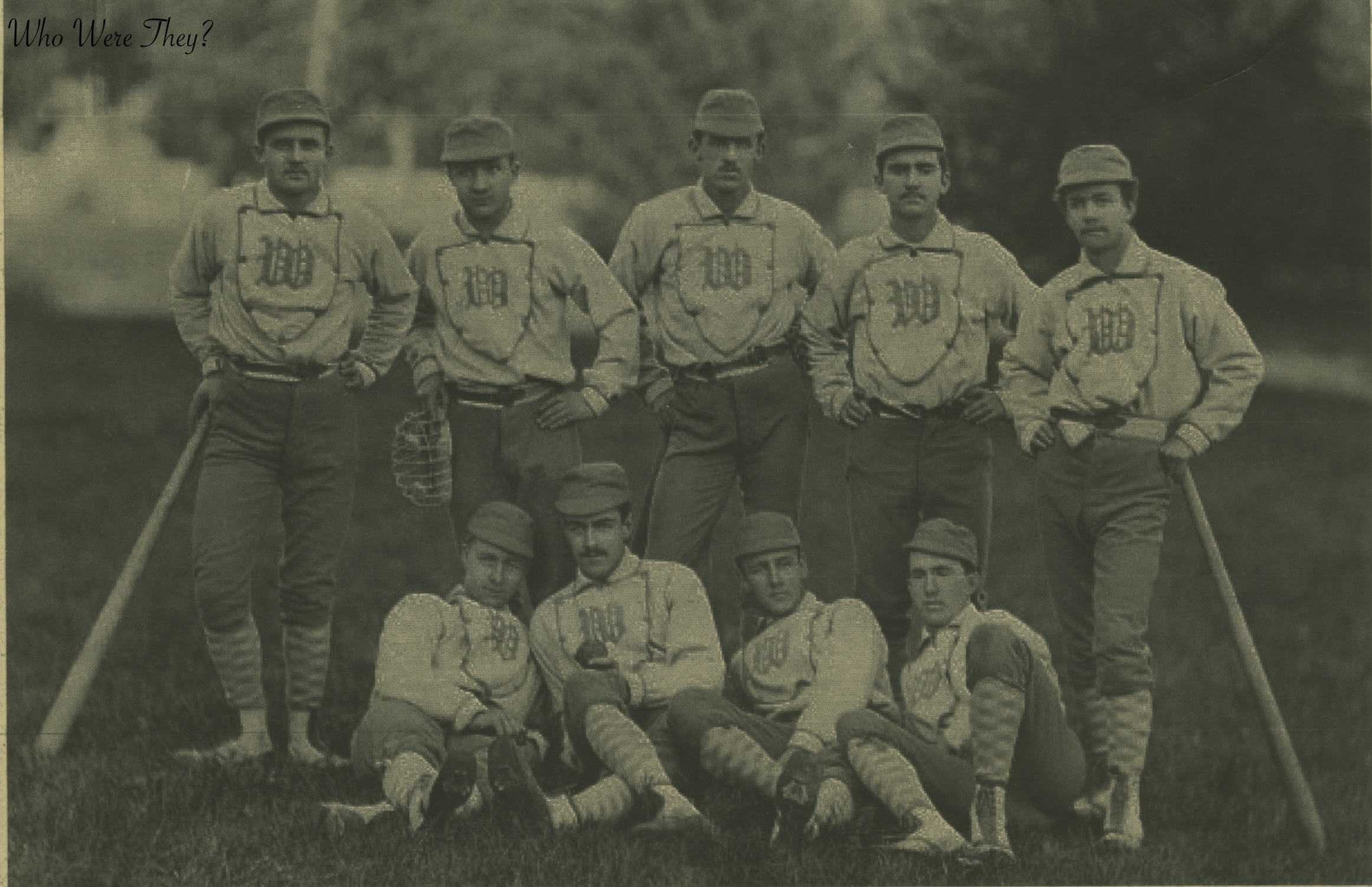
This fantastic image is identified only as “Baseball, 1890.” I wish I knew more about the team! Their uniforms have a large W on the front, but that could be anything from Washington to Woonsocket. Baseball was really well developed by the 1890s, having started out prior to the 1850s with local teams each having some variation of their own rules. In 1860, the National Association of Base Ball Players unified all the local rules into one set, and these were published and distributed throughout the US and beyond, enabling teams to travel more and play clubs farther away from home with confidence in the rules.

Early baseball used a black or brown leather ball stitched with white thread – unlike our modern white leather with red stitching. The men also didn’t use gloves, but caught the ball barehanded. Can you imagine catching one of those screaming line drives with your bare hands!? Me neither!  There is great similarity between vintage and modern baseball, but also some nuances that really make a difference. Until 1884, pitchers had to keep both feet on the ground and pitch underhanded. Early on, a ball that was struck and bounced inbounds before going out of bounds was considered fair regardless of where it left the field. In the 1870s, the umpire might ask a bystander if a ball was caught fairly before making a ruling! Until 1892, a bat could have a flat side. After that time, all bats had to be round.

Although Abner Doubleday (1819-1893) is credited as the inventor of baseball, he was well unaware of that during his lifetime! The myth came about after a dispute between Henry Chadwick, a British journalist, and Albert Spalding, an American baseball player. When Chadwick (correctly) asserted that baseball had evolved out of many ball and bat games, in particular rounders, Spalding took great offense and helped establish the Mills Commission in 1905. The Commission searched far and wide for someone who could identify any American person who might have had an early knowledge of the game. Well, out came an elderly fellow who claimed to have seen drawings made by Doubleday back in 1839. It did not matter that the “witness” had been five years old, while Doubleday was in West Point at that time, they took his assertion that he had attended school with Doubleday in Cooperstown, NY as factual. The false identification was published in newspapers and Spalding forever linked Doubleday to baseball. Spalding, by the way, was the originator of a little sporting goods company in 1875…you may have heard of them?

Today there are vintage baseball clubs that play by their favorite year’s rules, be they before the Civil War, the Knickerbocker rules, the Union Association rules, etc. These clubs dress much as our fellows above, in bibbed shirts and knickers, and there is a definite emphasis on gentlemanly behavior among players. Early on, a base ball player could be fined for using coarse language in front of fans.

There are many wonderful resources available to learn more about the history of baseball. Click the links below for more reading.

19th Century Baseball

Vintage Base Ball Association

The Society for American Baseball Research

For other vintage sports photos, click on the category “sports.”

This week’s Sepia Saturday prompt shows Irish boys taking a break from a game called hurling. Well, we don’t have hurling here in America (at least, not as a sport!) so I’m drawing on American sports to provide us with our image for the week.

Click to enlarge


Here we have a truly American sport that was invented by James Naismith in 1891. Basketball was invented as a distraction for the YMCA in Springfield, MA to keep energetic students occupied during the winter. It was also designed to be a strategic game, not a physical one. The only way to score a goal was to carefully lob a ball into a basket suspended over the players’ heads. Players were not allowed to bounce the ball, but instead were to move the ball down the court by passing it to one another. The original baskets were in fact, baskets: peach baskets, to be exact. The first basketball game was played in December 1891 as a nine-on-nine game and ended with a score of 1-0.

The photo above was advertised as a basketball team in 1890, but since basketball was not invented until ’91, we now know that date to be wrong. The team was G. H. S. and it was suggested the team was from the Chicago area. That makes it likely this is Geneva High School, Geneva, IL – a school that dates back to 1876. The photographer is listed in the lower right corner as Northup. The team has six players and I find it interesting that they have padded knickers. Being as the game was invented to be nonphysical, I don’t really know why padding would have been necessary. While you can see the ball they used, apparently this style of ball wasn’t the standard until the 1950s. Prior to that time, soccer balls could be used where no basketball was available. My best guess is that the photo is from 1895-1905, based on the studio props. By that timeframe, basketball was wildly popular in high schools and colleges across America. The photo itself is rather large, about 8.5″x10.5″ matted to 11.5″x14″.

Modern basketball of course is fraught with injuries, the players are incredibly strong and not at all scrawny like those shown above. Scores for professional teams routinely get into the 100s. A lot has changed in the 111 years since the sport was invented, but basketball continues to be an exciting and fast-paced game enjoyed by many.

Check back later for some 19th century baseball teams.

For more Sepia sports, click over to Sepia Saturday to see what other participants have kicked up.

Go for the goal!


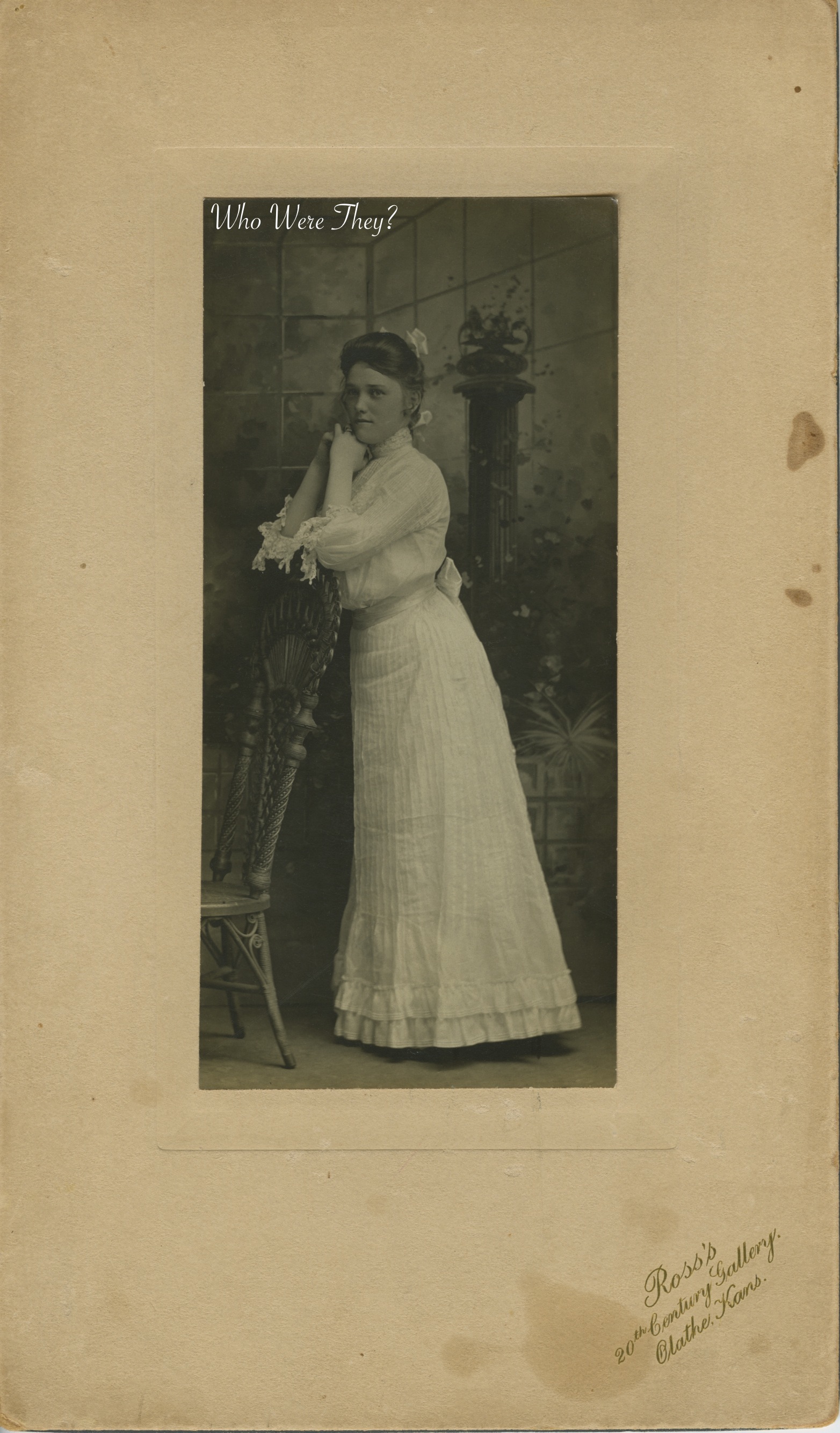
Browsing through my photo treasures, I came across this lovely young lady, posed in a thoughtful and reflective mien, and realized that this also came from the same shop as Millard Fillmore, etc. Looking at the previous photo I have identified as Lois Montgomery, wife of Eylar Fillmore, I suspect this is another photo of that same lady. The photographer was Ross’s 20th Century Gallery in Olathe, KS. The photo itself is 2.5″ x 6″ and mounted on bristol board that is about 4.5″ x 8.75″. That doesn’t make it a cabinet card, but what were these 20th century mounted photos called? Just “portraits”?


Sometimes when I look at old photos I am struck at just how average some people look. They have faces that span the years, like some of the recent doppelgängers I have posted, or someone from the 19th century looks like they might just walk out of the local shopping mall. Faces tell the story of our emotions, our deep secrets, and our lives, and are truly extraordinary, each in its own way. No two faces are alike. Even identical twins have some dissimilarities in their faces, that although difficult for the untrained eye to perceive, are there none the less.

I particularly like this group of old photos because the people are very average, almost unextraordinary in their ordinariness. And yet, you see a father proudly sitting with his children and the family dog, a soldier ready to risk his life for his country, young women feeling flirty and free. Were they simply attempting to blend into this amazing ecosphere called American life? Or, is it that these faces reflect our own lives, our toils and worries, our triumphs and victories?

It cannot be overlooked that a photo of an Asian soldier presumably in the US – in California, even – during the war era must be uncommon (considering I can go into several antique shops on any given day and find numerous and plentiful snapshots of white soldiers from the same era). Was this man Japanese and enlisted in one of the segregated Japanese-American units?

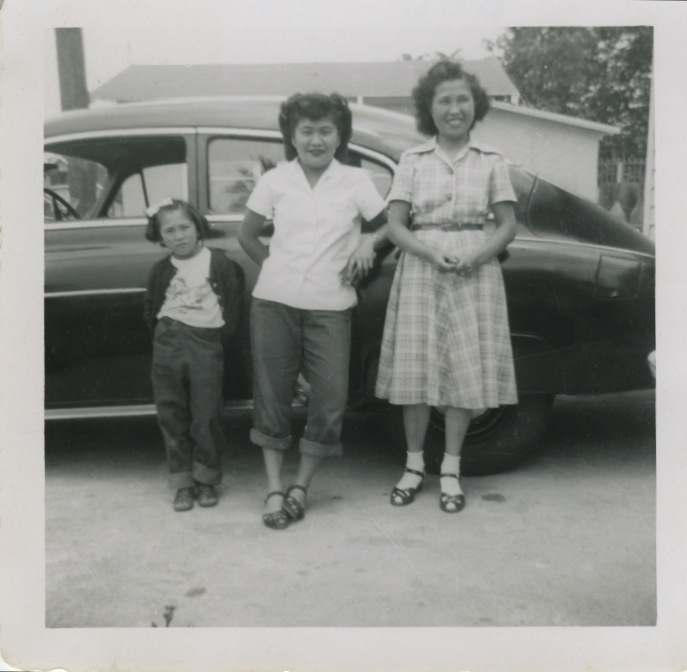
Was this the new family car? Getting ready to go out for some fun? I love how the little girl is sort of slouchy in what looks like an attempt to imitate her elder, and yet comes off as looking as though she needed some more practice.

As you look into these faces, what do you see?

When you are finished with your contemplations here, click over to Sepia Saturday to find more of the ordinary and extraordinary faces from around the world.

Click, with great haste!