Who Were They?

Lost and forgotten photos from the past

Monday.1

Dinie?

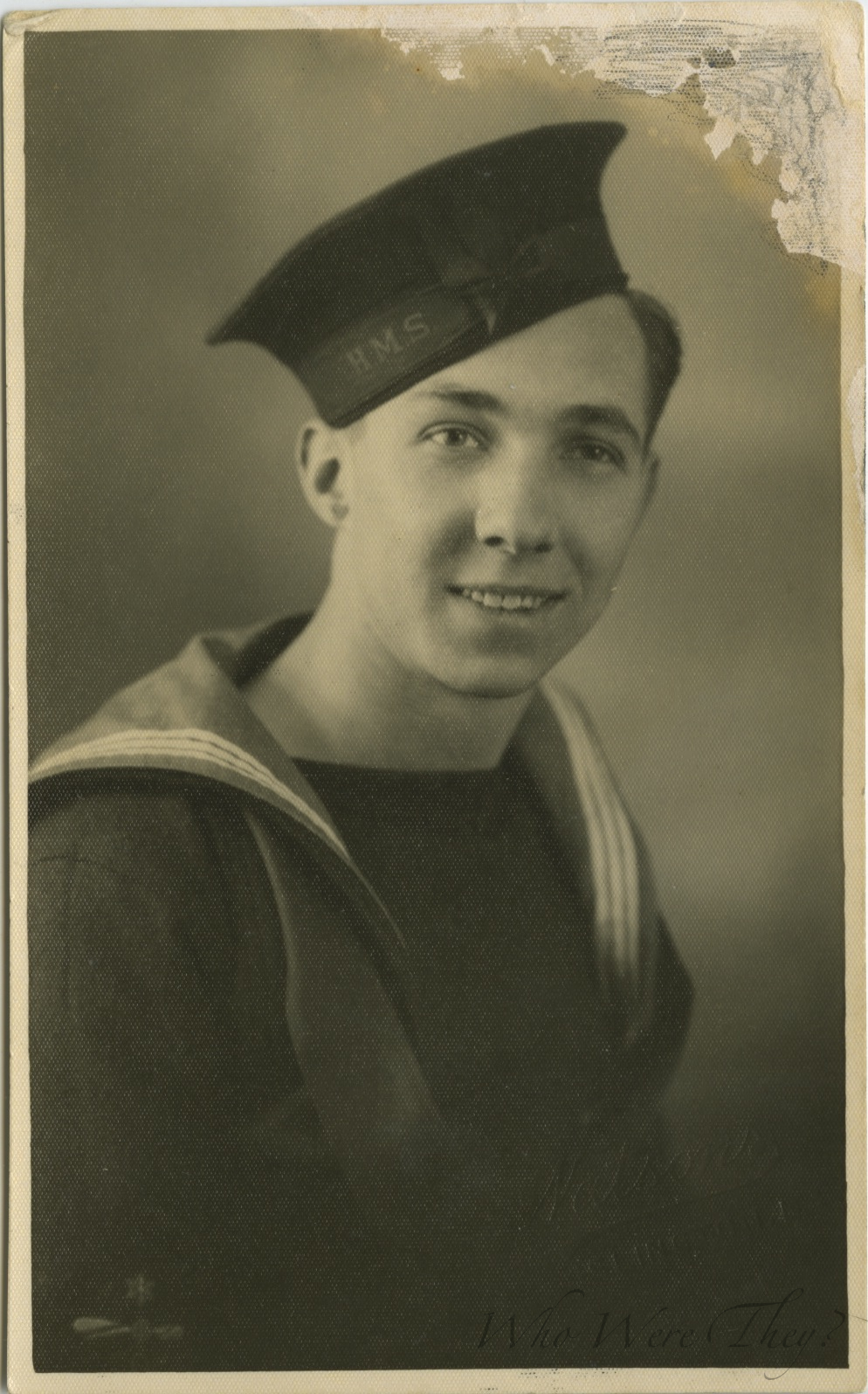
This photograph of a handsome young man was taken in Islington, Newfoundland. The year is unknown but after World War I, Newfoundland had a minimal military presence, so the photo is possibly from the WWI era.

At that time, Newfoundland was still an independent country although under the British dominion, and owing allegiance to Britain. Since the military in Newfoundland had been virtually nonexistant since 1870, a recruiting effort took place, and eventually enough men were raised to create the Newfoundland Regiment.  After basic training and acclimating to military life, the Regiment was eventually sent to Suvla Bay and the disastrous Gallipoli Campaign. This Regiment escaped with relatively few casualties (40 deceased, 150 ill), and they went on to fight again at the Battle of the Somme. They were not as lucky during this battle, and on July 1, 1916 they lost approximately 90% of their number (670 of 780) were lost. The following day, only 68 men were able to make it to roll call. It was a devastating blow to the Regiment, but recruiting efforts back in Newfoundland continued and their ranks swelled again. They continued to see action, sometimes terribly, with April 23, 1917 being the last day for 435 of their numbers at the Battle of Arras. Throughout the war they deported themselves with incredible valor, earning the distinction of “Royal” being added to their name by King George V, an honor that had not been bestowed during battle for the previous 101 years.

After WWI, the Royal Newfoundland Regiment saw very little action over seas, and sent no infantry to fight during WW2. They did send two artillery units and have since maintained a presence, however limited, in world activities. After becoming a Canadian province in 1949, the Regiment has been the primary military presence in the province, and they have acted as U.N. Peace Keepers around the world. Amazingly, in August 2010, the regiment experienced their first combat loss in almost 100 years, when Corporal Brian Pinkson died of wounds sustained in Afghanistan. July 1st continues as Memorial Day in Newfoundland and Labrador in honor of those many men lost in 1916.
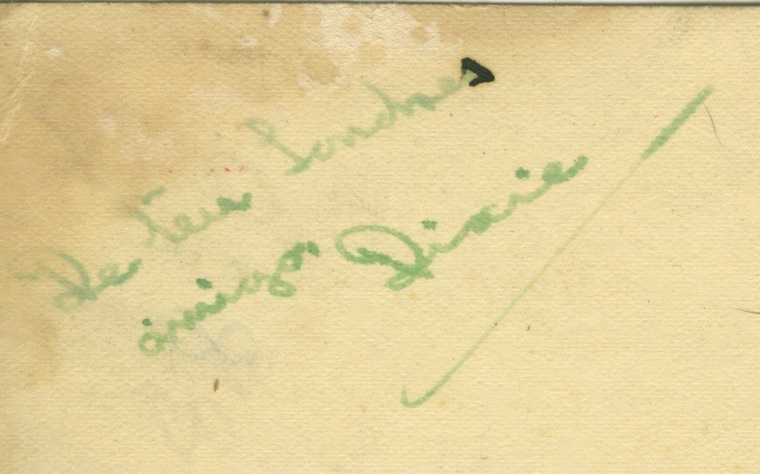
Monday Back

De teu Londres amigos, Dinie

The back of the photo has a handwritten note, which maybe someone else can decipher more accurately. The writing in green ink is angled across the top left corner. I can’t make the name turn into something I am familiar with (not Diane, Dane, Dario, etc.). The studio was called Watson’s. It is possible this man was not part of the Royal Newfoundland Regiment, but in fact visiting Newfoundland as part of the recruiting efforts by Britain, or even later on in the 20th century. We shall never know though, since whoever he was, he didn’t sign his last name.

UPDATE; Thanks to Pierre Lagace’ at Lest We Forget, the dating of this photograph has been changed to World War II era. Pierre believes this might have been a British sailor not stationed on a ship – as his hat band would say the name. Possibly the man was stationed in Newfoundland and had his photo made while there. It makes the salutation “to your London friends” have a little more context, certainly.

It isn’t always easy to find an old photo with a big banner in it, but when you do they are usually something good to stir up discussion. Such is my hope this week.

Union labor rally

Union labor rally

It seems like the moment you say “unions” people’s opinions are usually split between pro and anti union sentiments. But when you look at the history of unions in America, they were intended for good and needed. Working conditions in the American Industrial Age were horrible. One early union movement was to the 8 hour work day, and the shops that followed this movement created unique labels so it would be easy for the purchasing public to find and support them. Union labels are generally attributed to the 1869 movement of Carpenters Eight-Hour League in San Francisco, CA (A Brief History of Labor Symbols, Susan Parker Sherwood, San Francisco State University). The labels indicated to buyers that the Products made in that factory were produced by laborers on an eight-hour workday as opposed to those on a ten-hour day. Later in 1874, the unionized cigar makers used a white label to differentiate their products from those made by lower paid workers.

This particular image from about the 1930s shows women in a parade float, likely going to a labor rally. When I see women and “union label” I think of the International Ladies Garment Workers Union and their catchy commercials from the 1980s. The union was formed in the early 1900s at a time when New York City was a major manufacturing center for clothing. The first organized action of the union came in 1909 when 20,000 workers walked out on the Triangle Shirtwaist workshop. 20% of the workforce striked, and in response Triangle locked them out. After 14 weeks, the union accepted an arbitrated agreement, but Triangle was not among the factories that signed the agreement.

Shortly after this, the union led another, larger strike in New York, leading 60,000 or so workers to step away from their sewing machines. This was called the Great Revolt and went on for months. After much arbitration, the strike was settled and workers returned to the factories.

Just two years after the initial strike against Triangle, the infamous Triangle Shirtwaist Factory fire occurred, killing 146 workers. Many of them perished because Triangle locked the doors of the floors to prevent workers from leaving early. This spurred greater support of the ILGWU and the momentum spread.

By the 1980s, unions in America we’re struggling under pressures to produce cheaper garments, and also from internal corruption. The ILGWU produced a number of commercials with a very catchy song with the following lyrics:

Look for the union label
When you are buying a coat, dress, or blouse,
Remember somewhere our union’s sewing,
Our wages going to feed the kids and run the house,
We work hard, but who’s complaining?
Thanks to the ILG, we’re paying our way,
So always look for the union label,
It says we’re able to make it in the USA!


For more Sepia rallys and slogans, click through to Sepia Saturday. You will be happy you did!

image

This week’s Sepia Saturday prompt is from roughly the same time frame as my contribution, but illustrates how in just a few short years the world can change drastically. The prompt photo, below, is from circa 1910, and shows a woman quietly stitching on a flag. The image is romanticized. She is the lady at home caring for the details while her man is away. As the prompt suggests, the image is comforting, shows care and contentment.

Woman with flag

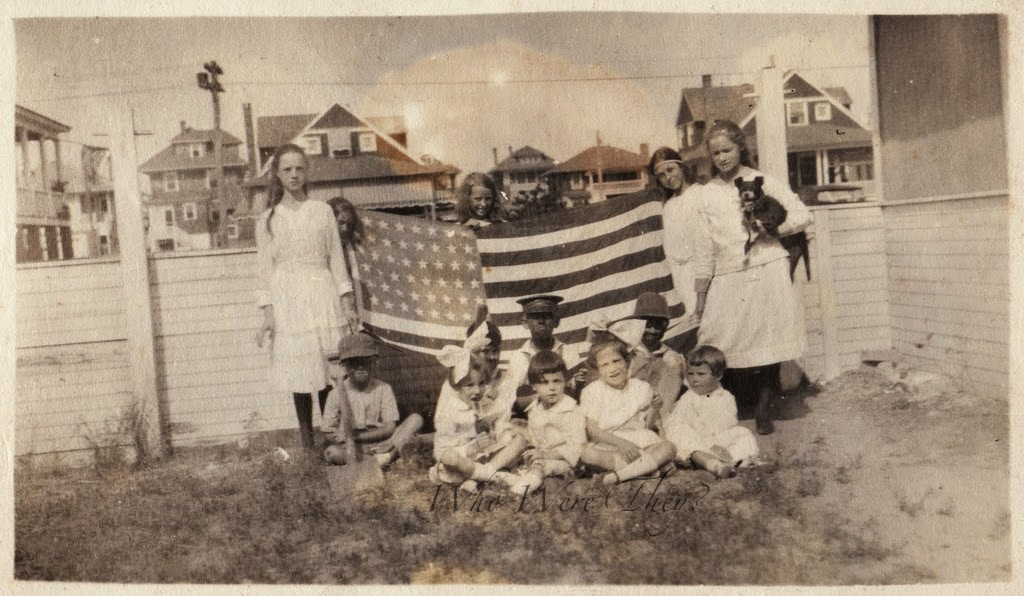
And next we have a photograph of children with a flag in Ocean City, NJ, around 1915. In 1914 the Great War started with the assassination of Archduke Franz Ferdinand and his wife Sophie while they were visiting Bosnia. While the US resisted being drawn into the conflagration, certainly it was on the minds of Americans who had family and friends back in Europe. This was a time of massive emigration from the Old Countries to the USA and many families had to leave loved ones behind until they could earn the passage to come over themselves. Additionally, Americans were welcomed into the armies of allies in Europe. All told, millions of people died, countries were decimated, cities were destroyed.

Ocean City, NJ

Ocean City, NJ

Some of the boys here have on caps and helmets, the mood is a bit more somber. These kids aren’t jubilant with patriotic fervor. They are showing their support and concern for Americans at war. In 1917, USA would officially enter the war.

This photo is from the private collection of my family, scanned by Cousin L. She had written on the back “Ocean City” but so far no one has identified any of these kids. This is a Velox real photo postcard.

For more flags from near and far, click the button below to Sepia Saturday. You will be happy you did!

Hail to the chief…

A diamond in the rough

A diamond in the rough

In the early 20th century, a variety of new and updated techniques to enhance photographs became popular. In this instance we see two – a decorative embossing on the bristol board and a nonstandard shaped photograph. Usually, photos were rectangular or oval, sometimes circular. I have seen other diamond shaped photos and I am certain the photographer did this to be artistic and add visual interest to the photographs.

In this case, the photographer’s information has been literally rubbed away with age. The bristol board is in poor shape – corners rounded with age and breaking, water stained, and it flakes if I touch it too much. In a frame, it would draw the viewer’s eyes to the diamond shape, focusing in on the subject, as was desired.

Miss Anna Solomon

Miss Anna Solomon

Some time in the early 20th century, Miss Anna Solomon sat for her portrait at the Root Studio in Monmouth, IL. As you can imagine, a female with a fairly common name is nearly impossible to trace. Maybe someone will recognize her face one day. Her clothing is lovely, her hair stylishly done in a circa 1910s style, and her face serene. The portrait is oval shaped and mounted on firm bristol board which measures 5×7 in total.